For International Women’s Day 2025, our event featured some of the inspiring women of Hughes Hall and explored wider issues of women’s experience.
Organised by Dr Derya Cavga and Dr Ariadna Albajara Saenz, the panel shared research, personal stories and ideas that resonated with the audience.
We also recognised some of the women from across our College community with a short video – click to watch.

Reflections from Dr Derya Cavga
The leaky pipe
Over the last three years of organising the International Women’s Day event, one of the conversations that stayed with me was from 2023, when Professor Jane Clarke, then the President of Wolfson College, shared the analogy of the leaky pipe. The leaky pipe describes how the number of women drops when we look at higher levels of many academic and professional settings, particularly those in STEM, because the women ‘leak out.’ Prof. Clarke then expressed that we cannot blame the water for leaking out; we need to fix the pipe. This means creating opportunities for women that account for any setbacks and disadvantages they may have had, which is encompassed in the phrase ‘gender equity.’ While gender equality is about treating everyone equally, gender equity describes ensuring fairness by considering people’s different circumstances.
Women who do manage to climb up this leaky pipe to take on leadership roles can be faced with different treatment than men. One such topic brought up by Senior Tutor Dr Tori McKee in this year’s IWD event was women being called ‘bossy,’ while a man in a similar situation is more likely to be called ‘assertive’ or simply ‘the boss.’ The advice from panellists Professor Nidhi Singal and Dr Oriane Chausiaux for the younger generation of women who might face this kind of double standard in workplace vocabulary was to stand their ground as the boss, or if the workplace is too toxic, to change, just leave it behind for a better place; the shared message being not to lose confidence.
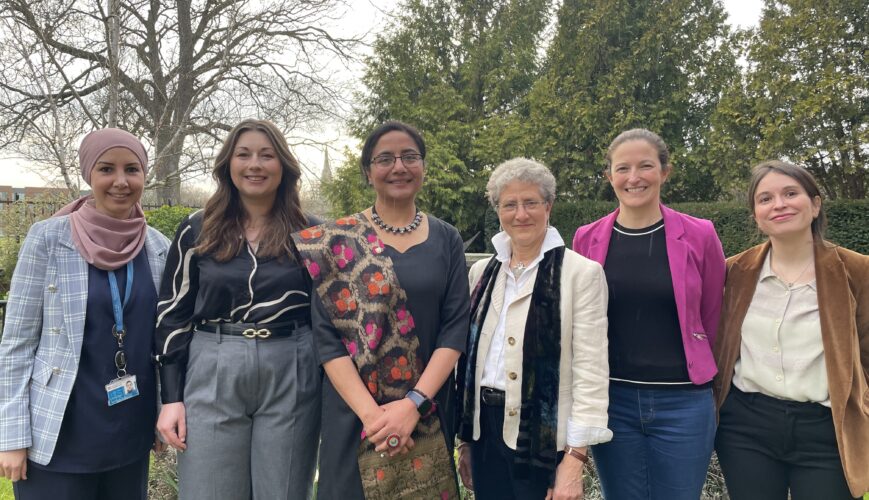
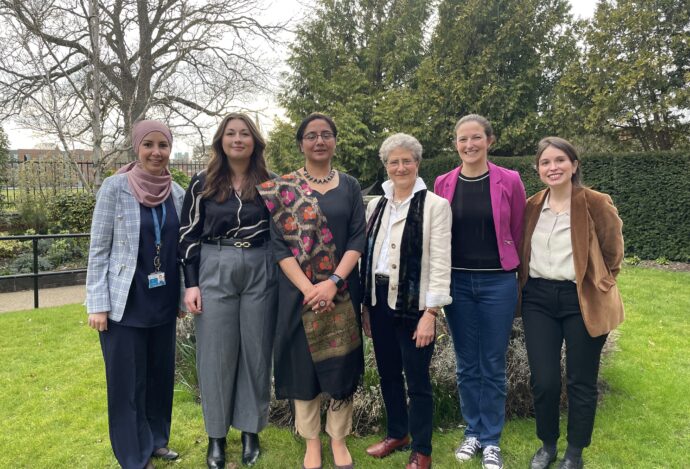
The panel and event organisers (from left) Dr Derya Cavga; Lucy Rogers; Professor Nidhi Singal; Annemarie Young; Dr Oriane Chausiaux; and Dr Ariadna Albajara Saenz.
Personal stories
This year’s panellists also talked about the influence of their parents on their career journeys and perception of gender roles. Panellist Lucy Rogers talked about how her mother encouraged her to think about the untold stories of women in history; about what women were doing at times of war or change. This is what encouraged Lucy to research the role of women in the development of Cambridge English during the late nineteenth and early twentieth centuries.
Echoing similar feelings, panellist Annemarie Young talked about how she was inspired to seek opportunities her mother didn’t have and to be the voice of the voiceless in her work writing about the experiences of refugees and children living under occupation.
Complementarily, Professor Nidhi Singal talked about the influence and support she received from her father. She expressed how important it is to have, in one’s family and workplace, men who truly support women, which is something she feels at Hughes Hall. Professor Singal also talked about how Hughes Hall is constantly evaluating itself to be more inclusive.
Dr Oriane Chausiaux then shared a very striking anecdote about making her company, Heartfelt Technologies, more inclusive and gender balanced. They learned that women tend to apply to job applications only if they tick all the boxes. To account for this, they added a note to their job descriptions asking candidates to apply even if they do not meet all criteria, as they may have other relevant expertise and experience to offer. Dr Chausiaux said this enabled them to hire a brilliant female software developer who wouldn’t have applied if it wasn’t for this added note.
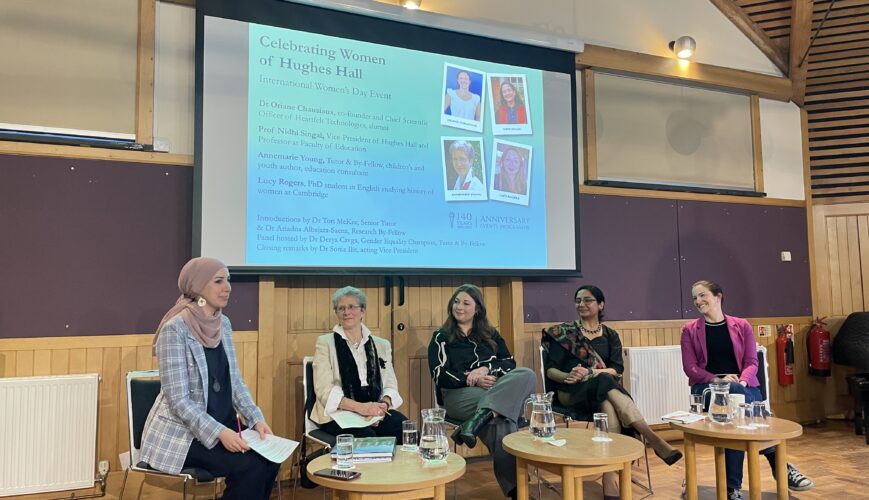
The event, “Celebrating Women of Hughes Hall,” occurred during the 140th anniversary of the college, which was originally founded to train women teachers.
Persistent inequalities
This brings us back to how women tend to ‘leak out’ if certain aspects of professional or academic life are not tailored to be more inclusive; many things that work for men do not work for women. Because men are often thought of as the ‘default gender,’ the world has been built for men, and there is a lot of missing research and understanding about women. One staggering example is how women are more likely to be seriously injured or die in accidents because car safety standards have been established on average male crash-test dummies for the past 60 years.
As Professor Jane Clarke put it in the 2023 event, women mistakenly thought they fixed gender equality issues in the ‘60s, but we still have a long way to go. As our college President Sir Laurie Bristow also pointed out in the President’s Bulletin, the gender pay gap persists, and we are even seeing regression in certain aspects of gender equality, especially in particular countries.
These are some of the reasons why we celebrate International Women’s Day: to talk about and raise awareness of the persisting issues, and to advocate for progress. We were able to achieve this in a wonderfully inspiring and celebratory way, thanks to our amazing panellists who work for inspiring causes, push boundaries, and attain remarkable achievements. It was a warm celebration of the amazing women of Hughes Hall, and a very inspiring evening with many great insights from our panellists to reflect upon.
Further information
Dr Derya Cavga is Gender Equality Champion, Tutor and By-Fellow at Hughes Hall, and has been organising and co-hosting the International Women’s Day event with Research By-Fellow, Dr Ariadna Albajara Saenz since 2023.
Thank you to the inspiring panellists: Dr. Oriane Chausiaux, co-founder and Chief Scientific Officer of Heartfelt Technologies and winner of the Women in Innovation Award by Innovate UK; Professor Nidhi Singal, Vice President of Hughes Hall and Professor of Disability and Inclusive Education; Annemarie Young, Tutor and By-Fellow of Hughes Hall with expertise in education and children’s literature; and Lucy Rogers, current Hughes PhD student working on uncovering the untold history of women in Cambridge.
31.3.25