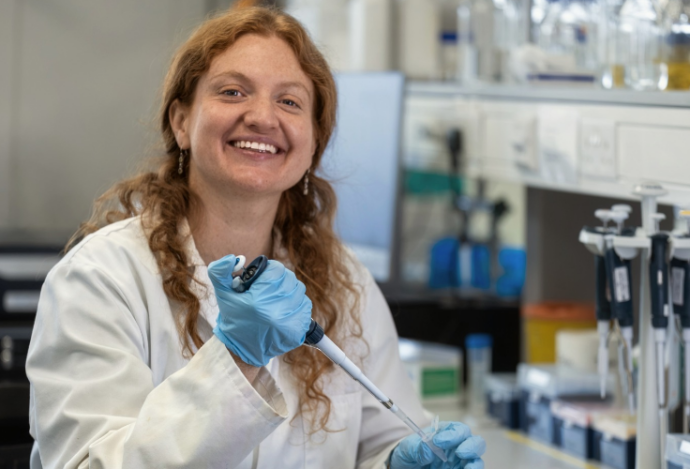
Hughes Hall Research-By Fellow, Dr Sarah Madden, is a senior postdoctoral researcher in the Department of Biochemistry.
Her research encompasses cancer therapeutics and understanding how proteins interact with DNA – she hopes in the future to develop powerful new cancer medicines for our DNA.
Sarah’s research interests are matched by a passion for contributing to academic culture in positive ways, especially around disability, gender equality and widening participation, themes that reflect her own lived experience.
We caught up with her ahead of UK’s Disability History Month to learn more about how she is working to make academia more accessible.
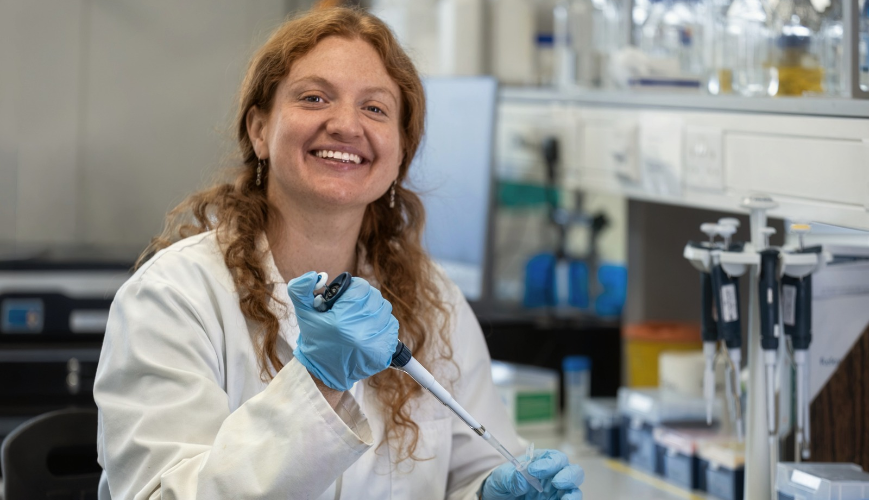
Dr Sarah Madden is a Research By-Fellow at Hughes Hall.
“I recently joined Hughes Hall as a Research By-Fellow. I was drawn by the friendly and egalitarian culture I found at the College’s opening evening, and by its values of inclusion, innovation and impact, which closely align with my own goals.
I believe it is important to consider what change you want your work to make in the world. Before becoming a senior postdoctoral researcher in the Department of Biochemistry, I worked for the University’s widening participation outreach scheme, giving talks and mock tutorials to visiting secondary schools, as well as contributing to outreach summer schools such as those run by the Sutton Trust. I have sat on Equality, Diversity and Inclusion Committees and given talks in this area, including as part of the Soapbox Science project, which works to raise the visibility of women in science. I also hosted the Twitter channel @iamscicomm, using it to showcase disabled scientists such as Dr Hamied Haroon at the University of Manchester, who famously did a bungee jump in his wheelchair.
I am most passionate about improving things for disabled researchers, since I believe progress in this area has been slower. My dream would be to one day use what I have learnt from my experiences to run a summer school for disabled secondary school students, as has been done for other minority groups in academia, to support their transition to university life.
Academia is not only inaccessible to many disabled people, with just 4% of senior academics in science identifying as disabled compared with 22% of working-age adults; those who do make it in also face considerable stigma¹. With academia being the highly competitive environment that it is, I believe people often see anyone who does not appear healthy and strong as less competent. Indeed, a survey by the Royal Society of Chemistry found that 31% of disabled chemists had experienced bullying or discrimination because of their disability². This stigma stops people from disclosing their disability, and so from receiving the adjustments they need to help them with their work. It also means role models and mentors with lived experience are not always visible to younger scientists coming through the system, perpetuating the disadvantage people face.
I hope we can work to reduce this stigma and make disabled researchers feel more accepted in academia. I believe improving equality and diversity benefits academia, as diverse teams are more effective teams. But more than anything, we should do it because it is the right thing to do.”
1 Disabled people in science need paradigm shift in support, Physics World, 2025
2 Royal Society of Chemistry: Disability-Inclusive Laboratories in the Chemical Sciences
18.11.26