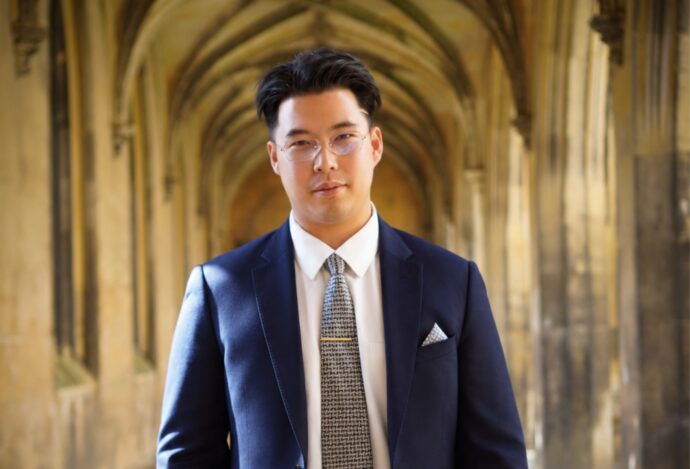
Kasipat Wongvitayakamjorn came to Cambridge to explore why promising social ventures struggle to survive beyond grant funding.
He hopes his findings will help funders develop more sustainable ways of supporting social entrepreneurs.
Kasipat’s ambition is simple: to help create a system in which people do not have to choose between doing good for their communities and earning enough to support themselves.
He explains: “We celebrate people who dedicate their lives to solving social problems, but we rarely ask whether they can afford to continue doing so.”
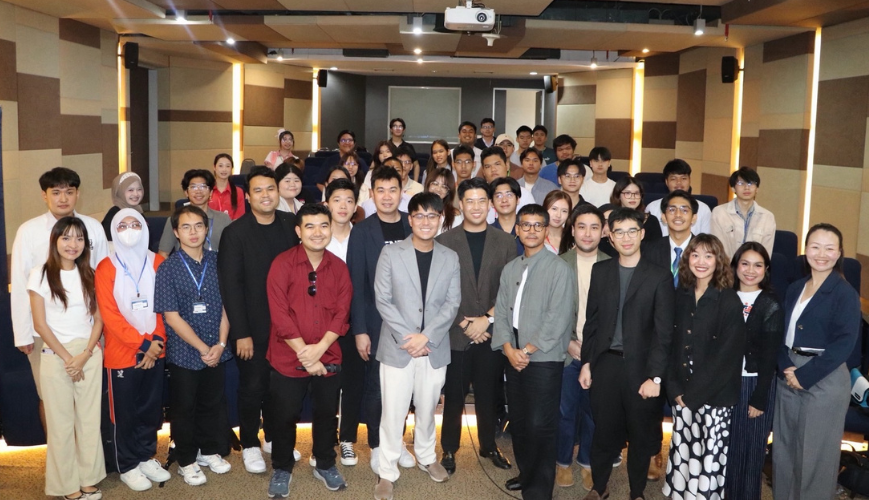
Adam’s House Philanthropy event 2026.
Kasipat’s research was inspired by his own experience of co-founding a nonprofit organisation in Thailand, supported through the YSEALI Seeds for the Future programme in 2024. The organisation focused on climate change awareness and helping young people develop solutions for their communities, including through a virtual hackathon involving participants from 11 countries.
While the project successfully delivered on its commitments, the experience revealed a wider challenge facing many grant-funded organisations: succeeding with a project does not necessarily equip an organisation to survive after its funding ends. This question eventually brought the Kasipat from Thailand to Cambridge to study Social Innovation and investigate why social ventures discontinue after grant funding ends.
The resulting dissertation, ‘Why Don’t You Keep Your Promises?’, draws on 20 semi-structured interviews with founders of Thai social ventures whose initiatives had closed, paused, significantly reduced their activities or transferred their work to others following the end of grant funding. The research developed the concept of “grant-to-organisation conversion failure”, describing situations where teams successfully deliver grant-funded projects without developing the organisational foundations needed to continue independently.
Importantly, the findings suggest that organisations do not necessarily discontinue because their founders lack passion or commitment. During the funded period, teams are often focused on meeting project requirements, leaving less time and capacity to develop sustainable revenue streams, retain team members or plan for life beyond the grant. Some organisations were able to adapt by developing alternative sources of income or maintaining communities of people committed to their mission. Others closed, suspended their activities or transferred their work elsewhere.

Kasipat Wongvitayakamjorn is pursuing a Masters in Social Innovation at Hughes.
The research argues that these findings have implications for how grant programmes are designed, particularly in Thailand and other emerging economies where early-stage social ventures may depend heavily on external funding. Funders could provide greater mentorship around sustainable business models and income generation, while reconsidering administrative requirements that can place additional pressure on small organisations. The research also raises questions about restrictions preventing founders from receiving reasonable compensation for their work.
The issue is deeply personal for Kasipat. Growing up in Kanchanaburi, outside Bangkok, he saw how opportunities were often concentrated in the capital and eventually moved there to pursue a career, first in journalism and later in strategy. His experiences working with community initiatives strengthened an interest in how resources and opportunities are distributed, while his own experience as a grant recipient demonstrated both the transformative potential and limitations of funding.
At Hughes Hall, Kasipat found an unexpected connection to home. Surrounded by the College’s greenery, Kasipat was reminded of the landscape where he grew up in Thailand. Hughes Hall became not only a place to live and study, but a reminder of the communities that had motivated his research in the first place.
Following his dissertation, Kasipat co-founded Adam’s House Philanthropy to put some of those lessons into practice and explore how aspiring entrepreneurs can build initiatives that survive and grow over time. Ultimately, his research seeks to encourage a wider conversation about the financial realities of social entrepreneurship and how funders can support organisations beyond the successful delivery of an individual project.
18.11.26