Ahead of the College’s 141st Anniversary, Alison Sawers (ASNaC postgraduate at Wolfson College) explores the early Principals of Hughes Hall for the WikiProject Women in Red. The project aims to redress the content gender gap on Wikipedia by creating articles about the lives of notable women.
In this, the third of a three-part series (Part I, Part II), Alison gives us a snapshot of the College’s final Principals – Eleanor Marguerite Verini and Margaret Wileman – whose terms cover 1945 to 1973.
Eleanor Marguerite Verini (1894–1987), sometimes called Marguerite, was the daughter of a Hampshire rector and an alumna of Cheltenham Ladies’ College. Her English degree came from St Hilda’s, Oxford during World War I, where she recalled making bandages, growing vegetables in the allotments, and playing at Sunday services for the wounded who were being looked after the Examination School.[1] Upon coming to Cambridge, she was granted membership of Girton College. She therefore received an MA from both Oxford and Cambridge when these universities began admitting women to degrees. In Oxford, this happened in 1921; in Cambridge, not until 1948. Therefore, the other Cantabrigians in this article – Hughes, Dent, Powell and Wood – did not have the chance to receive degrees from their alma mater.[2]
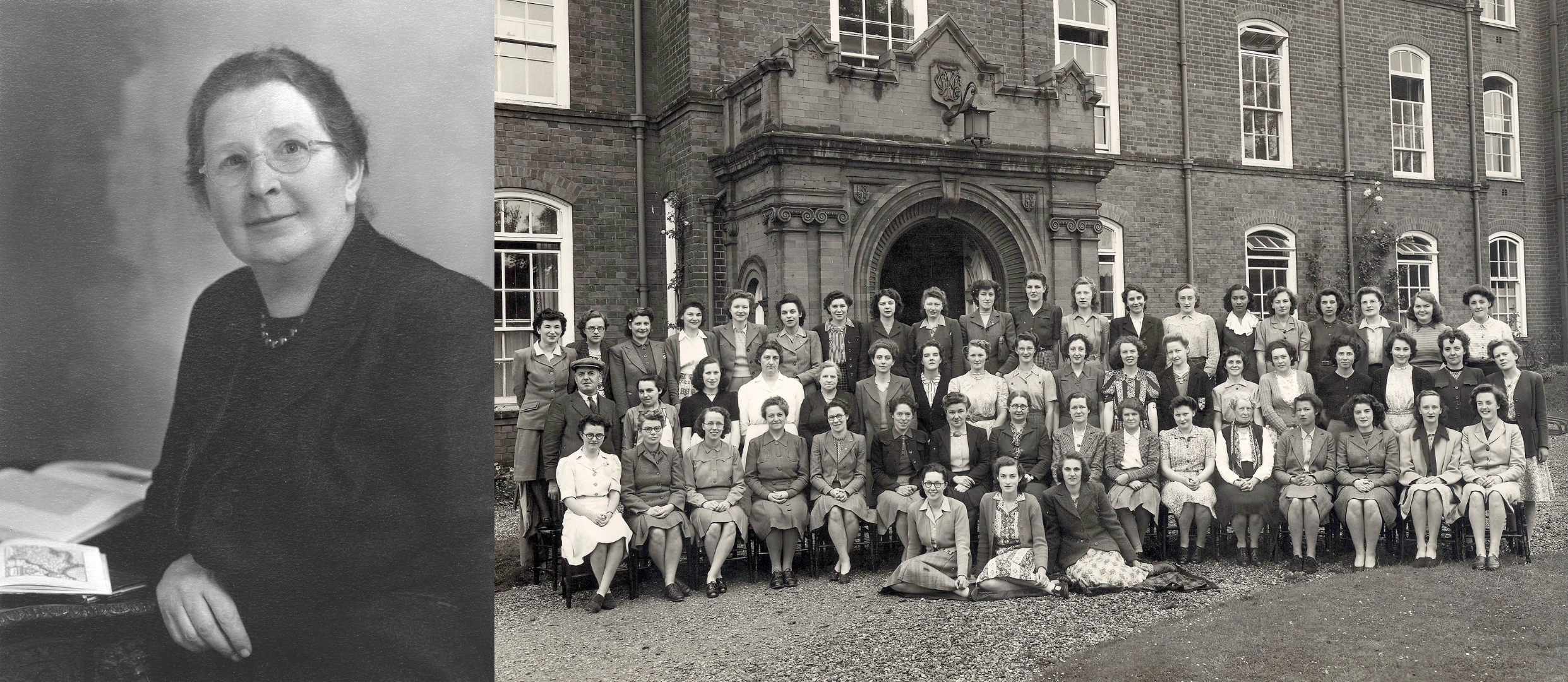
Eleanor Marguerite Verini (left and centre) with the 1946 cohort of Cambridge Training College. (Photographs from Hughes Hall Archives.)
Although Hughes’ original vision for the College to be unsectarian had been upheld, the Education Act 1944 triggered a new conversation about the nondenominational teaching of religious studies in schools, and one of the things that recommended Verini for the post was her experience teaching teachers of scriptural studies at Board of Education holiday courses. She even had a prior connection to CTC: she taught English there from 1925–9 and before that, trained under Henriette Dent at Clapham High School. Since then, she had been headmistress of two nearby high schools: Ely and Loughton.
Faced with a post-World War II drop in numbers, Verini addressed the College’s ongoing problem with space by securing a new annexe, 1–2 Wollaston Road, for use as college accommodation. The College did not have enough space to house the number of students it would need in order to be financially viable, and Verini, like many of her predecessors, was constantly in contact with the Ministry of Education, negotiating teachers’ salaries and pensions and students’ fees, and asking the Ministry to consider the College’s unusual circumstances and small size.
Verini put her experience teaching religious studies into practice, delivering lectures not only to the women of CTC but also to men and women students at the Faculty of Education. Students at Westcott House, who were not eligible to attend University lectures, asked her to come and hold discussions with them in her rooms, which she did for many years, even after her retirement.
In 1948, women students were finally allowed to become full members of the University of Cambridge. Their numbers, shared across Newnham and Girton, were capped at 500 per year. For comparison, CTC was receiving 300 applicants per year for the sixty-five spaces it had.[3] In order to be included in future discussions about admissions numbers, Hughes Hall needed to receive recognition from the University. Such recognition would also help formalise the increasing co-operation between CTC and the Faculty of Education. Therefore, in 1949, CTC was acknowledged – not as a College, which would not happen until 2006 – but as a ‘Recognised Institution for Women’ at the University.
The change in status came with a change in job title for Verini: she was titled Lecturer in Education and Director of Women Students. A change to the College’s name followed, since ‘Training College’ was no longer felt to be appropriate – although the old name was mourned, with Verini remarking that the initials CTC ‘seemed to stand for the College entity more vividly than the words they indicated’.[4] The name Hughes Hall (officially the Elizabeth Phillips Hughes Hall Company) was adopted in 1950 as a nod to the first Principal to signal that the College’s heritage was not to be forgotten.
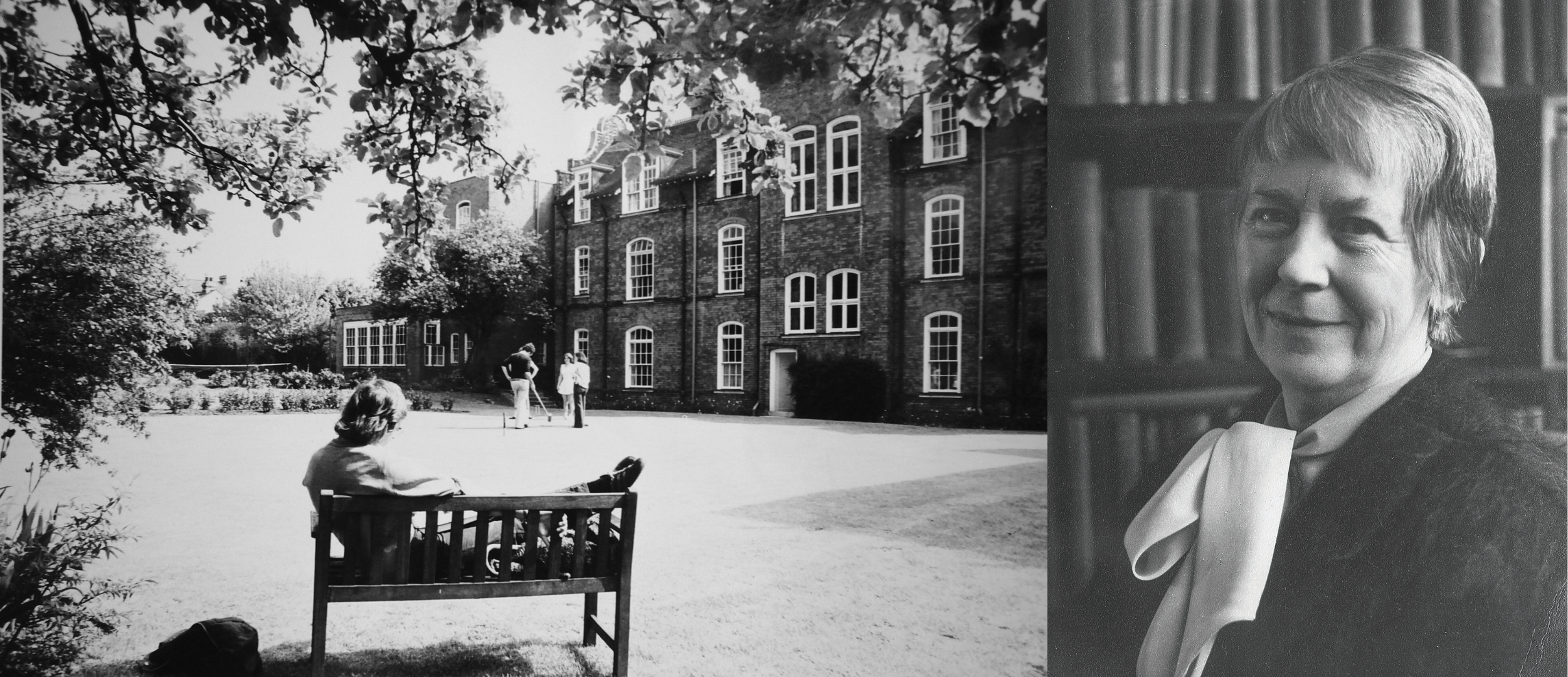
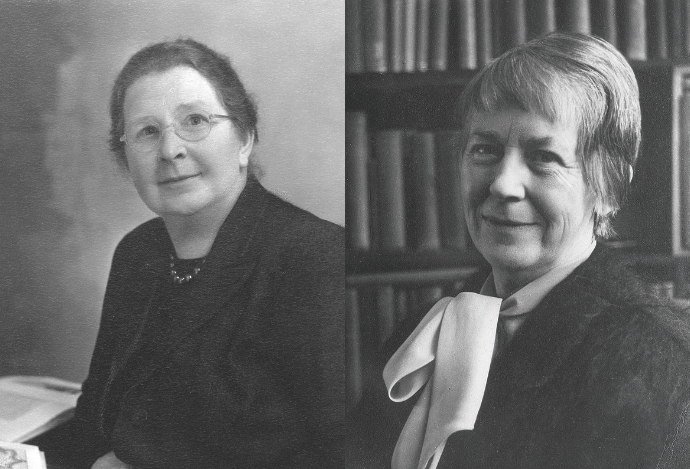
Margaret Wileman (right) and the building that now shares her name, photographed for the 1970s College prospectus. (Photographs from Hughes Hall Archives.)
The next twenty years saw some of the greatest changes at Hughes Hall. Margaret Wileman (1908–2014), like many of the heads of Hughes Hall, was highly educated, well-experienced, and, on a personal level, deeply faithful. She studied modern languages not only at Lady Margaret Hall, Oxford, but also in Paris; she had taught and lectured at girls’ independent schools and university colleges for fourteen years; and she was a Roman Catholic who spent her retirement running educational programs for nuns.
As the University of Cambridge expanded its provision for postgraduate students in the 1960s by approving Darwin College, Lucy Cavendish, and St Edmunds’, Hughes Hall also took steps to become an Approved Foundation of the University and was recognised in 1968. During the last few years of Wileman’s twenty-year headship (1953–73), the College acknowledged that it had moved from its roots as a teacher training college for girls’ schools because of the rise of the University’s Department of Education and the drop in the number of girls’ schools as co-education became more common. Therefore, the College began to offer degrees other than education and, in 1973, began admitting men as students. Wileman is now the namesake of Hughes Hall’s main building, the Margaret Wileman building. Interestingly, the title changed to President in Wileman’s the May of 1973, her final year, so she is arguably Hughes Hall’s last Principal and first President.
The opening of the College to male students fulfilled Elizabeth Phillips Hughes’ original vision: ‘We shall never get first-rate training until men and women are trained together’.[5] However, one of the outcomes of the change was that after Wileman, Hughes Hall did not have another woman head until diplomat Sarah Squire became President in 2006. The College, although it has achieved gender parity in its heads of College, has now had as many Presidents named Desmond as women Presidents.
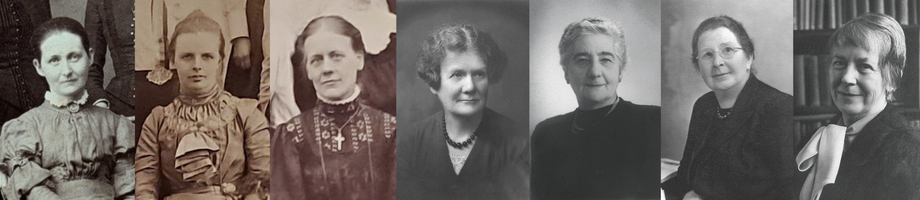
Nevertheless, the seven women Principals from 1885 to 1973 steered the Cambridge Training College through many struggles, national crises, educational policy changes and financial near-disasters. Their successive leadership ensured the survival of a small and unconventional institution and shaped its gradual transformation into the Hughes Hall of today.
With many thanks to Alison Sawers for her article and the Hughes Hall Library and Archives Team for their additional research. Read Part I and Part II here.
_____
Footnotes
[1] Interview conducted with Verini in 1985, quoted in Graham, Malcolm, Oxford in the Great War (Pen and Sword, 2014) and Mahoney, Oliver, ‘From the Archives: the war-wounded and St Hilda’s war-work’, St Hilda’s Chronicle (2016), p. 35.
[2] Although Wood was one of the hundreds of ‘steamboat ladies’ who received their degree from Trinity College, Dublin in recognition of their work at Oxford or Cambridge, some of them travelling to Dublin by boat. See Parkes, S. M., ‘Steamboat Ladies’, Oxford Dictionary of National Biography (Oxford University Press, 2007), doi:10.1093/ref:odnb/61643, accessed 9 April 2026.
[3] Figures from Bottrall, Hughes Hall, p. 87.
[4] Annual Report 1952, quoted by Martin, Ged, ‘The Cambridge Training College for Women Teachers: the founding decade 1885–1895’, https://www.gedmartin.net/martinalia-mainmenu-3/232-the-cambridge-training-college-for-women-teachers#edn7 [accessed 9 April 2026]
[5] Speech to the Royal Commission on Secondary Education in 1894, quoted at https://www.hughes.cam.ac.uk/about/history/ [accessed 9 April 2026]
_____
General references
Bottrall, Margaret, Hughes Hall, 1885–1985 (Cambridge: Rutherford, 1985)
‘Ely High School 1905–1972—Miss EM Verini, Headmistress 1929–36’, http://www.elyhighschoolforgirls.org.uk/VeriniEM.htm [accessed 9 April 2026]
Le May, G. H. L., ‘Hughes, Elizabeth Phillips (1851–1925), college head and promoter of education in Wales’, Oxford Dictionary of National Biography (Oxford: Oxford University Press, 2008), doi:10.1093/ref:odnb/37579 [accessed 9 April 2026]
Shepherd, Janet, ‘Wood, Mary Hay (1868–1934), educationist and college head’, Oxford Dictionary of National Biography (Oxford: Oxford University Press, 2004), doi:10.1093/ref:odnb/51783 [accessed 9 April 2026].