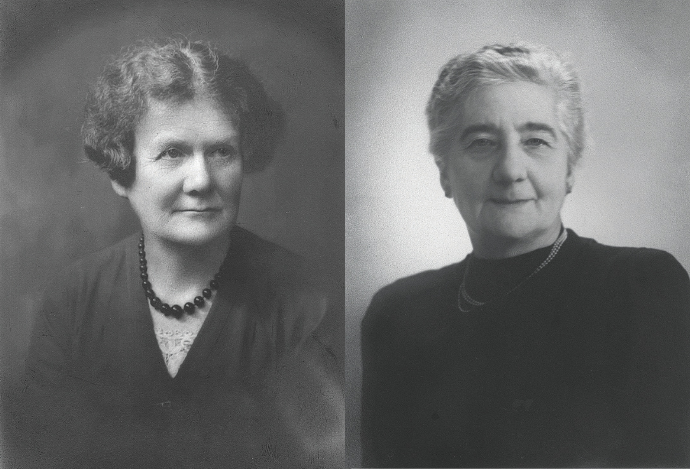
Ahead of the College’s 141st Anniversary, Alison Sawers (ASNaC postgraduate at Wolfson College) explores the early Principals of Hughes Hall for the WikiProject Women in Red. The project aims to redress the content gender gap on Wikipedia by creating articles about the lives of notable women.
In this, the second of a three-part series (Part I, Part III), Alison gives us a snapshot of the College’s next two Principals – Mary Hay Wood and Henriette Dent – whose terms cover 1908 to 1945.
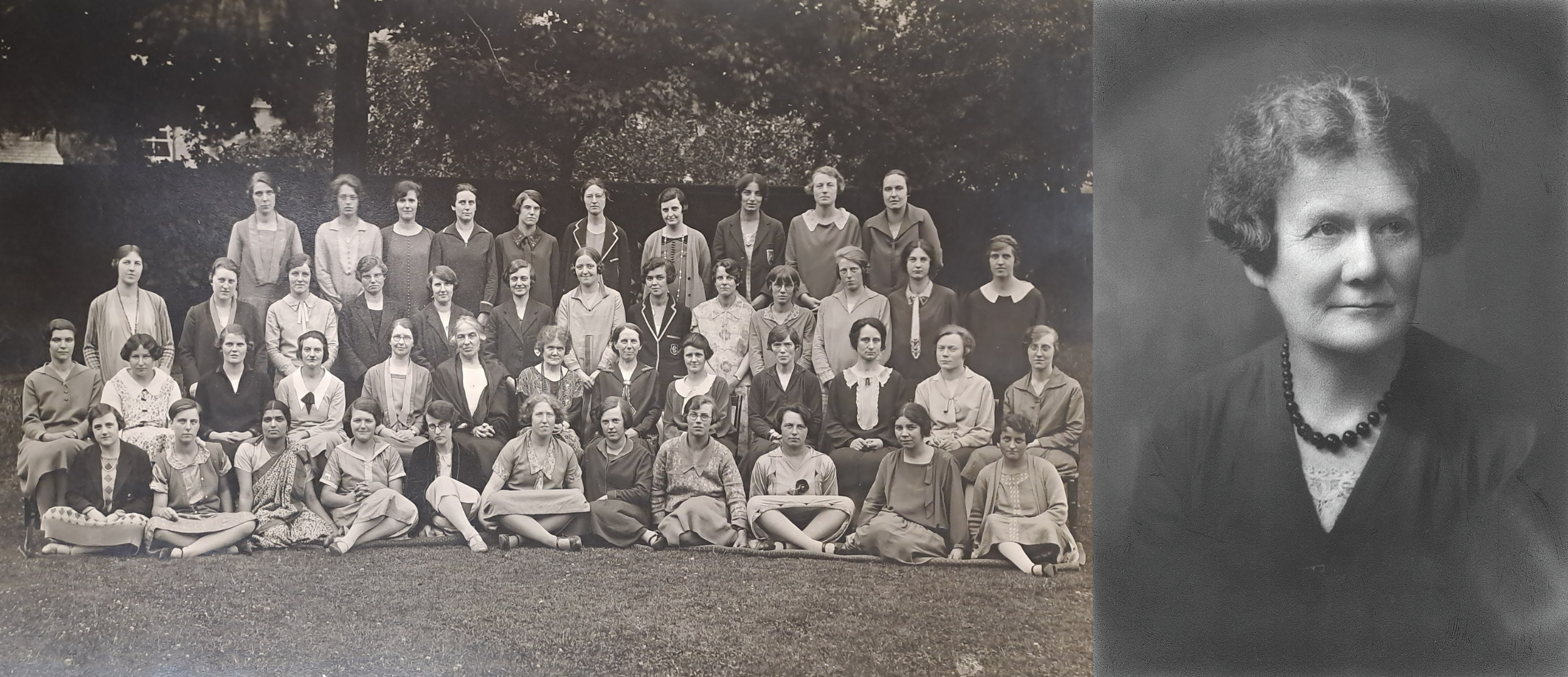
Mary Hay Wood (centre and right) was the longest serving Principal of the College. (Photographs from Hughes Hall Archives.)
Following the departure of Helena Langhorne Powell in 1908, the post of Principal of Cambridge Training College was not advertised: a replacement had already been selected. The vice-principal of St Mary’s swapped places with Powell and became the next Principal of CTC. Mary Hay Wood (1868–1934), daughter of a London barrister, had studied Classics at Girton College, Cambridge in 1886. Although Cambridge did not award degrees to women at the time, she later received an MA from the University of London and a DLitt from Trinity College, Dublin on the strength of her thesis, ‘Plato’s Psychology and its Bearing in the Development of Will’.[1] From 1890–1904 she taught at boys’ schools and at her own former school, North London Collegiate (where she had been taught by the College co-founder, Frances Buss) before coming to St Mary’s.
Wood saw CTC through a period of consolidation, a flu epidemic, and World War I. In her time, students attended two lectures a day, one at 8:40am and one at 5:45pm, with the middle of the day given to the preparation and delivery of school lessons. There were also evening classes. Numbers and finances dipped sharply during World War I, while students offered English classes to Belgian refugees and found their practice schools thrown into temporary measures as the school buildings were requisitioned for other purposes. But applications rose again afterwards as women explored their options in the post-war world. Keen to recruit high-quality applicants, the College added ‘postgraduate’ to its title in 1920–1.[2]
As the longest-serving Principal (1908–1933), Wood devoted her whole later life to the College. When she retired in 1933, she planned to use her retirement gift from the College to travel, but she learned that she had cancer. Donating the gift back into the college fund for students in need, she died a few months later. She was memorialised by a former student and her successor as Principal as ‘one who so loved wisdom as to live according to its dictates, a life of simplicity, independence, magnanimity, and trust’.[3]
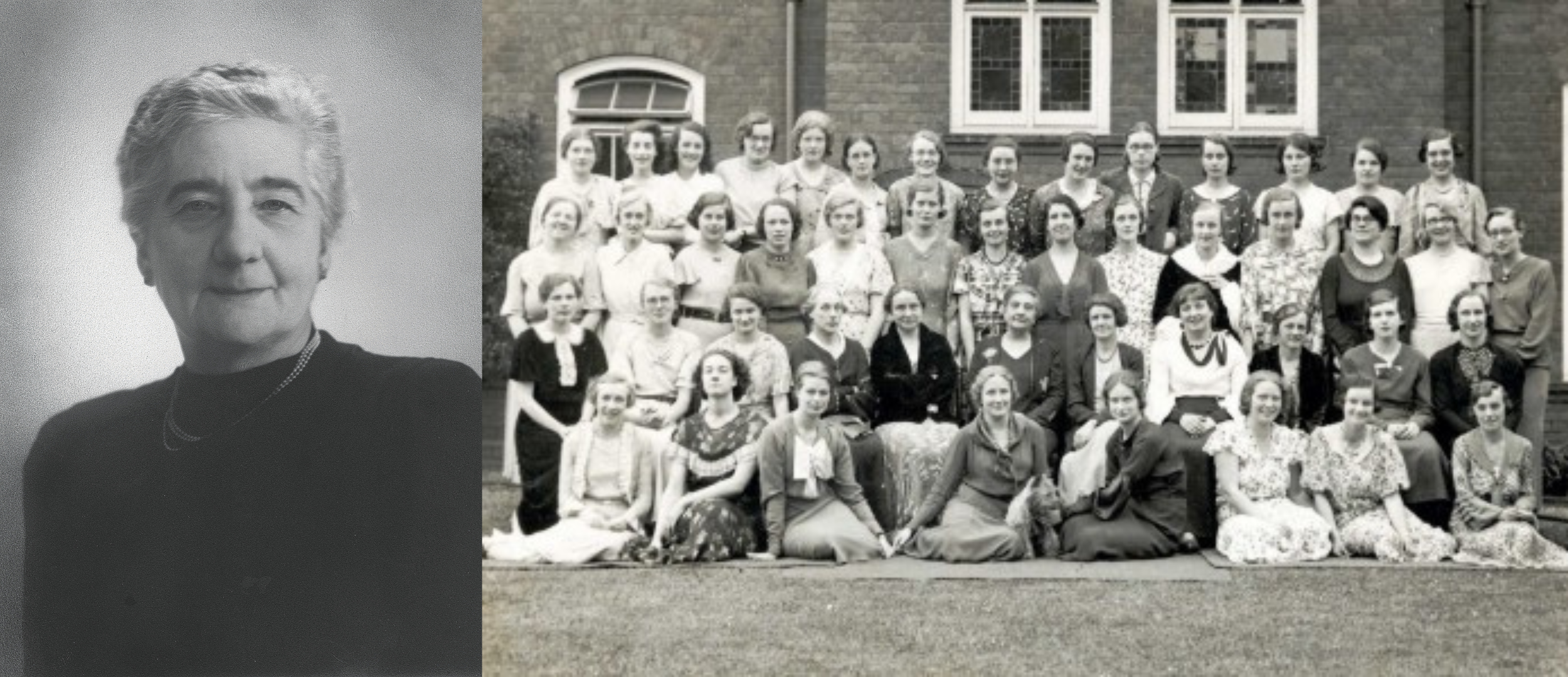
Henriette Dent (left and centre) with her 1940 cohort. (Photographs from Hughes Hall Archives.)
This successor was Henriette Dent (1883–1966), another former teacher from St Mary’s College, Paddington – a popular and modernising Principal (1933–1945). Having studied History at Girton College, she worked as Head of the Postgraduate Department for teacher training of Clapham High School, 1915–33. Although she was a gifted lecturer herself, she emphasised the importance of seminars and tutorial groups in training. Presiding over the purchase of the freehold of the Wollaston Road site and the building of a new wing, she also carried out several quality-of-life improvements, including establishing a common room with a radio for lecturers. During her tenure, the College recorded a record number of First-Class passes, despite the disruption of World War II – even when a bomb fell at the end of Mortimer Road.
As the Department of Education (one of the precursors to the Faculty of Education) began to arise within the University, CTC provided some teaching to the men students and Dent was appointed the first Woman Examiner for the Teachers’ Certificate practical examination. However, she remained wary about being merged with the Department in case this imperilled the College’s lecturers’ jobs or its independence to organise its own teaching practice.
Dent ‘retired’ from CTC in 1945, only to serve as Acting Principal of King’s College of House and Social Sciences for two years. She also spent eleven years as Chairman of the Education Committee of the Girls’ Public Day School Trust (GPDST), having come from a GPDST school herself.[4]
One of Dent’s former pupils at Clapham was now headmistress of Ely High School, and was offering CTC students places to spend two weeks getting teaching experience at her school. This former pupil was to become the next Principal of CTC.
The leadership of Wood and Dent steered the College through times of turmoil and the challenges of a changing educational landscape, securing its place within Cambridge. In Part III, Alison turns her attention to the final two Principals, Eleanor Marguerite Verini and Margaret Wileman, whose tenure would see Hughes Hall through the post-war era and towards its historic transition to a co-educational institution.
_____
Footnotes
[1] Heidel, W. A.; Wood, Mary Hay, ‘Plato’s Psychology in its Bearing on the Development of Will’, The Journal of Philosophy, Psychology and Scientific Methods 5:17 (1908), 471. doi:10.2307/2011674.
[2] Lambert, Jean, ‘Addressing Need for Over a Century—Hughes Hall’, https://www.hughes.cam.ac.uk/about/news/addressing-need-for-over-a-century/ [accessed 10 April 2026]
[3] Recorded in Bottrall, Margaret, Hughes Hall, 1885–1985 (Cambridge: Rutherford, 1985), p. 68.
[4] Kamm, Josephine, Indicative Past: A Hundred Years of the Girls’ Public Day School Trust. Routledge. p. 133, 147, 216.
_____
General references
Bottrall, Margaret, Hughes Hall, 1885–1985 (Cambridge: Rutherford, 1985)
‘Ely High School 1905–1972—Miss EM Verini, Headmistress 1929–36’, http://www.elyhighschoolforgirls.org.uk/VeriniEM.htm [accessed 9 April 2026]
Le May, G. H. L., ‘Hughes, Elizabeth Phillips (1851–1925), college head and promoter of education in Wales’, Oxford Dictionary of National Biography (Oxford: Oxford University Press, 2008), doi:10.1093/ref:odnb/37579 [accessed 9 April 2026]
Shepherd, Janet, ‘Wood, Mary Hay (1868–1934), educationist and college head’, Oxford Dictionary of National Biography (Oxford: Oxford University Press, 2004), doi:10.1093/ref:odnb/51783 [accessed 9 April 2026].