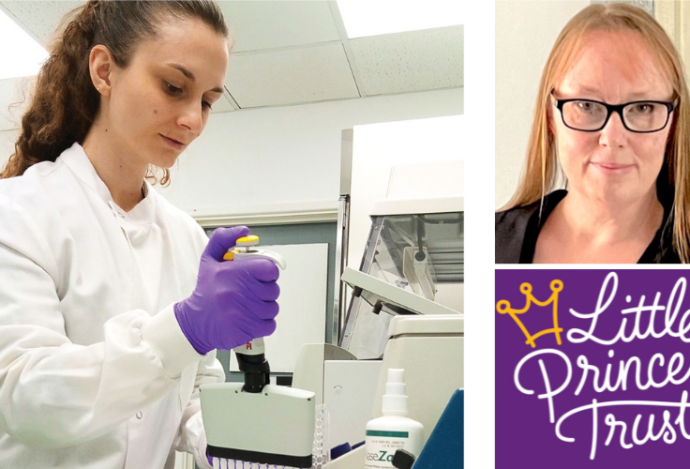
Neuroblastoma is one of the deadliest childhood cancers – something Professor Suzanne Turner and Dr Perla Pucci, both Fellows of Hughes, are determined to change.
Thanks to a major new grant, they hope to discover how and why the most aggressive forms of neuroblastoma stop responding to treatments, and improve patients’ survival and quality of life.
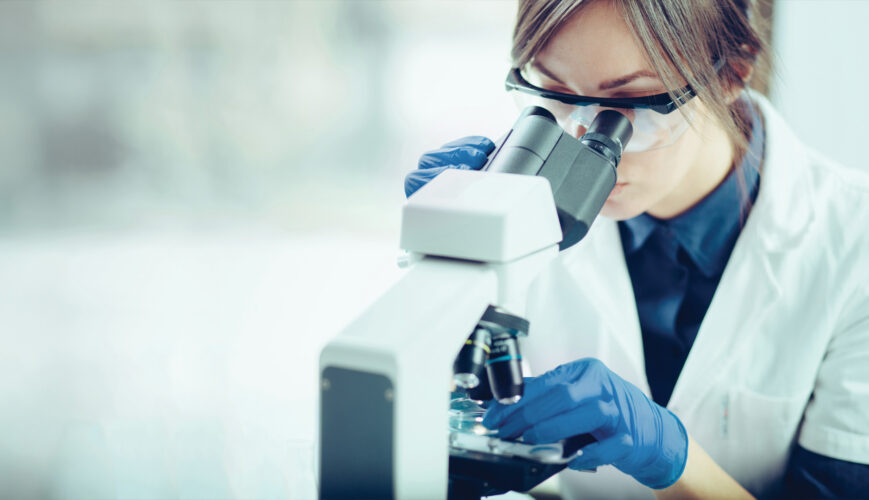
In an unremarkable block between Addenbrookes’ A&E department and the main hospital building, the University Department of Pathology labs are crammed into a narrow corridor filled with state-of-the-art equipment.
The most common solid tumour after brain tumours to affect children starts in the adrenal glands and the nerve tissue at the back of the abdomen. Difficult to diagnose, neuroblastoma often spreads and presents with high-risk forms, when it is hard or impossible to treat. Existing treatments are aggressive and yet still largely ineffective: surgery, chemotherapy, radiotherapy, stem cell transplant. Too aggressive for some of the very young patients, as neuroblastoma can develop soon after birth. Of the hundred or so patients affected each year, most present with high-risk disease, which is still incurable.
In January 2024, a new three-year project was launched at the Department of Pathology at the University of Cambridge led by Professor Suzanne Turner and Dr Perla Pucci to make major headway in the research into this cruel disease. This cutting-edge research is funded by the Little Princess Trust, a charity well-known for providing free wigs to children undergoing chemotherapy, in partnership with the Children’s Cancer and Leukaemia Group, both funding major research centres in childhood cancer.
Dr Perla Pucci, who came to the UK from Italy to study at the Open University, joined Suzanne’s lab as a postdoc in 2020. Now they are joint principal investigators in a programme to test novel compounds and combinations of existing and experimental drugs to improve responses to treatment in neuroblastoma.
In an unremarkable block between Addenbrookes’ A&E department and the main hospital building, the University Department of Pathology labs are crammed into a narrow corridor filled with state-of-the-art equipment. Off the corridor, which looks like one of the hospital wards, each team has its own laboratory, as well as shared facilities such as sterile hoods to work with cells to avoid contamination; vented hoods to work with dangerous compounds; tissue culture laboratories to handle samples of tumours and examine slides under the microscope; body-temperature incubators for live cells; and giant freezers and liquid nitrogen containers for frozen samples.
Thanks to a research grant the lab was able to buy a ‘drug robot’, a machine that can test thousands of compounds at one time on cell samples of different types, faster and more accurately than any human. The medicines tested can be existing drugs or compounds that are already approved for use in a clinical setting, or more experimental drugs; often ‘drug libraries’ from pharma companies or research bodies are used. Experiments are carried out to test established treatments that are known to work on other diseases – the drug repurposing approach – or new combinations of drugs that work better in the cancers studied.
The lab’s location in the hospital is a great benefit. Across oncology, there is collaboration and contact between the clinical and the research side; something that is likely to grow once the new Cambridge Cancer Research Hospital is built. Sometimes, specialist nurses from the wards come on a lab tour. Samples can be taken from current patients and drugs pre-tested to see how their cancers might respond.
There are many practical challenges to neuroblastoma research. Because the cancer is relatively rare, and manifests very differently in different patients, it is difficult to do large-scale statistical studies without having to wait for extended periods of time (potentially decades). The lab works on cancer cells at all stages: in test tubes (in vitro), in mice (in vivo) and eventually with real patients’ samples in the lab and in clinical trials. Where past patients with a certain cancer or mutation have given permission, their cells can grow into established cell lines used by scientists all over the world, sometimes decades after the patient’s own death. From these cell lines, molecules can be extracted to look at DNA, RNA and proteins to see why different cells in certain conditions might respond differently to treatments.
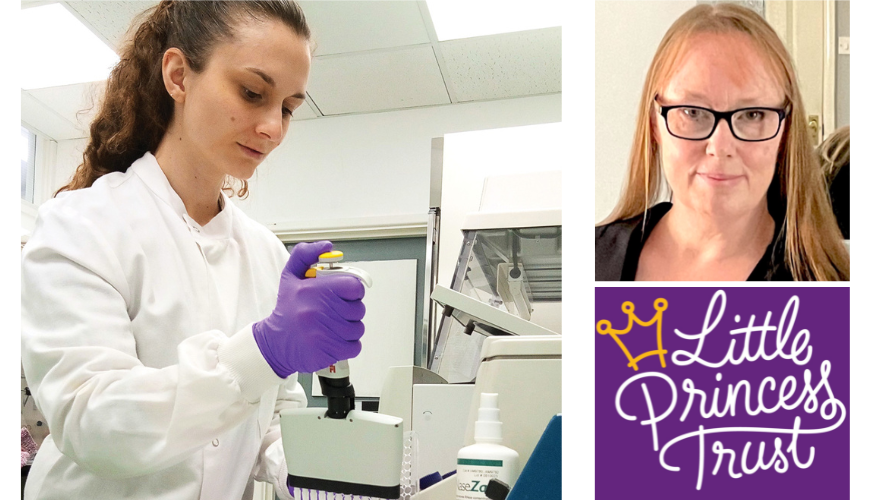
From left: Dr Perla Pucci in the lab, Professor Suzanne Turner.
Suzanne and Perla will assess patient tumours and blood for the presence of important epigenetic changes: chemical changes that change how the DNA is expressed (which parts of the genetic code are activated) without changing the DNA sequence itself. ‘There is so much we still don’t know about how neuroblastoma works at the molecular level,’ says Perla. ‘We focus on ALK, a protein that when found aberrantly increased in patients makes the tumour very aggressive. ALK is present in embryonic cells, but in healthy individuals it disappears after birth. We need to find out why it causes a problem in some individuals.’ Because ALK doesn’t occur in healthy cells, any treatment focused on it will target the cancer cells only, which means the usual damage chemo does to healthy cells could be avoided. However, some patients can stop responding to treatment. Finding effective and synergistic combination therapies is key, to reduce single drug doses but create successful responses in patients, with reduced toxicities.
If we can understand the molecular accidents that cause or contribute to cancer, such as why ALK is produced in the cells of some patients, and why its inhibition is not sufficient to save the lives of others, we can try to revert them and cure neuroblastoma. But there are other approaches. ‘Sometimes neuroblastoma can resolve spontaneously, due to molecular characteristics in some patients that we do not fully understand. If we could pinpoint where this occurs, that could help us find a cure for others.’ Because neuroblastoma works in different ways in different patients, personalisation of treatment is key.
After the lab stage, the treatments are tested in mice, to see if they would cause harmful side effects in complex organisms; this is where the dose and length of treatment is determined. With childhood cancers, clinical trials can of course only happen once a certain medication is confirmed as safe for use in the first phase studies.
Every research study starts with a hypothesis to be tested. ‘We can test hundreds and thousands of compounds in the lab, but sometimes the results are not what you expect,’ says Perla, ‘so the hypothesis set at the start is always evolving.’ Over the next years, this painstaking work will test many thousands of possible solutions alongside leaps in our understanding of how a patient’s cells respond at the molecular level, bringing hope to patients and families around the world.
- This article is one of many in the latest edition of The Owl, Hughes Hall’s College magazine. To read the publication, visit The Owl.
25.2.25