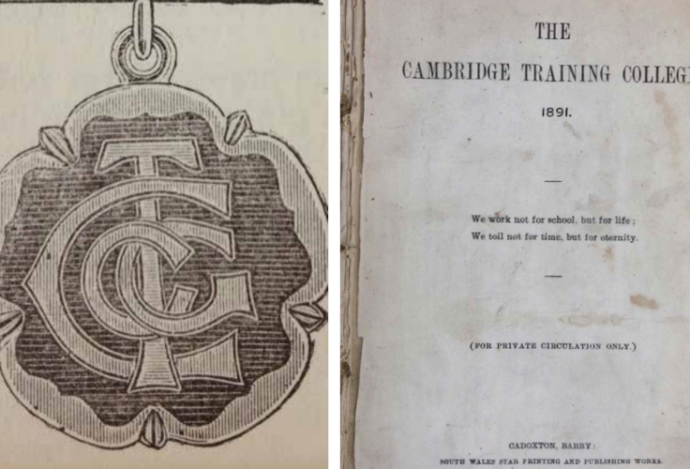
The badge of the Cambridge Training College Gild (C.T.C.G) was created in 1893 but may no longer exist as a concrete artefact.
However, contemporary Gild documents, currently the sole known source of evidence for the existence of the badge, provide details of its origin, designer, purpose, composition and dimensions, and include a black and white image of an actual size engraving of the object and its attached bar and ribbon.

The badge of the Cambridge Training College Gild (left); the title page of the very first Gild Leaflet
Crafted from solid silver, almost wholly by hand, the badge was shaped as a conventional marsh marigold enclosing the monogram ‘C.T.C.G’. Its attached metal bar and tri-colour ribbon of green, blue and yellow, to which it was affixed by suspension rings on badge and bar, measured one inch. The C.T.C.G was established in 1891 to provide professional support for continuing and former students of the Cambridge Training College for Women (C.T.C.W). In around 1892, the Gild Committee proposed having ‘College badges’ for its fifteen officers and committee members. Significantly, Miss Elizabeth Hughes, principal of C.T.C.W. and president of C.T.C.G., offered to finance the badges, clearly an indication of their importance to College and Gild. The committee’s proposals regarding shape, inscription and colours were formally ratified by a majority of Gild members.
By 1894, as a result of popular demand, the committee had agreed materials and cost for a cheaper badge for the whole membership. The decision to produce a less expensive version was communicated to all members through the Gild Leaflet for summer 1894 in an account written by A. Warren that was also designed to promote badge sales. Warren’s article specifies that the silver badge, first worn by Gild officers and committee members at the general meeting in December 1893, was shaped in the form of the ‘college flower’, had a ribbon in ‘college colours’ and cost ‘10s’. Clearly, the marsh marigold had been adopted, albeit unofficially, as the ‘college flower’ – the ‘Marsh Marigold Tramp Club’ is mentioned in 1893 – and green, yellow and blue chosen as ‘college colours’.
Neither is formally documented in official College records. Presumably, members chose the marigold because it grew abundantly in Newnham, site of the original College buildings – perhaps also as Marian emblem – and the colours green and yellow to reflect the plant’s leaves and flowers. Funded by Miss Hughes, the Gild, and presiding officers and committee members, the committee badges remained the Gild’s property and were to be passed to succeeding officials when term of office expired.
However, by general agreement, any member could purchase a silver badge at ‘10s.’ or an affordable – for schoolmistresses of the 1890s – machine-made, die-stamped version in bronze, including ribbon and bar, for ‘2s. 6d.’ Moreover, they were marketed as being convertible to brooches or watch-chain trinkets. There are no extant records of where the bronze badges were struck or the identity office of the six ‘C.T.C. friends and students’ submitting designs. Only the chosen designer is named: ‘an original design by our artist-friend, Miss Maude Berry, to whom our hearty thanks are due’.
Little is known about ‘our artist-friend’ Maude Berry. So far, research in other archives has revealed that Maude’s connection with C.T.C. was probably through her brother Arthur, a Fellow in mathematics at King’s College who lived in Newnham, nearby C.T.C. Yet, intriguingly, key questions remain unanswered. Did Maude make the silver badge, produce the engraving and waive her fee, as ‘hearty thanks’ implies? What was/ were her artistic medium/media?
A letter from Ada Berry, her brother, to Roger Fry in 1889 refers to ‘Maude (the artist)’ and her appreciation of Fry’s draughtsmanship while a letter dated 1925 written by her to friends or relations mentions designing a Christmas tableau (KC Archives). Contemporaneously, female artists were working in metals, including precious metals and gold and silver jewellery design, for example, May Morris, daughter of William and Jane Morris, and, commonly, metalworkers crafted their own designs.
Without doubt, the Gild’s badge has historical importance within and beyond our College. Anticipating the badges and brooches of women’s suffrage groups, it symbolised the Gild as a ‘force’ for ‘reform’ and for the mutual benefit of those with common knowledge, interests and work. It linked educational developments to socio-political change and the nineteenth-century notion of progress while, apparently, supporting the Arts and Crafts movement.
It designated a democratic and co-operative union, a ‘bond of fellowship’ not a hierarchy with segregated ranks. With Gild numbers increasing, it was intended as an insignia for identification, recognition and connectedness outside Gild gatherings, in particular the growing number of professional conferences and newly established associations and guilds, possibly socialist given the Gild’s invitation to the Fabian Society’s ‘Mrs Sidney Webb’ to address the membership in 1897.
Speculations about the badge’s owners, meanderings and subsequent destinations abound. Buoyant badge sales recorded in the London and Manchester branch accounts of the Gild attest its popularity and justify the Gild’s pride at finally securing ‘a badge of its own’. An example of this distinctive and intriguing artefact has yet to emerge, and, of course, we are very keen to hear from anyone encountering or, even better, possessing one.
The full article was written by Life Fellow, Tutor and former Archivist, Jean Lambert, and is available here.
8.5.25