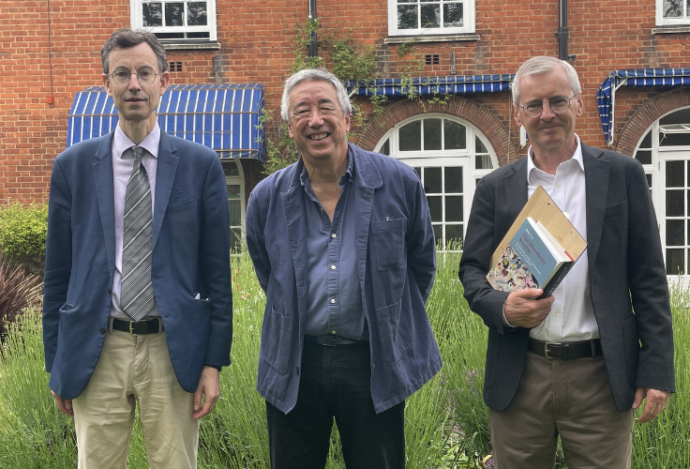
Hughes Hall welcomes Bobo Lo and Professor Brendan Simms to discuss the changing nature of global order
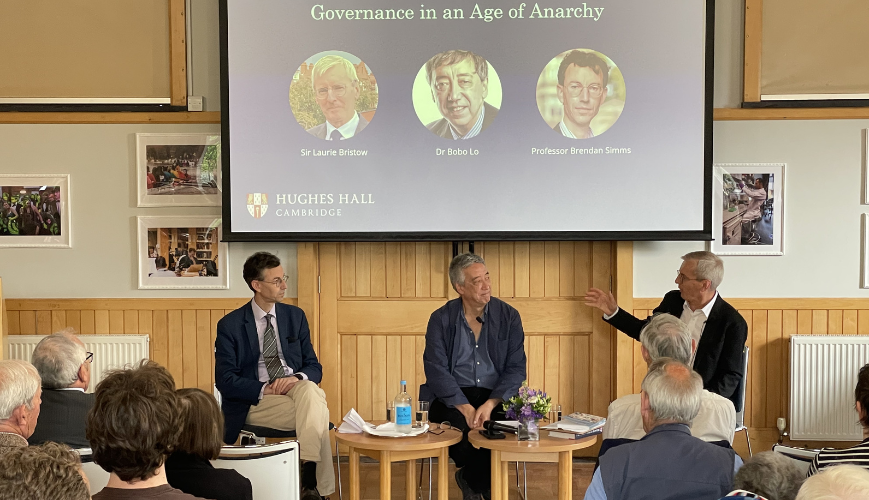
Centred on Bobo Lo’s latest book, and chaired by Hughes Hall President, Sir Laurie Bristow, the discussion examined the decline of the post-Cold War international system, the growing complexity of global challenges, and the prospects for building a more effective and inclusive global order.
Bobo Lo is an independent international relations analyst and Non-resident Fellow at the Lowy Institute, with previous senior roles at Chatham House and the Australian Embassy in Moscow. A leading expert on Russian foreign policy, he has authored widely praised books, most recently ‘The Disorderly Society: Rethinking Global Governance in an Age of Anarchy’ (2025).
Brendan Simms is Professor of European Geopolitics at Cambridge and Director of the Centre for Geopolitics, specialising in European history and international intervention. He teaches and contributes actively to policy and public debate through advising governments and writing for major media outlets.
Understanding a changing world
Dr Lo began by setting out the core purpose of his work: to understand how the post Cold War “rules-based international order” has unravelled, what has replaced it, and whether it can be rebuilt.
He argued that rather than a sudden collapse, the current moment reflects a long-term process in which the liberal international order has moved “from the zenith of its influence into near collapse.” And that this decline cannot be explained solely by external challengers such as Russia or China, but must also be understood as the result of sustained failures within Western policymaking.
From order to disorder
A central theme of the discussion was the increasingly fragmented and unstable nature of the global system with today’s world lacking any coherent replacement for the previous order, with existing frameworks – from the United Nations to visions of multipolarity – proving insufficient to provide stability or consensus.
This has led, he argues, to a “void of global governance” in which there is little agreement on rules, authority, or enforcement with the world facing not one crisis, but many simultaneously: climate change, technological disruption, pandemics, geopolitical rivalry and economic pressure were.
Bobo Lo described this as a “perfect storm of global threats and challenges, the result being a system in which threats are interconnected, mutually reinforcing, and difficult to address in isolation.”
Values, interests, and credibility
A key tension running through the discussion was the relationship between values and international politics; it was argued that Western governments have weakened their own position through inconsistency and double standards, particularly when promoting human rights abroad while failing to uphold them universally.
This has led to a broader loss of credibility, making values-based foreign policy more difficult to sustain. Instead, the conversation pointed towards a more pragmatic approach, focused on behaviour, cooperation, and shared outcomes rather than ideological alignment.
Bobo Lo summarises his analysis

Towards a “new internationalism”
Looking ahead, Bobo Lo proposed the need for a reimagined framework for global cooperation, which he described as “New Internationalism” with three core principles:
- A broader understanding of self-interest, recognising global interdependence
- Greater inclusiveness, particularly in representing Global South priorities
- Increased flexibility, allowing for different political systems and values
Together, these principles aim to create a form of global governance that is more representative, adaptable, and resilient in a diverse and changing world.
Hope in uncertainty
The evening ended on a cautiously optimistic note. Lo argued that history shows how rapidly global systems can change under pressure, pointing to moments such as the end of the Cold War or post-war reconstruction. Cooperation remains not only possible but necessary: without it, the ability to address global challenges – from climate change to conflict – will remain out of reach.
Hughes Hall will continue to host events addressing the biggest questions of our time. See what’s coming up on our events pages.
2.7.26