Disability History Month is celebrated annually in the UK, this year from 20 November – 20 December, with the theme of ‘Disability, Life and Death’.
Dr Ben Marshall, Hughes Hall’s Head of Student Wellbeing and Welfare and Disability Liaison Officer, shares some thoughts and advice.
“We are currently in Disability History Month. This year’s national theme is ‘Disability, Life and Death’. This gives me, as the college’s Disability Liaison Officer, the quite intense task of offering a few reflections on the subject.”
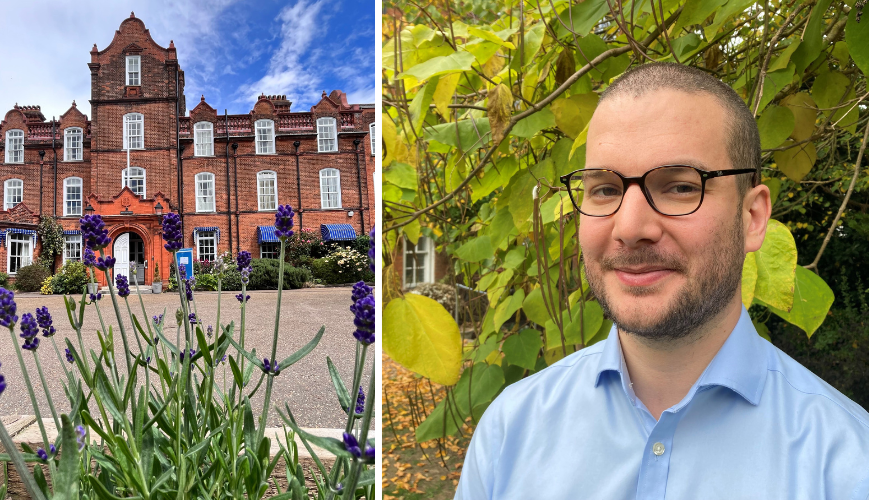
Dr Ben Marshall is the Disability Liaison Officer at Hughes Hall.
My first reaction is that (although it’s less catchy) for me the Lives bit should probably be plural, to reflect the plurality of disability experiences. My second reaction is that the Deaths bit should probably be too, not only to emphasise the significant numbers of disabled people who have died unnecessarily as a result of Ableism across our society (and let’s not downplay this, disability IS a life and death matter for many), but also to touch on the various smaller, symbolic deaths ‘by a thousand cuts’ a disabled person experiences as they navigate life in a world often built by but not for them.
With the above emphasis on plurality and divergence I was keen not to speak on behalf of others. I chatted with some disabled students I’ve had the pleasure of working with recently to improve a few aspects of accessibility within college. Julia Betancourt is an expert by practice and experience who recently joined us for an MPhil in Education, with her research focused on exploring the set of factors that disabled educators need to navigate. I asked her about some key principles for disability allyship: something actionable that our community might take away from this article.
- Julia first noted the importance of language: in particular, cultivating an awareness of the roots of any terms that you do choose to use as these are frequently rooted in oppression. Language is an important tool of signalling safety and the deep understanding of seen-ness to disabled people. Deploy it purposefully.
- Julia was also keen to point out that we won’t always know what a situation calls for, in terms of language or actions and that’s ok: when in doubt, consult. It’s always ok to simply and authentically ask what a disabled person would like to happen or how they might like to be collaborated with. Making occasional mistakes is human. Just own them and seek advice on how to not make the same ones again. There is a host of expertise out there, whether by research, practice or direct experience of disability.
- Finally, Julia also suggests that all members of the community acquire and maintain an understanding of the essentials of Disability Justice and how enmeshed disabled peoples’ fight for acceptance and inclusion has been with broader political and societal struggle. Engaging directly with disabled people is only one part of this and Julia suggests media like ‘Demystifying Disability’ by Emily Ladau and the documentary ‘Crip Camp’ on Netflix as starting points for an education in this perspective.
I’ll close this piece by expanding on and reiterating an observation that the organisers of Disability History Month make: that (without playing into challenging stereotypes like the ‘mad genius’) many of our greatest minds have managed complex disabilities. Had reductionism and bigotry fully won in the 1940s or at a great many other points in our history, we would have missed out on so much as a species.
On the other side of this, imagine where we might be if we fully and consciously moved towards unlocking the full potential of empowering every member of our society, without exceptions. As a College that still takes our progressive founding seriously, I hope members will join Julia, Spencer (our Deputy Senior Tutor and Disability Champion) and I in trying to advance things purposefully.
Next term we are trialing a disability advisory forum for the College. If this is something you would like to be a part of, please do get in touch.
Dr Benjamin Marshall (bjm71@hughes.cam.ac.uk) is the College’s Disability Liaison Officer and Dr Spencer Johnston (scj43@hughes.cam.ac.uk) is the Senior Member Disability Champion. Please get in touch if you’d like to discuss any aspect of disability inclusion and support in our College community.
10.12.25