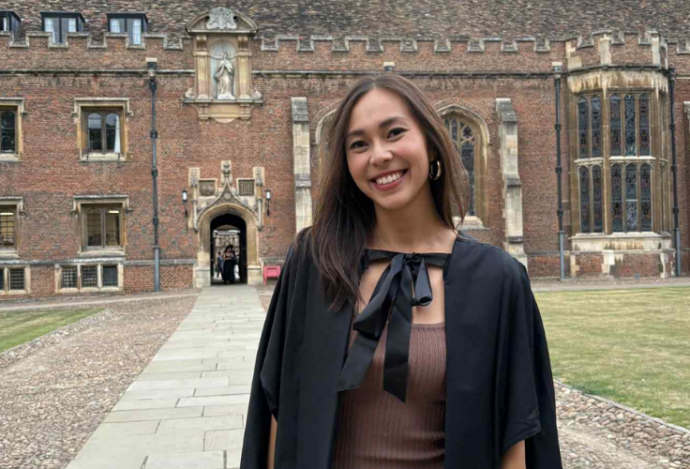
Debbie Kwan is a third year PhD student exploring ways to promote and measure cognitive empathy in children.
Passionate about children’s wellbeing, Debbie brings her teaching experience to academia. Her paper ‘Measuring cognitive empathy using story stem narratives’ has just been published in the journal Frontiers in Developmental Psychology.
“As communication becomes increasingly mediated through phones and social media, opportunities for face-to-face interaction begin to diminish. This realization sparked my interest in exploring empathy—particularly how it can be nurtured within classroom settings. This topic has since become a central focus of one of my PhD projects where I have developed an intervention to promote empathy in 5-6 year old children.”

Debbie Kwan is a third year PhD in Education student.
Background and research interests
I am originally from New Zealand, and I come from a primary teaching background. I have always enjoyed working with young children and genuinely believe I have the heart and patience for it.
During my master’s at Harvard university, I came to understand that our children are very heavily growing up within a media/technology-based world. Researchers at the time expressed concerns that this environment would lead to a loss of empathy among younger generations, as in order to empathize, we have to be able to read body language and facial cues.
Before you can promote empathy, you have to understand how to measure it. This is when I realized that the measurement of empathy remains a significant challenge in the current field. Empathy has typically been measured using self-reported methods. As you can imagine, there are many limitations to this approach – e.g. language barriers, self-presentational biases, and in the case of young children, whether they understand how they are feeling and whether they are able to report them reliably.
“My paper introduces a novel methodology for assessing cognitive empathy through a play-based approach called story stem narratives. As play holds a central role in children’s lives, the use of story stems can provide a developmentally appropriate and engaging means of capturing children’s understanding of others.”

Debbie is Captain of the Hughes Hall Badminton Team.
Life in Cambridge
Outside of studying, I am the captain of the Hughes Hall badminton team and have been for the previous two years. This experience has been very rewarding, especially being able to meet new friends and getting to converse with an array of people studying many different subjects who come from various places across the world. I am also a part of the Hughes Hall netball team, which has been equally fun to be involved in.
“I am lucky enough to be part of the PEDAL Research Centre at the Faculty of Education, where our work focuses on the role of play in child development. As a former teacher in play-based learning environments, I deeply appreciate the significance of play in early childhood education. Being at a research centre that places play at the heart of children’s learning is not always easy to come across, so I’m genuinely grateful to be part of this research community.”
Not to mention, just how stunning Cambridge is in itself. The history, the buildings, the traditions, the dining halls, the list could go on! It is truly a privilege to exist here. The people and the knowledge that come and leave this place is what makes it all magical.
I will also take any opportunity to sing praises of my two incredible supervisors, Professor Paul Ramchandani and Dr Beth Barker, whose support, guidance and encouragement have been instrumental throughout my PhD journey.
Finally, Hughes Hall has truly become my home in Cambridge—its community is arguably the warmest and most welcoming of the colleges!
- Learn more about the PEDAL Research Centre: https://www.pedalhub.net/
- Read Debbie’s paper, ‘Measuring cognitive empathy using story stem narratives’ here: https://www.frontiersin.org/journals/developmental-psychology/articles/10.3389/fdpys.2026.1738605/full
17.2.26