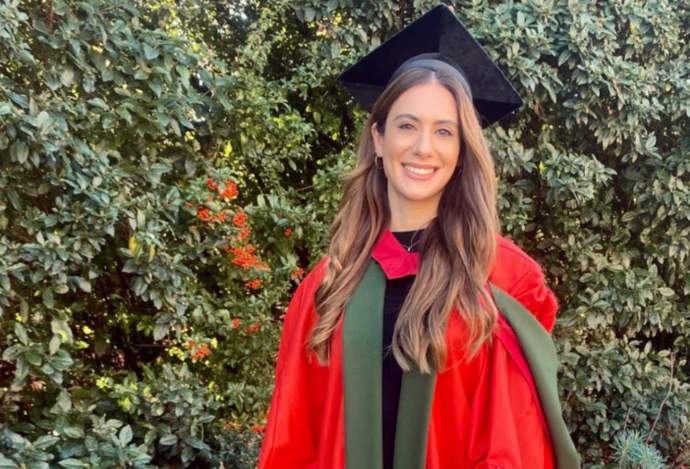
Meet Hughes Hall Research By-Fellow and applied economist, Dr Konstantina Maragkou.
Konstantina works with large-scale survey and administrative data to understand why some groups face systematic disadvantages and how policies can be designed or improved to create fairer opportunities for everyone.
“My research investigates inequalities in education and employment, combining policy-relevant questions with advanced quantitative methods. In practice, this means asking questions that are both rigorous and deeply human.”
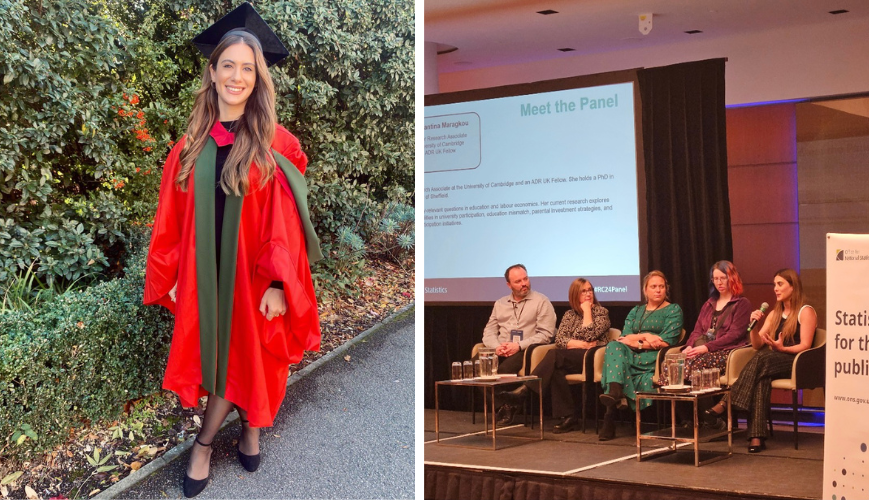
Konstantina is an applied economist specialising in quantitative methods and quasi-experimental research designs.
Background
I am from Cyprus, and I grew up curious about how social and economic systems shape people’s lives. This curiosity led me to move to the UK for my undergraduate studies in Economics at the University of Essex, followed by a Master’s in Applied Economics and Data Analysis. I quickly discovered that I loved combining numbers with real-world questions, finding patterns in complex data and thinking about how evidence can inform better policies.
I then moved to the University of Sheffield for my PhD in Economics funded by the Centre for Vocational Education Research. During this time, I began focusing on inequalities in education and employment, exploring why some people face persistent barriers and how policies can help level the playing field.
Soon after completing my doctorate, I joined Cambridge as a Research Associate. I later became a Senior Research Associate and now work as an Assistant Research Professor. Each step of this journey has strengthened my methodological skills and deepened my belief in the importance of research that can meaningfully influence people’s lives.
Current Work
My research investigates inequalities in education and employment, combining policy-relevant questions with advanced quantitative methods. I work with large-scale survey and administrative data to uncover patterns and causal relationships that can inform more equitable social and labour market outcomes. In simple terms, I try to understand why some groups face systematic disadvantages, and how policies can be designed or improved to create fairer opportunities for everyone.
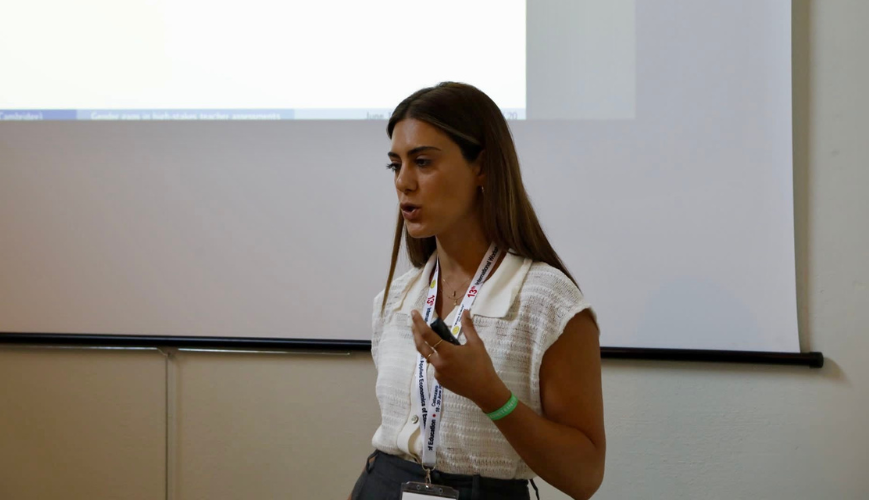
In practice, this means asking questions that are both rigorous and deeply human. For example, I study how socio-economic differences shape parental investment strategies and the consequences these decisions have on children’s educational outcomes. I investigate how teacher gender and religious-based biases may influence student performance, exploring how subtle forms of bias can ripple through a child’s academic and professional future. I also examine academic mismatch, when students are placed in schools or programs that do not fully align with their abilities, and how this can affect labour market outcomes. Finally, I evaluate the effectiveness of educational interventions designed to reduce these inequalities, helping to identify strategies that truly make a difference in young people’s lives.
Challenges
Completing my PhD during the Covid-19 pandemic was a unique challenge. By the time I moved to Cambridge in October 2021, much of the uncertainty and isolation of the earlier months had eased, but the effects of the pandemic were still very real, and adapting to a new environment while navigating this unusual context was not easy. Yet, being in Cambridge felt grounding. Even in those strange months, the sense of community, the intellectual energy, and the support of colleagues made me feel at home. It reminded me that research is not just about data and analysis, it is about people, curiosity, and collaboration.
Thoughts on Being Part of Cambridge and Hughes Hall
Hughes Hall has been central to my experience here. The College gives a real sense of home, a space where you are supported and encouraged to grow. One of my favourite experiences was during my first year as a research associate, when I attended a seminar with scholars from completely different disciplines. I was struck by how approachable and curious everyone was, people who are experts in law, art, philosophy, and science were all eager to discuss their work, listen to mine, and share ideas. It made me realise that Cambridge is not just about academic excellence, it is about fostering a community where curiosity thrives across boundaries.
The College is a place where brilliant minds are also everyday people. You can have dinner with someone who studies the latest economic models or someone researching medieval literature, and the conversation flows naturally from theory to personal reflection. That sense of openness, diversity, and intellectual engagement has been one of the most rewarding parts of my journey here.
Being at Cambridge and Hughes Hall is more than a career milestone, it is an opportunity to be part of a community that values curiosity, dialogue, and impact. It has shown me that the best research happens not in isolation, but in a space where people, ideas, and questions can meet and grow together.
16.3.26