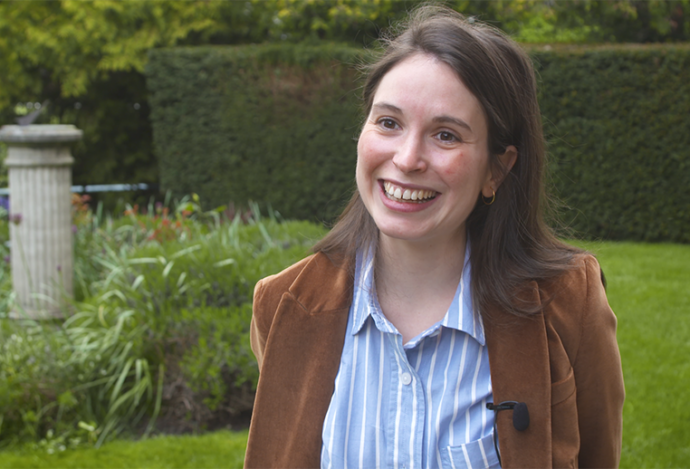
Dr Albajara Saenz is a Research Associate in the Department of Psychiatry and a Research By-Fellow at Hughes Hall.
Her current research project is looking at the outcomes and effectiveness of Mental Health Support Teams (MHST) in England to improve the support being provided to children and young people in schools.
These support teams comprise mental health professional working in schools and colleges to provide early intervention and support for children and young people with mental health difficulties. As these difficulties become increasingly common among children and young people, Ariadna hopes her findings will improve understanding of what works well in supporting mental health in school settings and identify areas where support could be strengthened.
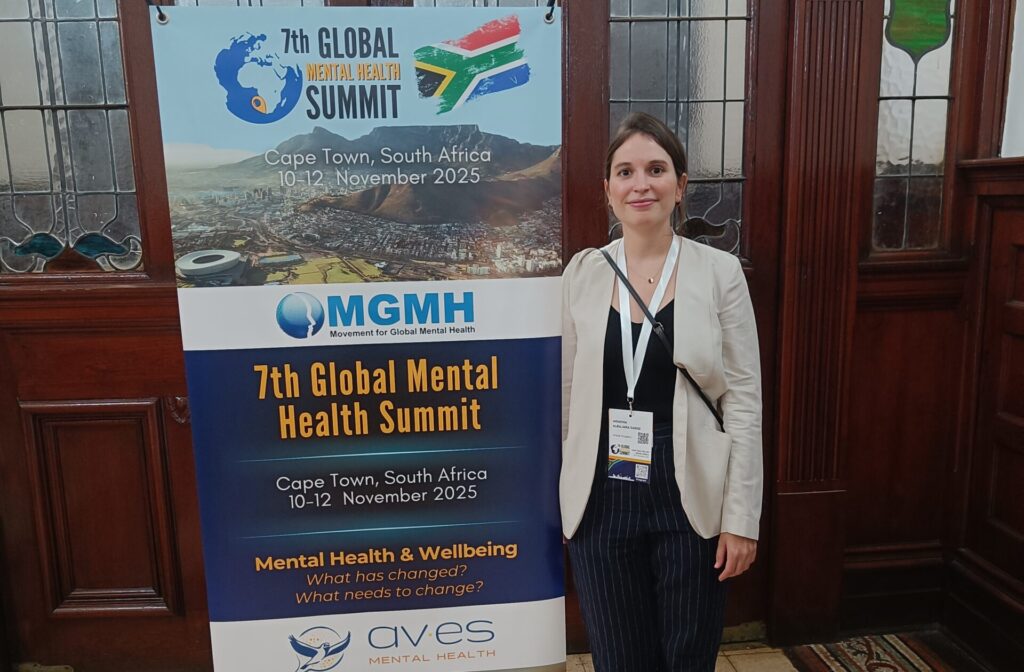
Dr Ariadna Albajara Saenz at the 7th Global Mental Health Summit in South Africa in November 2025.
Dr Albajara Saenz told us more about her background, current work and plans for the future.
Tell us about your background
I am originally from Spain and completed my Bachelor’s degree in Psychology at the Universidad Autónoma de Madrid. During my degree, I did an internship in Clinical Neuropsychology, which led me to pursue a Master’s degree in Neuropsychology at Université d’Angers, where I developed a strong interest in child neuropsychology. During my Master’s, I also completed an internship at the Fondation Ophtalmologique Adolphe de Rothschild, where I gained experience in neuroimaging research. These experiences led me to pursue a PhD in Psychology and Educational Sciences at Université libre de Bruxelles, where I explored the shared and disorder-specific functional and structural brain abnormalities associated with attention-deficit/hyperactivity disorder and autism spectrum disorder.
During the final months of my PhD, the COVID-19 pandemic hit and, like many others, disrupted my plans. However, I managed to secure a position as a Child Neuropsychologist at Erasme Hospital in Brussels. This experience made me realise the complexity of clinical cases, exposed me to the day-to-day needs of patients, and highlighted the critical role schools play in supporting children with conditions such as ADHD and autism. This became a turning point for me, as I decided to focus on research with direct practical applications.
Fortunately, I was awarded a Fondation Wiener-Anspach postdoctoral fellowship, which enabled me to join Professor Tamsin Ford’s group in the Department of Psychiatry at the University of Cambridge for two years. I then secured a Research Associate position, which allowed me to continue my work within the group, where I currently focus on projects related to school-based mental health interventions, SEND (special educational needs and disability) provision and children’s mental health in low-and middle-income countries.
What you are working on now?
My current research project is looking at the outcomes and effectiveness of receiving support from Mental Health Support Teams (MHSTs). MHSTs are teams of mental health professionals who work with schools and colleges in England to provide early intervention and support for children and young people with mild to moderate mental health difficulties. These were implemented, after being proposed in the Transforming Children and Young People’s Mental Health Provision Green Paper published in 2017.
This research project is a collaboration between the University of Birmingham and the London School of Hygiene and Tropical Medicine (LHSTM) and led by Professors Jo Ellins and Nicholas Mays. The work conducted at Cambridge is led by Professor Tamsin Ford, also a Fellow at Hughes Hall. Right now, we are currently finishing data collection and starting data analysis. For our qualitative study, we have spoken with children, young people and parents/carers receiving MHST support across 6 different sites in England to explore their experiences of support.
For our quantitative study, we are exploring whether children and young people who access MHST support report improved outcomes on quantitative measures. You can find more information about our work here: https://exploringmhsts.org/ .
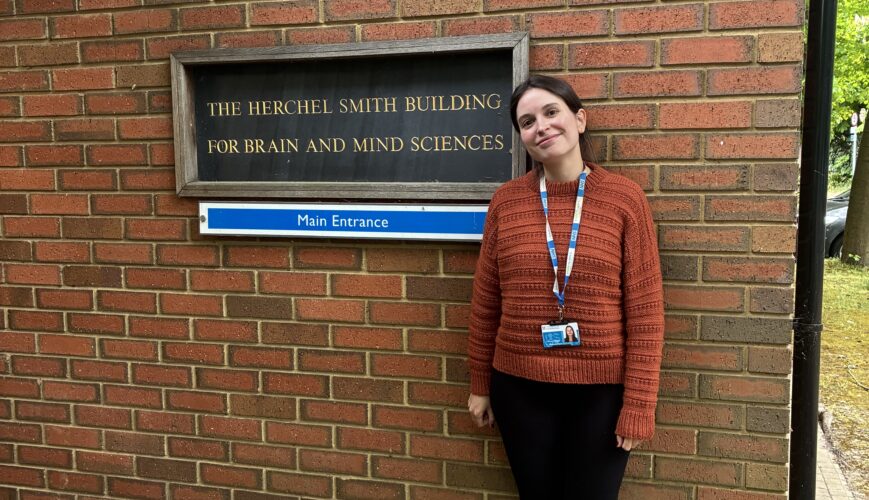
Dr Ariadna Albajara Saenz at her place of work, the Herchel Smith Building for Brain and Mind Sciences (wearing the jumper she knitted herself – a hobby that helps with maintaining her own mental health).
In addition to this, I have also been involved in a study using data from the Disrupting Harm project (https://www.end-violence.org/disrupting-harm), delivered by ECPAT International, INTERPOL, and the UNICEF Office of Research – Innocenti. Our study examined mental health and wellbeing indicators among internet-using adolescents aged 12 to 17 years across twelve low- and middle-income countries (LMICs) in Africa and Asia.
The findings provided important insights into the validity and use of a range of mental health measures among adolescents, as well as valuable within-country observations that may help inform and tailor interventions, policies, and future research on adolescent mental health to local contexts. The resulting paper was recently published in JCPP Advances (https://doi.org/10.1002/jcv2.70087).
What do initiatives like Mental Health Awareness Week mean for you?
This year’s Mental Health Awareness Week theme is “action”. In recent years, there has been a growing awareness of mental health, and more people are openly talking about it, which is very positive. However, it is essential that concrete actions are put in place to improve mental health support. This includes making support more accessible, reducing waiting times, and increasing investment in both services and research.
I believe that initiatives such as Mental Health Awareness Week are valuable in reminding us of the importance of mental health. However, as this year’s theme highlights, awareness alone is not enough and meaningful action is needed.
What are you plans for the future?
In the future, I hope to continue my research on school-based mental health interventions and children’s mental health across countries. One of my main motivations is to translate my findings into evidence-based practices and policies that contribute to improving children’s mental health, not only in England but also in other countries, such as Spain, my home country.
Click below to hear more from Ariadna on her work

And, tell us about your experience of Hughes Hall
Hughes Hall is a welcoming and inclusive college. During my years at Hughes, I have had the opportunity to present my research on several occasions in a supportive environment, participate in panels, showcase my work in news articles, and organise events such as the College’s International Women’s Day event. Hughes Hall has also supported me in attending conferences around the world, most recently the 7th Global Mental Health Summit in South Africa in November 2025.
Hughes Hall also offers many opportunities for networking and peer support. It has enabled me to strengthen my links with researchers in the Faculty of Education and has also introduced me to lifelong friends, for whom I am deeply grateful.
12.05.26