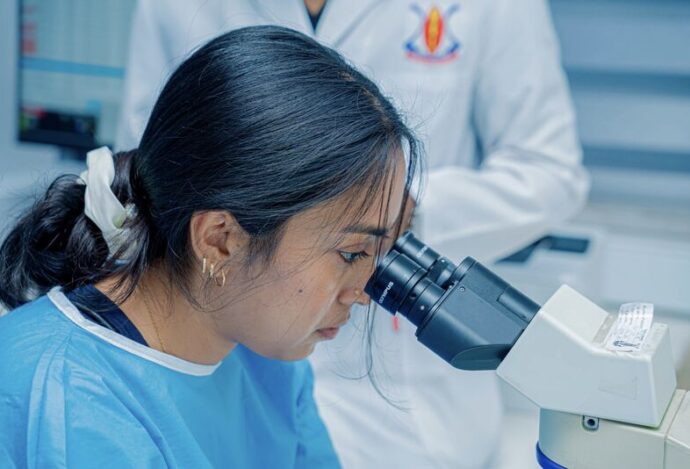
Dr Adiba Khan is a postdoc in the Department of Pathology working on paediatric endemic Burkitt Lymphoma.
Dr Khan moved to the UK from Bangladesh to do an Integrated Masters in Biomedical Science at Newcastle University and then went on to do a PhD in Cancer Sciences at the CRUK Scotland Institute, University of Glasgow.
Here she tells us about her journey to Cambridge, current research, and about the opportunity recently to further her work in Tanzania.
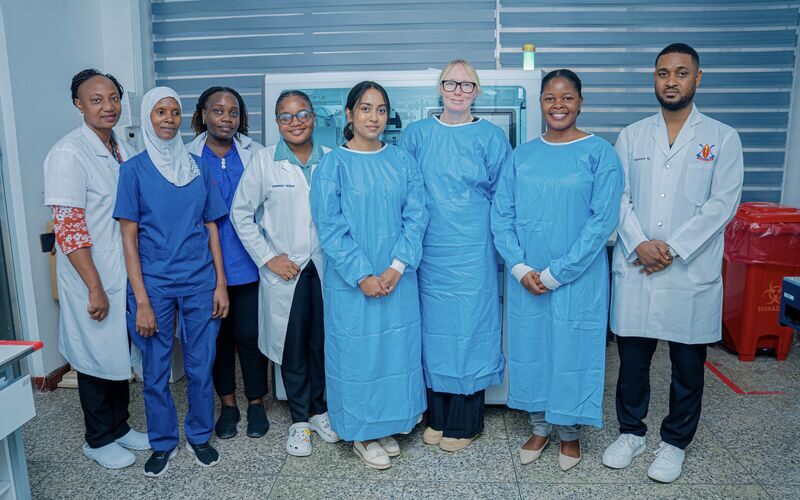
Dr Khan, centre, with colleagues from Cambridge with specialists from Tanzania’s Muhimbili National Hospital.
The journey to Cambridge
During my undergrad I wasn’t quite sure what I wanted my career to look like. I just knew I wanted to contribute to cancer research, especially having grown up around several close relatives who suffered from the disease. Luckily, for my third-year project I got into a very good lab working on breast cancer epigenetics. It was my first time in an academic research lab, and my supervisors were truly inspiring. They encouraged me to think independently and critically about my data, and I admired how they approached science and how they balanced their personal lives with the workload. I really enjoyed my time there, especially being able to follow my own curiosity to drive my research, and that experience is what made me decide to pursue a PhD and stay on the academic track.
As we all know, applying for a PhD in the UK is competitive, but it was even more challenging as an international student because funding options were quite limited. Fortunately, I was awarded a CRUK PhD Studentship, which allowed me to join the CRUK Scotland Institute at the University of Glasgow. My time in Scotland was very memorable and enriching. I loved the institute, the research, the people and especially the views of the Scottish Highlands from our lab windows.
In the third year of my PhD, however, the COVID-19 pandemic brought everything to a standstill, including my research, which was mostly based on in vitro and in vivo experiments. For months I couldn’t do any lab work. The upside was that the break gave me plenty of time to learn coding and upskill in bioinformatics. That ultimately helped me get my current postdoc position, since a big part of the work involves bioinformatics analysis.
Research focus
My current research at Cambridge focuses on understanding the genetic and biological vulnerabilities of endemic Burkitt lymphoma (eBL), an aggressive form of blood cancer that predominantly affects children in low-and middle-income countries (LMICs) such as those in sub-Saharan Africa. The prognosis for children who suffer from this in LMICs is quite poor, often due to the lack of both medical and financial resources in these settings, and coming from a developing country myself, I feel quite passionate about contributing to research that can make cancer diagnosis and treatment more accessible and equitable.
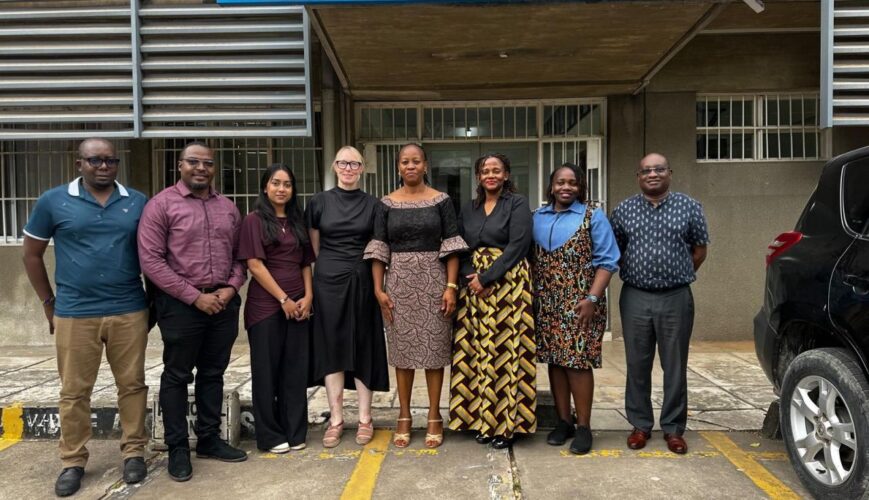
Dr Khan’s work in Tanzania includes with colleagues pictured from the University of Dar es Salaam, “reinforced that meaningful progress in cancer research depends not only on scientific discoveries, but also on working together, sharing knowledge and building strong partnerships across countries.”
My postdoctoral project began with a collaboration with the Uganda Cancer Institute (UCI), work funded by Little Princess Trust and Great Ormond Street Hospital, where we have now established a biobank of fresh, frozen primary tumour tissues. More recently, we have also started collaborating with partners in Tanzania, Nigeria, and we have just been awarded an Alborada-funded grant to set up a collaboration in Ethiopia.
Using the samples from UCI, I am developing laboratory models that allow us to study how eBL tumours grow and evolve in response to treatment. So far, we have successfully established a model by growing tumour cells from patients in mice. This allows us to study the cancer in a living system while preserving important characteristics of the original tumour. By using genetic barcoding to track individual groups of cancer cells, I hope to understand why some cells thrive, how tumours change over time, and which biological vulnerabilities could be targeted by future treatments.
Alongside this, I am also working towards developing an early cancer detection assay to improve diagnostic accuracy, reduce misdiagnosis, and support earlier diagnosis in resource-limited settings. Early and accurate diagnosis can make a significant difference to treatment outcomes, particularly in places where access to specialised diagnostic facilities may be limited.
From research to international partnership
In addition to my collaboration with the UCI, we have recently established a new research partnership with Muhimbili National Hospital in Tanzania, working with Dr Advera Ngaiza and her team. Earlier this year, I had the opportunity to visit Tanzania with my PI, Professor Suzanne Turner, as part of our Cambridge Africa Alborada Fund-supported collaboration.
A key focus of the visit was capacity building, where I trained local doctors and scientists in tumour sample processing, cryopreservation and biobanking to support future paediatric cancer research. We also visited the University of Dar es Salaam, where we met with academic colleagues to discuss opportunities for future collaboration and strengthen research links between our institutions.
For me, this experience reinforced that meaningful progress in cancer research depends not only on scientific discoveries, but also on working together, sharing knowledge and building strong partnerships across countries.
Being part of an impactful community
Being part of the Hughes Hall research community is a wonderful opportunity to connect with researchers from diverse disciplines, backgrounds and career stages. I really value the welcoming and supportive environment, which encourages the exchange of ideas, interdisciplinary collaboration and learning from one another’s experiences. As a researcher working on global cancer challenges, I find it particularly valuable to be part of a community that brings together people with different perspectives and shared ambitions to make a positive impact through their work.
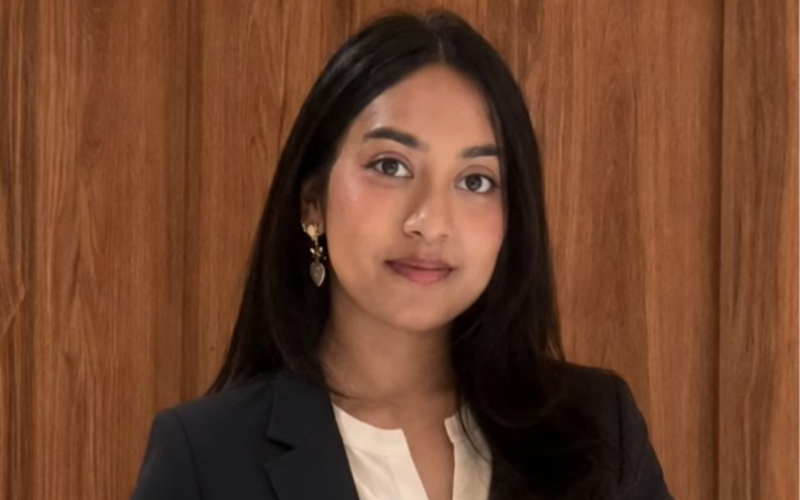
Being part of the Hughes Hall research community is a wonderful opportunity to connect with researchers from diverse disciplines, backgrounds and career stages.
What next
In the future, I hope to continue developing my research in cancer biology, with a particular focus on improving our understanding, diagnosis and treatment of aggressive cancers such as endemic Burkitt lymphoma. I would like to build on my current international collaborations to strengthen research capacity in LMICs and help translate scientific discoveries into practical solutions that can benefit patients globally.
Ultimately, my goal is to contribute to making cancer diagnosis earlier, more accurate and more accessible, while helping to reduce global inequalities in cancer care.
12.11.26