Ahead of the upcoming exhibition Maimonides from Scratch at the Manchester Jewish Museum, Dr Sonya Nevin discusses her latest work, and life as an ancient historian.
“Working on Maimonides from Scratch has been very rewarding. This is not the era that I usually work with and, for a Greek historian, it’s the other side of the Mediterranean! The project animation is called Maimonides the Healer.”

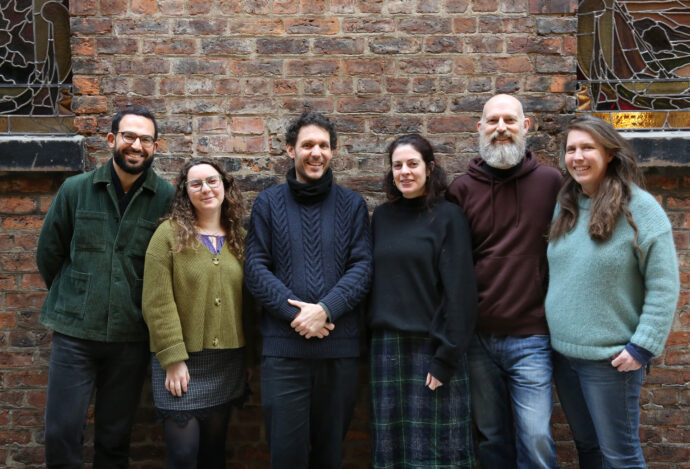
The research team (from left): Eliaou Balouka, Anoushka Alexander-Rose, Sami Everett, Anastasia Badder, Steve K Simons and Sonya Nevin.
Moses Maimonides
Maimonides (born 1135, Spain; died 1204, Egypt), a Jewish philosopher, jurist, physician and rabbi, was a central intellectual figure of medieval Judaism whose contributions in medicine, philosophy and religion have influenced countless scholars. Maimonides from Scratch is a showcase exhibition which brings to life the trajectory and texts of Maimonides, also known as the Rambam, as part of the historical and contemporary Sephardi world.
“The wider project explores how key themes from Maimonides’ life – movement, language, and encounter – connect to the experiences of Jewish communities today.”
It also seeks to broaden our understanding of his legacy by engaging with the Genizah (archive), where many of his documents were preserved, and by examining his use of Judeo-Arabic.

The showcase exhibition brings to life the trajectory and texts of Maimonides as a rabbi and doctor and as part of the historical and contemporary Sephardi world.
Shared learning
Maimonides is an important figure in many different communities. We learned from Melonie Schmierer-Lee at the University Library that seeing Maimonides’ own handwriting can be a very moving experience for some people. That said, we also discovered through a broad consultation that he is sometimes regarded as rather distant, austere even, perhaps because he is such a towering intellectual figure, particularly in religious and legal matters.
“Creating an animation that introduces him in a personable manner and shows a little of his life as a medical doctor has been a way of humanising him and making him more approachable.”
That creates a good starting point from which the animation can then communicate more about his inter-community significance and his medical legacy.
As part of turning what we’d learned about Maimonides into an educational resource, we collaborated with pupils at the King David primary school in Manchester and volunteers at the Manchester Jewish Museum. We had discussions about what they knew and wanted to know about Maimonides, about memory and storing knowledge, and about movement. The children made stop-motion animations on the themes of memory and movement; it was great to see how bold, creative, and inventive they were and how they took to the technical side of the task. The storyboard of the main project animation took shape through consultation from these groups who offered really insightful thoughts and feedback.
The project animation is called Maimonides the Healer. It will be shown in an exhibition at the Manchester Jewish Museum from 11th February until 24th June 2026. The exhibition will also include material about the planning and development of the animation, the King David’s pupils’ animations, material relating to medicine in the medieval Mediterranean, and a hands-on chance to imitate Maimonides’ handwriting.
Rewarding work in Cambridge
I’m an ancient Greek historian with a specialism in Classics education – teaching and otherwise communicating about the ancient Greek world. Around fifteen years ago I began collaborating with animator Steve K Simons making animations from ancient objects. The animations are informed by research and have an educational aspect.
“The University Library contains a phenomenal range of special collections, and Cambridge is very good at enabling opportunities for cross-pollination across specialities which helps with developing something really special.”
Maimonides from Scratch worked with The Taylor-Schechter Research Unit, which contains thousands of documents once stored in the Ben Ezra Synagogue in medieval Cairo. This includes real letters written to and by the medieval polymath Moses Maimonides. The project was an opportunity to communicate something about his life and about the genizah collection in a new way. The animation developed in the course of the project sees Maimonides writing one of his letters and we see that within the lesser-known context of his work as a medical doctor.
During the project, it has also been interesting to collaborate with specialists in the wider University and with their contacts beyond, particularly The Parkes Institute at the University of Southampton and the Manchester Jewish Museum. While I come from Classics education, the project also involves members of the Faculty of Divinity and Cambridge Interfaith Programme, the Faculty of Asian and Middle East Studies, and The Taylor-Schechter Research Unit at the University Library.
I work mostly with ancient Greek vases – our work is under the banner The Panoply Vase Animation Project, however we have begun to venture into other objects such as a Roman fresco, a Mesopotamian stone carving, and – recently – a medieval letter!
Being at Hughes Hall
I’m a By-Fellow at Hughes Hall, a tutor, and a supervisor for the Education degree. It’s great to be part of an academic community that on the one hand is very friendly and, on the other, is made up of people who are driven and excellent at what they do.
“I enjoy walking into College via the cricket pitch and seeing the great buildings lit up in the sunshine or standing out as a warm red glow in a wide grey sky.”
The depth of work on education in Hughes is particularly enjoyable; it’s inspiring and informative to hear what people are working on. I enjoy being a tutor and a supervisor too; students at Hughes are very dedicated and it’s great to help people on their journey.
Further information
- The exhibition is running at the Manchester Jewish Museum from 11th February until 24th June 2026.
- For more, see details of the exhibition.
- The animation’s online home is: Maimonides from Scratch.
3.2.26