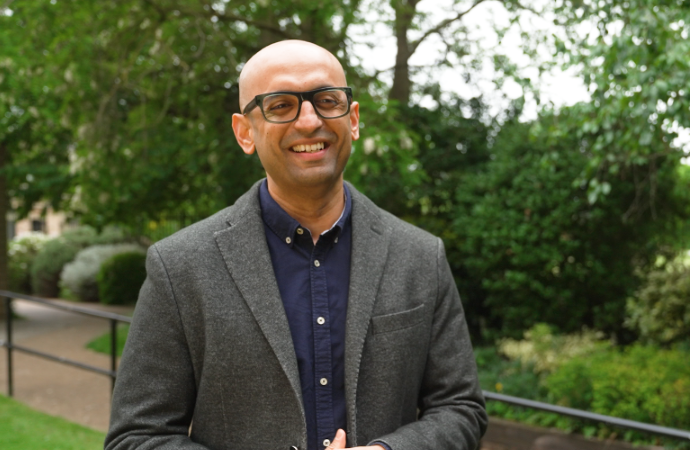
Hughes Hall By-Fellow and alumnus Dr Amit Bhave features in Startups Magazine discussing his innovative approach to building multi-sector resilience to a changing climate – and an early entrepreneurial leaning.
With an interest in problem-solving and entrepreneurship which started as a child in Mumbai, Dr Amit Bhave enjoys the change, challenge and potential of being an innovator.
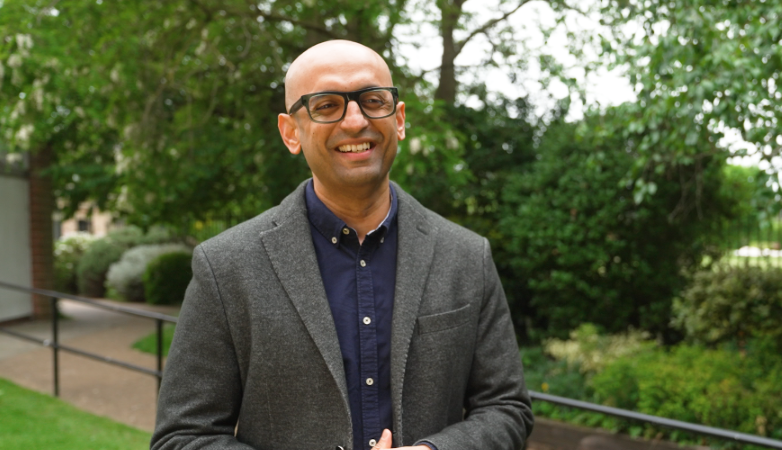
Dr Amit Bhave is a By-Fellow at Hughes Hall.
Dr Amit Bhave is working closely with Connected Places Catapult to develop a digital platform to boost infrastructure’s resilience to a changing climate.
“Rather than wait for a calamity to happen, climate simulations need to be run in advance to help inform effective mitigation strategies,” the digital entrepreneur says. “Connecting systems and networks allows us to be proactive, rather than reactive.”
Dr Bhave is the Chief Executive of Computational Modelling Cambridge (CMCL) which aims to “solve practical and complex problems, within and across sectors using digitalisation”. He is currently collaborating with Connected Places Catapult to develop a Climate Resilience Decision Optimiser (CReDO) into a market ready platform which identifies where added resilience may be needed to protect critical infrastructure from failure caused by extreme weather, such as extreme heat and flooding.
Dr Bhave’s focus is to help ensure dramatic natural events do not disable essential national infrastructure, or that a failed asset does not lead to a “domino effect” that cascades to other sectors. “It shows the importance of working in a connected way to mitigate these cascading risks,” he says.
Growing interoperability across sectors
CReDO is designed on a digital approach that Dr Bhave and his team call ‘The World Avatar’, which is seen as “a digital glue” that can be applied to link different systems, company departments and organisations in infrastructure, waste management and materials.
Dr Bhave says the main problem he and his company are trying to solve through the World Avatar is to bridge a “gap in connectedness” between different systems to solve emerging issues. “If information remains in silos – or is not accessible – the actions taken will suffer. Digital agents can wrap around existing solutions, and make them talk to each other,” he explains. He has led CMCL for 18 years, which started as a spin-out from Cambridge University focused on developing software for chemical industry and the automotive sector, in particular for low-carbon vehicles.
Seven years ago, the company became an “enabler of interoperable systems” to promote the benefits of a “connected mindset” among companies. Since its pivot, it currently turns over £1.45 million, and is seeing growth of around 20% a year.
Early signs of entrepreneurship
Dr Bhave was born in Mumbai, enjoyed mathematics and science, loved cricket and became interested in entrepreneurship while at school – fixing faulty fountain pens and selling them on. “I was always intrigued by trying to solve a problem, adding value and making money,” he says. “The solutions I used to offer were very much frugal hacks.”
He describes Mumbai growing up as a well-connected city with affordable rail travel, but acknowledges it can be considered “chaotic, because there’s so much going on”.
Dr Bhave recalls an early idea of giving commuters on trains access to laptops. “I distinctly remember imagining scenarios where I handed a laptop to every individual, to combine everyone’s efforts to solve practical problems.”
He considered developing an algorithm to work out the best places to plant trees beside rail lines to make Mumbai greener: but while his “crazy ambition” came to nothing, he is amused that today’s rail users have access to so much more information and compute, using mobile devices.
Dr Bhave studied Chemical Engineering, fascinated by India’s growing industrial capability in producing consumer goods, from toothpaste to paints. He went on to complete a Masters, which led to a work placement in Germany as an industrial chemist carrying out experimental research.
At the turn of the Millennium, Dr Bhave arrived at the University of Cambridge to embark on a PhD in computational modelling and chemical engineering, where he met Professor Markus Kraft, his supervisor and Co-Founder of CMCL.
The pair wrote a computer program aimed at reducing future fuel emissions. “We presented papers at conferences, and received interest from automotive manufacturers in Japan and Germany. That’s where my commercialisation and entrepreneurship bug kicked in.”
He received a scholarship to a London Business School-led programme on technology commercialisation and entrepreneurship in 2004. Dr Bhave also continues as a By-Fellow at Hughes Hall, Cambridge; experiences that he says have contributed immensely to his role as the CEO and Co-Founder of CMCL.
- Read more about Dr Amit Bhave’s work in the full Startups Magazine article.
- Original article courtesy of Mike Walter at Connected Places Catapult
22.11.26