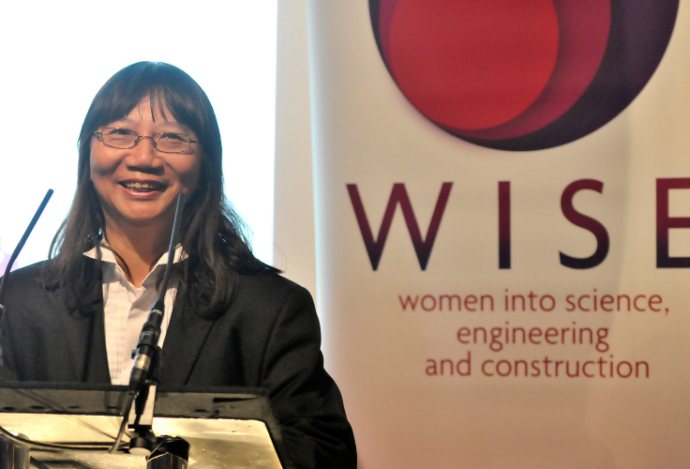
Dr Phebe Mann is an outstanding civil engineer, academic and judicial office holder – and an international role model for women in STEM.
For International Women in Engineering Day 2026, we spoke to Phebe about her influential and wide-ranging work, her commitment to engineering that can change women’s lives, and her advice to students.
Since qualifying as a Chartered Civil Engineer in 1999, Phebe has worked across highways, structures, surveying, dispute resolution and housing, giving her a broad view of the built environment and the people it serves. Her engineering career has not been confined to practice: she also has a foot in academia, currently holding a Visiting Professorship in Construction Law, Management and Engineering at Loughborough University.
Phebe is the first woman to hold seven professional qualifications concurrently in the UK: Chartered Civil Engineer CEng MICE, Chartered Surveyor FRICS, Chartered Construction Manager MCIOB, European Engineer Eur Ing, Member of the the Chartered Institute of Housing CIHM, Fellow of the Chartered Institute of Arbitrators FCIArb, Fellow of the Royal Society of Art FRSA, Fellow of the Higher Education Academy FHEA, the first female chair of the Chartered Institute of Building in Leicester. She inspires others to provide leadership and innovation in diversity.
She is also global STEM Ambassador, Talent2030 Hero, and was a Queen’s Young Leader’s mentor supporting women from commonwealth countries. She has been shortlisted as a Finalist in two categories (Allyship Champion of the Year and STEM Champion) in the Inspiring Women in Construction and Engineering Awards 2026.
In addition to her engineering career, Phebe trained in law and was called to the bar at Lincoln’s Inn in 2020. She now sits in several tribunal jurisdictions, which has provided her with a new setting in which she can apply her technical understanding in making decisions.
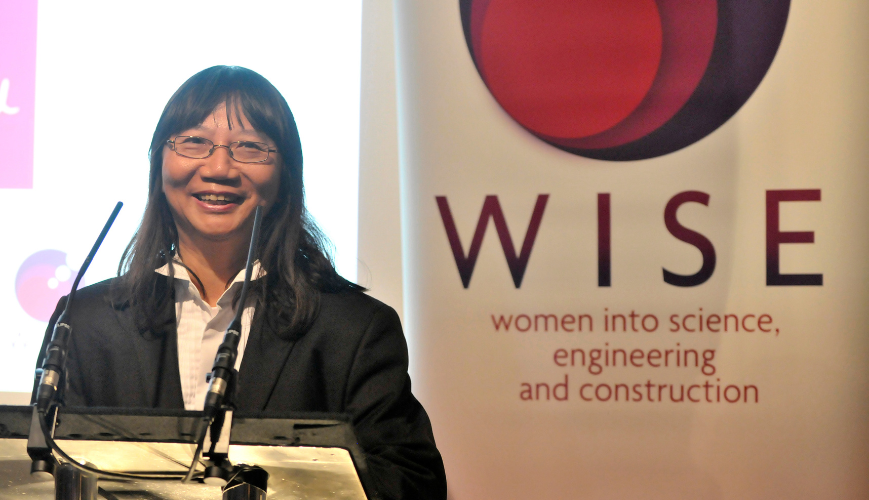
Phebe speaking at WISE (Women into Science and Engineering).
Inspired at Cambridge
My experience at Hughes Hall pursuing Computer Science was intellectually stimulating and personally significant because it reinforced the value of interdisciplinary thinking and the importance of widening access to professional pathways.
After my time at Hughes, I also took part in the Interdisciplinary Design for the Built Environment programme at the Cambridge Institute for Sustainability Leadership (CISL). This strengthened my belief that engineering is not just about technical competence but also about judgement, communication and service to society.
Being in an environment that encouraged mature reflection and cross-disciplinary exchange helped shape how I approach leadership, teaching and inclusion. It also deepened my confidence at navigating different professional worlds while staying grounded in the purpose of engineering.
Career development
My career developed in a fairly non-linear way, and I’ve found that to be one of its strengths. After my early engineering work, I contributed to major projects for organisations including Westminster City Council, Cambridgeshire County Council, and Atkins (now AtkinsRéalis). These projects ranged from strategic road schemes to complex urban works, including the A1(M) Alconbury to Peterborough and the A11 Stump Cross to Four Went Way.
I expanded into academia, teaching at several universities and later receiving recognition for my doctoral research on online collaborative design. Over time, I also developed qualifications and experience in law, arbitration and mediation, which have enabled me to bring engineering insight to tribunal work and governance.
I was really humbled to be one of the winners of the Top 50 Women in Engineering Award 2018.
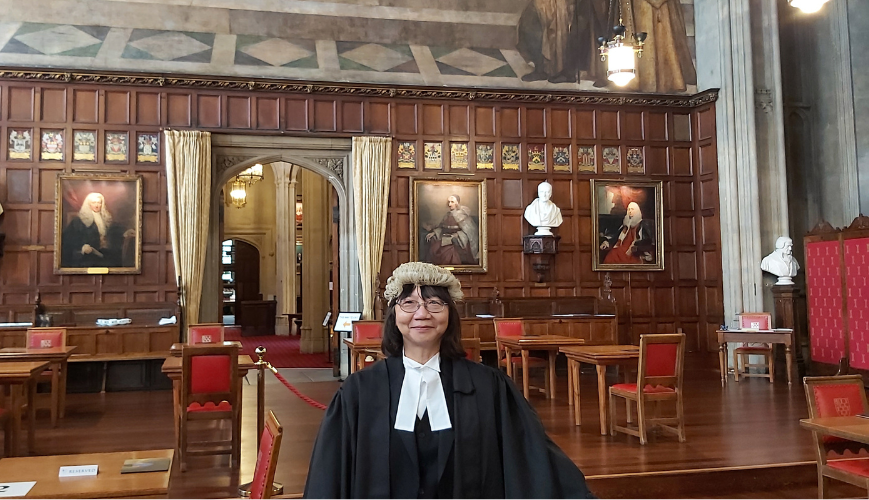
Phebe is also a trained lawyer and was called to the bar at Lincoln’s Inn in 2020.
What are you working on now?
At present, I am the Deputy Chair of Council at the Institution of Civil Engineers (ICE), where I steward knowledge, guide governance discussions and support the Institution’s learning society function. In this role, I also contribute to the ICE Learning Society Committee, helping to strengthen the link between expert panels, regional communities and wider engineering knowledge-sharing. Additionally, under ICE’s terms of reference, the President normally chairs the Council. If they are unavailable or conflicts of interest arise, the Deputy Chair will stand in as Council Chair, providing a non-executive voice and supports evidence-led decision-making.
Alongside that, I continue with academic work and tribunal duties, where my engineering background is valuable in cases involving transport, regulation, land and related matters. A consistent theme across all this work is making systems fairer, clearer and more inclusive.
Advice for current students
My advice would be to see engineering as a profession that needs both technical ability and human understanding. Don’t feel you have to fit a narrow stereotype, because there are many ways to succeed in the field and many paths into it. Seek experienced mentors, among whom I would be pleased to count myself, stay connected and take opportunities that stretch you, even if they seem slightly outside the expected route.
For female students in particular, your perspective is very much needed, and that diversity is not just about fairness: it leads to better engineering by bringing broader insights and better decisions.
My career has taught me that engineering can be a route to impact, leadership and inclusion, and that there is a space for many different kinds of talent in the profession. I am delighted to be regarded as an inspirational woman in Cambridgeshire highlighted on International Women in Engineering Day.
22.6.26