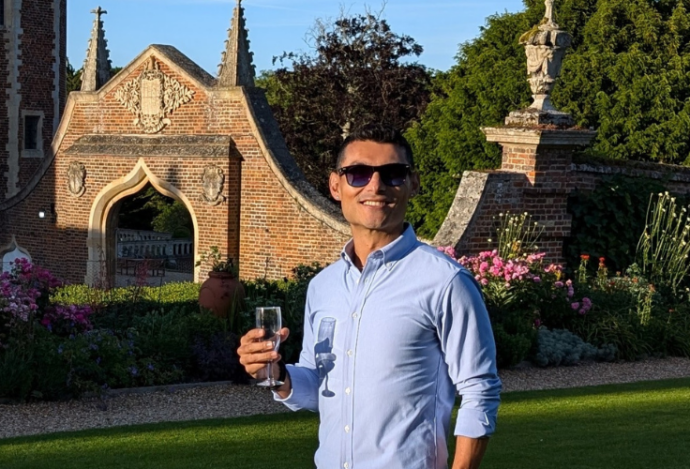
Héctor Pérez-Urbina (2023, MSt AI ethics and society) has a mission to “safeguard and promote human flourishing through the judicious use of technology”, resisting the loss of agency that can arise from dependency on AI.
We caught up with Héctor about the impact of his studies in AI ethics and his reflections on studying remotely for a part-time degree.
In the age of AI, Héctor is committed to ensuring that humans remain the architects of their own thinking, which he terms ‘cognitive sovereignty’. His public benefit company, Tlanextli Group, serves to spread awareness of the opportunities and risks of developing technologies to promote more informed and considered attitudes towards using them.
While working at Google Research, where his role was to foster responsible use of AI, Héctor decided to seek out a part-time Master’s degree on AI ethics.
“I have a DPhil in AI from Oxford, but I had never looked at the ethics side,” he says. “I realised I was lacking a lot of knowledge because I couldn’t understand some of the concerns I heard from people who had studied AI ethics. I thought they were too critical of technology and I didn’t see many of the flaws they pointed out. So I looked for a programme, and Cambridge had the perfect one.”
“Maybe technology isn’t always the right solution; maybe we need to look at things from another perspective sometimes.”
Tech goggles
“One of the most important things I learned from that Master’s has to do with something called ‘tech goggles’,” says Héctor. “We ‘technical’ people are made to look at the world in a specific way so that we can see problems that we can fix. In doing so, we tend to make things simpler and define a problem in terms of how technology can help. But maybe technology isn’t always the right solution; maybe we need to look at things from another perspective sometimes.
“I still have those tech goggles on because I’ve been wearing them for many years, but at least now I know I have them. I can now ask myself: ‘Is this really a technological problem? Is the way I defined the problem complex enough, or is it just a caricature of the problem, simplified so that it can be solved with technology?’”
It was this more open mindset which led Héctor down the path to setting up his own company after leaving his job at Google.
“I was really concerned with the problem of cognitive surrender,” he says, referring to the process of becoming passive consumers of algorithmic output, rather than active technology orchestrators.
“Even as a graduate doing a course on AI ethics, I felt really tempted to use AI too much to do my assignments. I really don’t think it’s responsible or realistic to simply ask young people to resist using AI in these ways. We need to look at the underlying incentives that make ‘cheating’ the rational choice. Also, what some may think of as cheating in a school environment would be rewarded in the tech industry or similar industries: using AI to solve a problem very quickly in an ingenious or novel way.
“I saw that there was a lack of guidance there and so decided to work on promoting cognitive sovereignty through judicious use of technology.”
Established in April 2026, Tlanextli (named from the Nahuatl word for light, illumination and the arrival of knowledge) partners with organisations and educational institutions to co-design and implement workshops, professional development experiences and other interventions to encourage more critical thinking about AI use and empower individuals not to forfeit their own mental agency.
Remote study
For the duration of his Master’s, Héctor was enrolled as a student at Hughes Hall, one of only four colleges offering membership to students of the MSt in AI ethics and society. This being a remote part-time course, with four residential weeks in Cambridge, Héctor spent only a brief time on site at Hughes Hall, remaining at his home in San Diego for the majority of his two years of study. Nonetheless, he was delighted by the ways that Hughes made him feel that he was a part of the community, even from afar.
“Even though I was here in San Diego and was only in College for a few days, I never felt excluded. I was always part of the gang: I got all the emails, I had someone to turn to for pastoral care, and I really liked receiving all that. I always felt that I belonged, and it was a really warm feeling.
“When I was in the UK, I always felt comfortable hanging out in College. I truly felt and still feel connected.”
14.9.26