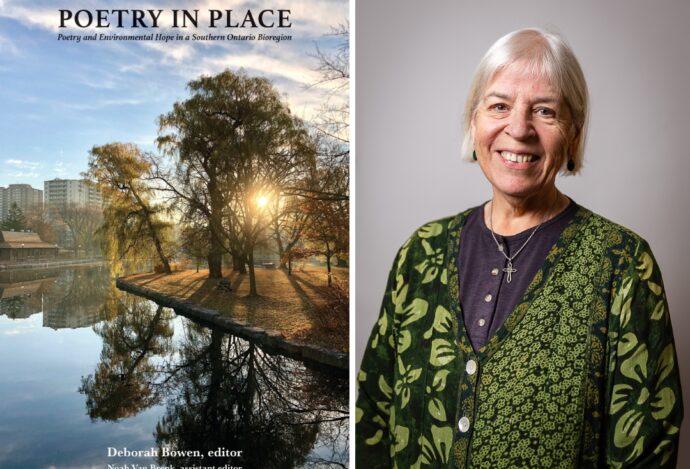
Deborah is chief editor of the anthology Poetry in Place: Poetry and Environmental Hope in a Southern Ontario Bioregion (Guernica Editions, 2025).
This collection includes poems by more than 40 contemporary poets who ask the question, in these days of climate disruption, “what is it that the land has to say to us?”
We spoke to Deborah about her experience editing the anthology and the role literature can play in sparking positive action against climate change.
Deborah’s time at Hughes Hall began in autumn 1970, after completing a BA in English Language and Literature at Somerville College, Oxford.
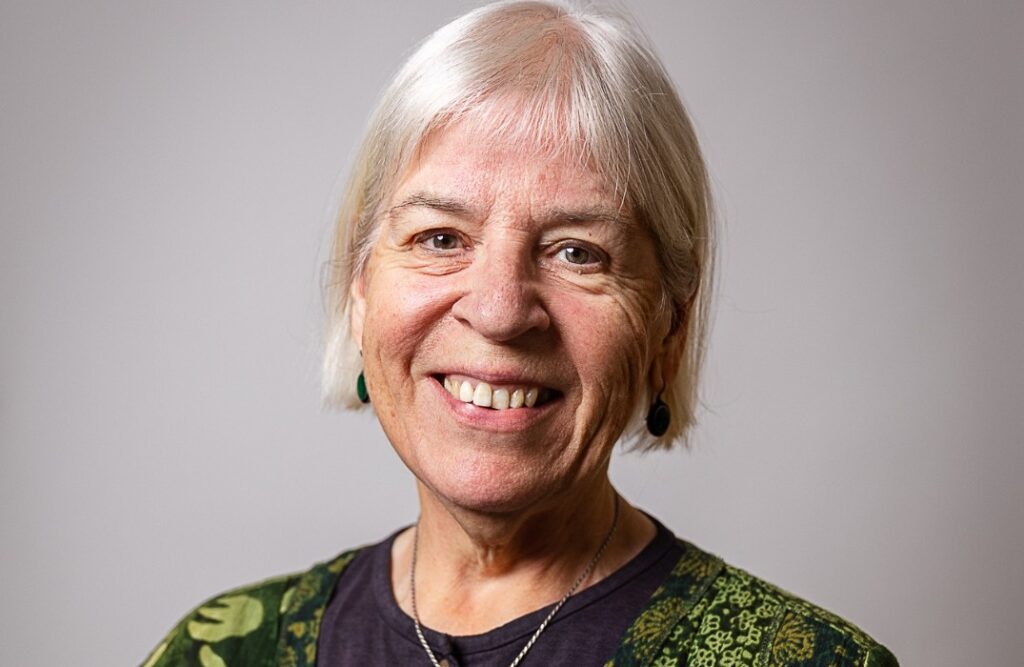
“I loved Hughes Hall. I was there only for a short while, but it was a friendly, energetic, and encouraging environment. I learned a lot about philosophies of education, classroom organization, and ways to be creative in teaching. I still have some of my textbooks from that time.”
My journey
“It was very neat to have an experience of studying at Cambridge as well as at Oxford! But I think I’ve only really appreciated what an incredible privilege both of these experiences were as I’ve gotten older.”
“I spent my teaching practice term at the North London Collegiate, a selective girls’ school in North London. I came away thinking I could teach quite well, and only in my first real job at a comprehensive school in Bristol did I realize that the NLC experience had been so lovely because the girls were so bright and eager to learn!”
After two years teaching in Bristol, Deborah and her husband moved to York where she taught undergraduates at the College of Ripon and York St John.
“I found that teaching undergraduates was much better suited to my temperament than teaching high school students, but I could use lots of the same techniques. I even got to supervise students on teaching placements, a task I hardly felt ready for, but enjoyed very much.”
After welcoming her first child, Deborah moved to Canada, where she completed her PhD at the University of Ottawa, continuing to teach undergraduates there and later at Université de Montréal. She then moved to Ontario to take up a permanent position at Redeemer University.
“In all these places I was always grateful for my background and experience through the Cert. Ed. At Hughes since many of my colleagues had no formal training at all in teaching.”
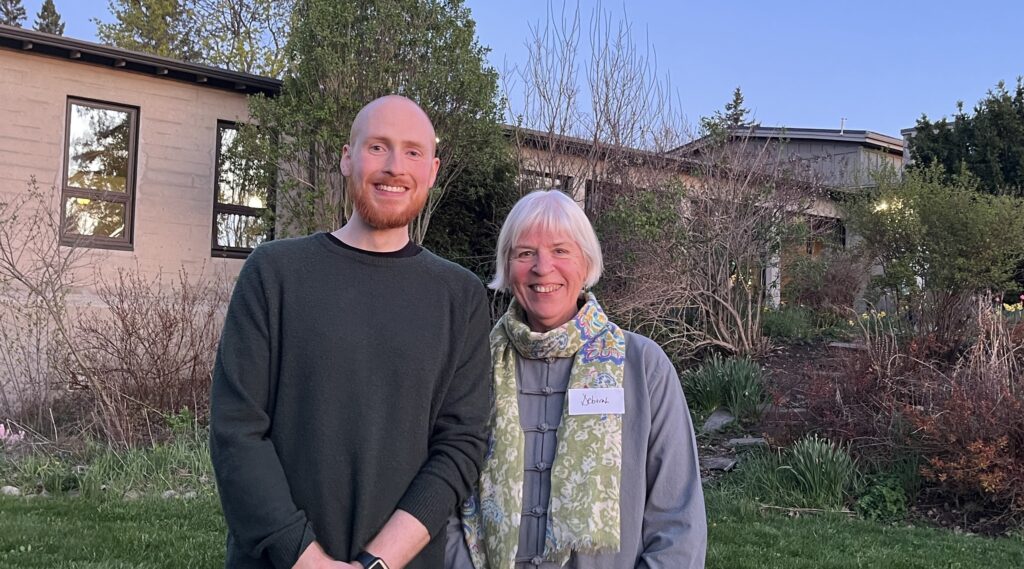
Deborah Bowen, the book’s editor, with Assistant Editor, Noah Van Brenk.
Poetry in Place
The idea for Poetry in Place came about when Deborah was asked to initiate a course at Redeemer University on ‘Literature and the Environment’.
“Teaching this course, I became increasingly aware that literature can open readers’ imaginations to seeing and hearing the environment anew. Gradually the idea evolved into creating an anthology of poetry about the local environment.”
“This area in southern Ontario, between the tip of Lake Ontario and the watershed of the Grand River, comprises very fertile land crisscrossed by the history of settler invasion and Indigenous marginalization, and despoiled by industry. Ecologically the area is unique in Canada as a zone where three distinct bioregions overlap. It happens also to be an area rich in creative writers.”
Deborah was fortunate enough to get a grant from the Social Sciences and Humanities Research Council of Canada to begin the anthology project. Over the course of five years, the project involved 43 poets, 6 illustrators and 5 student assistants.
“Collecting the poetry was a matter of word-of-mouth alongside advertising through writing groups and university writing programs; we were keen to involve not only White settlers from many different backgrounds but also Indigenous writers alongside Black and Asian poets who have settled here. All the poets were writing about and/or living in this geographical area. We interviewed all of them over Zoom during the Covid pandemic and included brief summaries of these interviews in the anthology.”
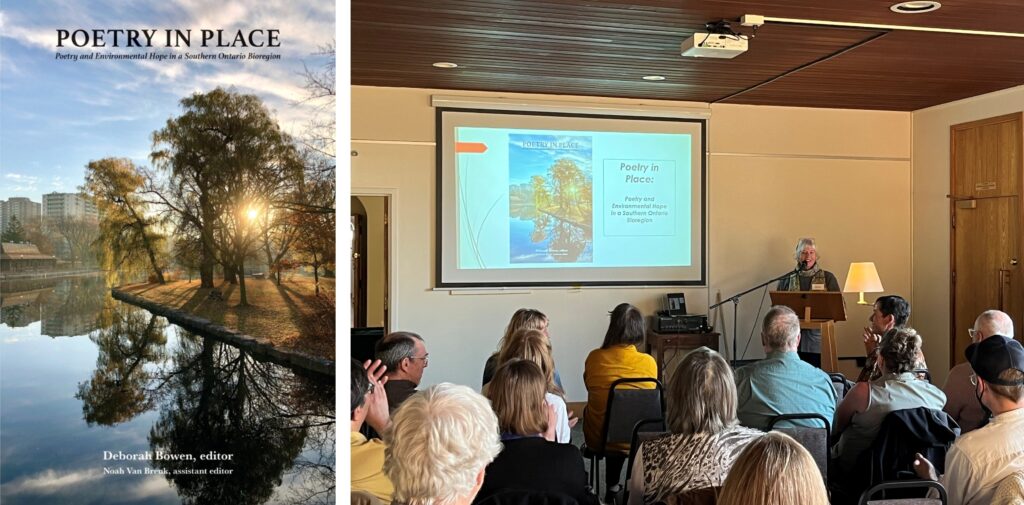
Deborah’s anthology ‘Poetry in Place’ alongside an image from one of the book’s local launches last year.
“In the interviews we asked each of them the same three questions, about their relationship to the land, their spirituality or other worldview, and their reason for writing poetry about the environment. The answers to these questions are, in my opinion, worth the price of the book.”
Deborah is a firm believer that poetry has power in inspiring action and change when it comes to tackling the problems that face the environment today.
“One of my graduate research assistants, herself an environmental scientist, liked to quote Robin Wall Kimmerer’s comment that ‘The data may change our minds, but we need poetry to change our hearts’. Her supervisor was Dr Madhur Anand, at the University of Guelph, both a poet and a scientist herself, who declares that ‘Poetry, like chlorophyll, is a catalyst for turning light into energy.’ These powerful statements have been backed up throughout the compilation of Poetry in Place, in the interviews as well as in the poems themselves.”
“Throughout the project, I kept returning to Robert McFarlane’s conviction in Landmarks that we need “a glossary of enchantment for the whole earth, which would allow nature to talk back and would help us to listen.”
“As the book reaches readers of many different kinds, it seems that that this poetry and these interviews are indeed working as catalysts of enchantment, to build environmental consciousness and to spur folks to action.”
With many thanks to Deborah for sharing insights and reflections on her work and career since leaving Hughes Hall.
- You can find out more about Deborah on the Redeemer University website.
- Find out more about the book or buy a copy: Poetry in Place: Poetry and Environmental Hope in a Southern Ontario Bioregion.
- If you’d like to feature in our ‘Meet our Alumni’ series and share your own work, please do get in touch.
25.2.26