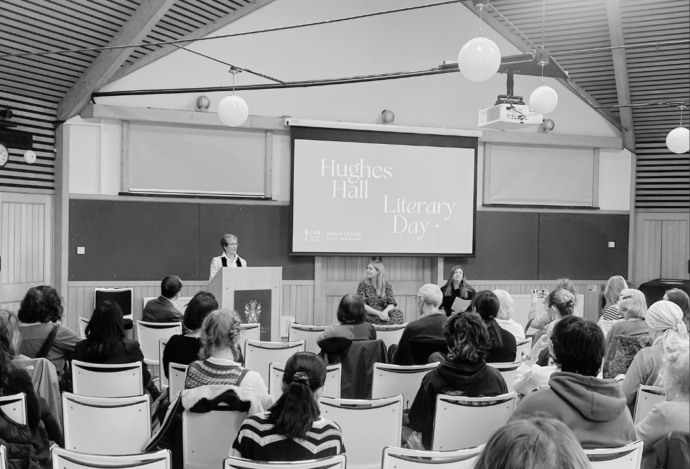
On 21 March 2025, Hughes Hall hosted its first ever Literary Day, as part of our 140th Anniversary celebrations.
140 people signed up to attend and watch eight incredible guest writers read and discuss their work.
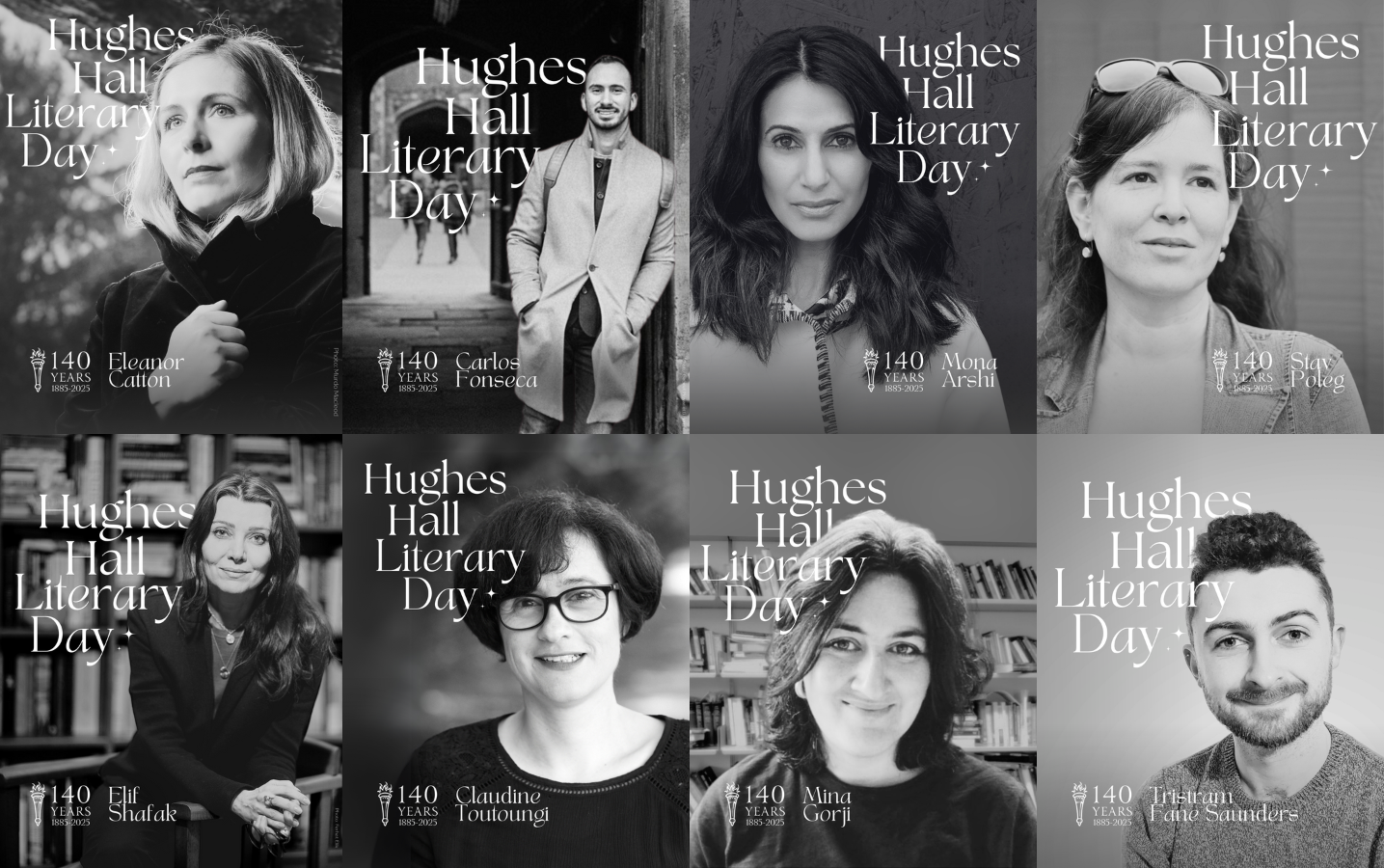
Photos by: Murdo Macleod (Eleanor Catton); Gabriel Piovanetti Ferrer (Carlos Fonseca); Ferhat Elik (Elif Shafak)
Recently at Hughes Hall we have hosted events considering some of the most pressing issues of the modern world – reflections on pandemic response, gender equality, and law and the climate crisis – and we have been lucky enough to be joined by some incredibly talented musicians for our Festival of International Artists. Hughes Hall Literary Day grew from a desire to expand this programme to include the art of writing in its many forms and genres with, as one attendee put it, “a real celebration of literature”.
From our founding as a women’s teacher training college to the present, Hughesians have worked at the forefront of key issues in education, conservation, health, justice, and more. To honour this history, we chose the theme of big questions and global issues. With such a broad brief, and such diverse writers, discussions were wide ranging, however, several themes coalesced naturally over the course of the day. From the first session, the speakers touched on environmentalism, the natural world, activism and burnout, online life, memory, what art can do, and how literature looks to the future. But in conversations like these which have complex and multifaceted answers, what is the role of art?
As was so beautifully put by our guest speaker Elif Shafak, literature “brings the heart into the conversation.” It opens us up to emotional experiences, it speaks to us in new voices and lets us look at things from fresh angles. Hughes Hall Literary Day was a celebration of this heart in all its forms – of art for beauty’s sake, for connection, as a way of posing questions and as a rallying cry. At a time of increasing political tensions and attacks on freedom of expression, reflecting on and making space for the arts remains vital.
There was a real buzz on the day. Heffers provided a well-stocked book stall, and attendees chatted to authors and had books signed in between events. The events themselves were lively, insightful discussions, each featuring guest writers in conversation with moderators who were themselves authors or academics. Whilst the sessions are impossible to recap in their entirety, here is a small taster of each event:
Eleanor Catton in conversation with Megan Hunter
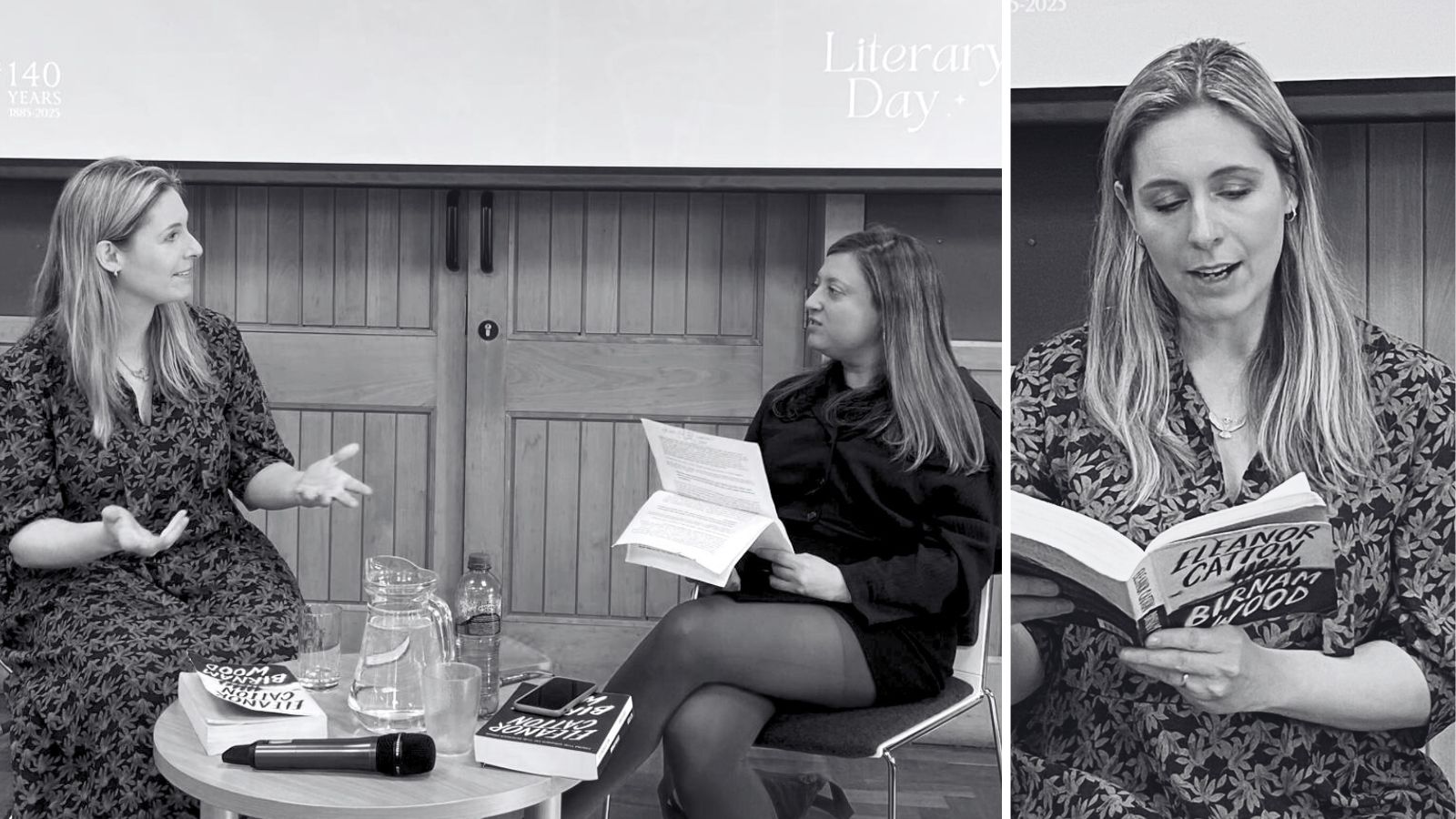
Eleanor Catton (left) in conversation with Megan Hunter (right); Eleanor Catton reading from her new novel. Photos by Catherine Jaskowiak.
Booker Prize winning author, Eleanor Catton kicked off the day reading from her most recent novel, Birnam Wood, which follows a group of environmental activists in contemporary New Zealand. Described by her publishers as an “eco-thriller”, Catton dug into what this means to her in conversation with Megan Hunter, Hughes Hall Senior Member and author of The End We Start From. Catton shared her thoughts on the craft of writing, particularly on writing tragedy with levity, and of writing a story in which all characters could be Macbeth and have their own Birnam Wood. It was important to Catton to write a sustained narrative in Birnam Wood. She said: “In the world of the social media scroll, which is so fragmented already, plot is the one experience you cannot find online.”
“It was simply wonderful to see Catton in action.” – attendee comments |
Carlos Fonseca in conversation with Adrian Poole
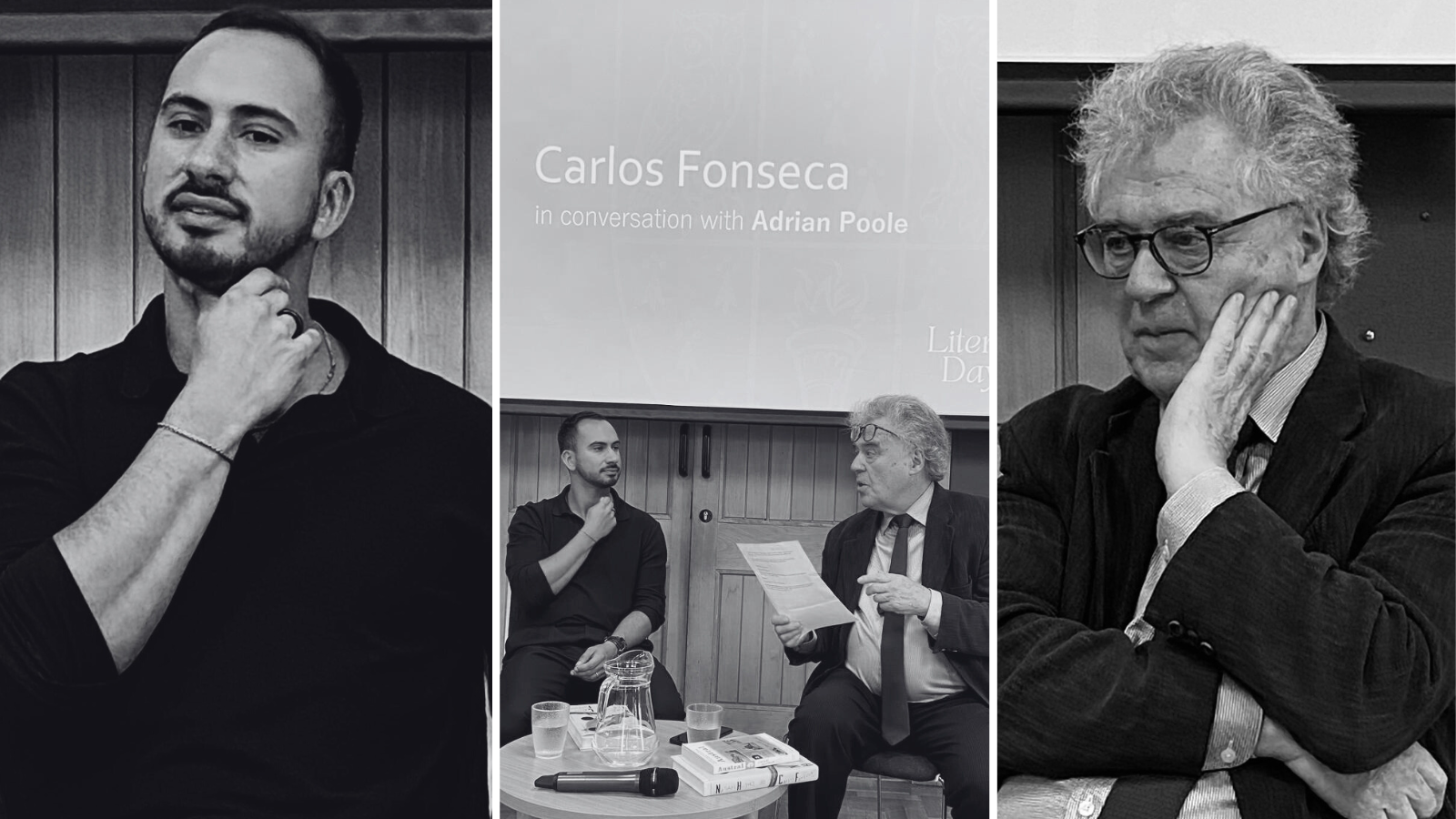
Carlos Fonseca (left) in conversation with Adrian Poole. Photos by Catherine Jaskowiak.
The second session began with a reading by writer and academic Carlos Fonseca, from his new novel Austral translated into English by Megan McDowell, followed by a conversation with Adrian Poole, Professor of English Literature. In an echo of some of the themes drawn out by Eleanor Catton and Megan Hunter in their conversation, Fonseca spoke about his interest in stories which betray the generic modes through which we make sense of the world: stories which are not simply a tragedy or farce, but which draw on elements from each. He highlighted a vignette from his book Austral in which the last speaker of a language refuses to cooperate with an anthropologist’s efforts to record it. Poole also noted Fonseca’s interest in visual images (an interest shared with poet Stav Poleg, who spoke later in the day about how her poetry is shaped by camera and film). They discussed how in online life there are too many images and too little context for those images. Drawing an analogy with captions, Fonseca said that, in his own writing, “the picture at the centre of what I want to say never appears,” a similar withholding to the interaction between the anthropologist and the indigenous speaker.
“A warm, thoughtful session, beautifully facilitated – Carlos spoke so elegantly about memory, legacy and storytelling” – attendee comments |
Elif Shafak in conversation with Burhan Sonmez
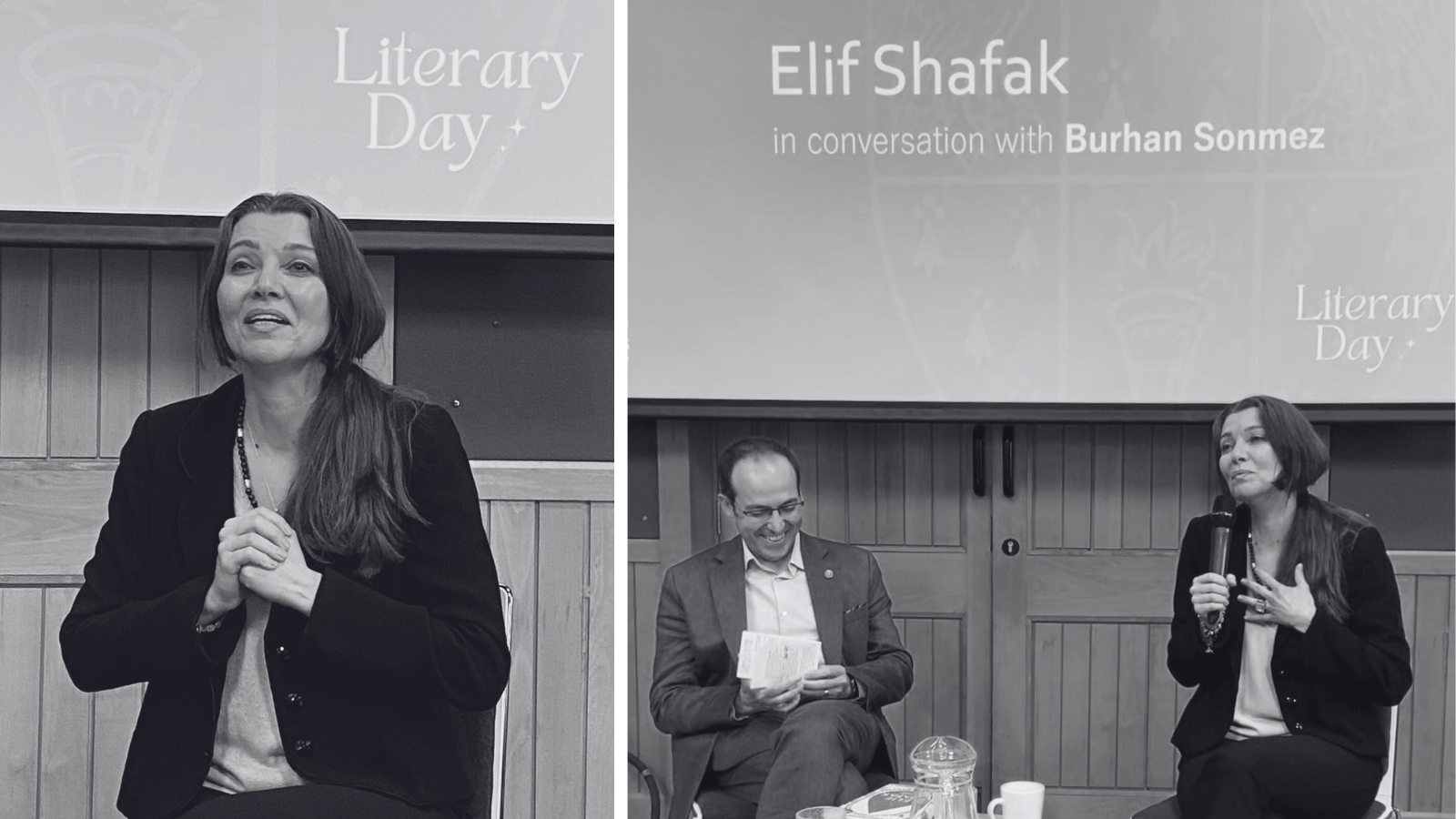
Elif Shafak at Hughes Hall Literary Day; Elif Shafak (right) in conversation with Burhan Sonmez. Photos by Catherine Jaskowiak.
Elif Shafak discussed her new book There Are Rivers in the Sky, a sweeping epic tracing connections between lives, joined together by the journey of a drop of water. The conversation was guided by the questions of Burhan Sonmez, Hughes Hall Senior Member and President of PEN International. Their discussions ranged from the names of her characters to Balkan culture and the real-life influences of her work.
In one of the most moving moments of the day, Shafak spoke powerfully about water scarcity and environmental degradation and their intersection with issues of conflict and gendered violence. Like the characters in her novel who exist across centuries and continents, they may not seem connected on the surface and are often treated as falling into separate spheres of enquiry or justice, but each is deeply affected by the others. When asked about what she hoped readers would find in her work, Shafak talked about compassion. She also noted how the form of the novel allows a multiplicity of voices (like Bakhtin’s polyphony) to hold plural conversations, leaving their conclusions up to the reader. As she put it, a writer’s “job is to ask the questions, not to give the answers.”
“I could listen to Elif Shafak talk all day.” – attendee comments |
World Poetry Day Panel
Claudine Toutoungi, Stav Poleg, Mona Arshi, Tristram Fane Saunders & Mina Gorji in conversation with Alexis Willett
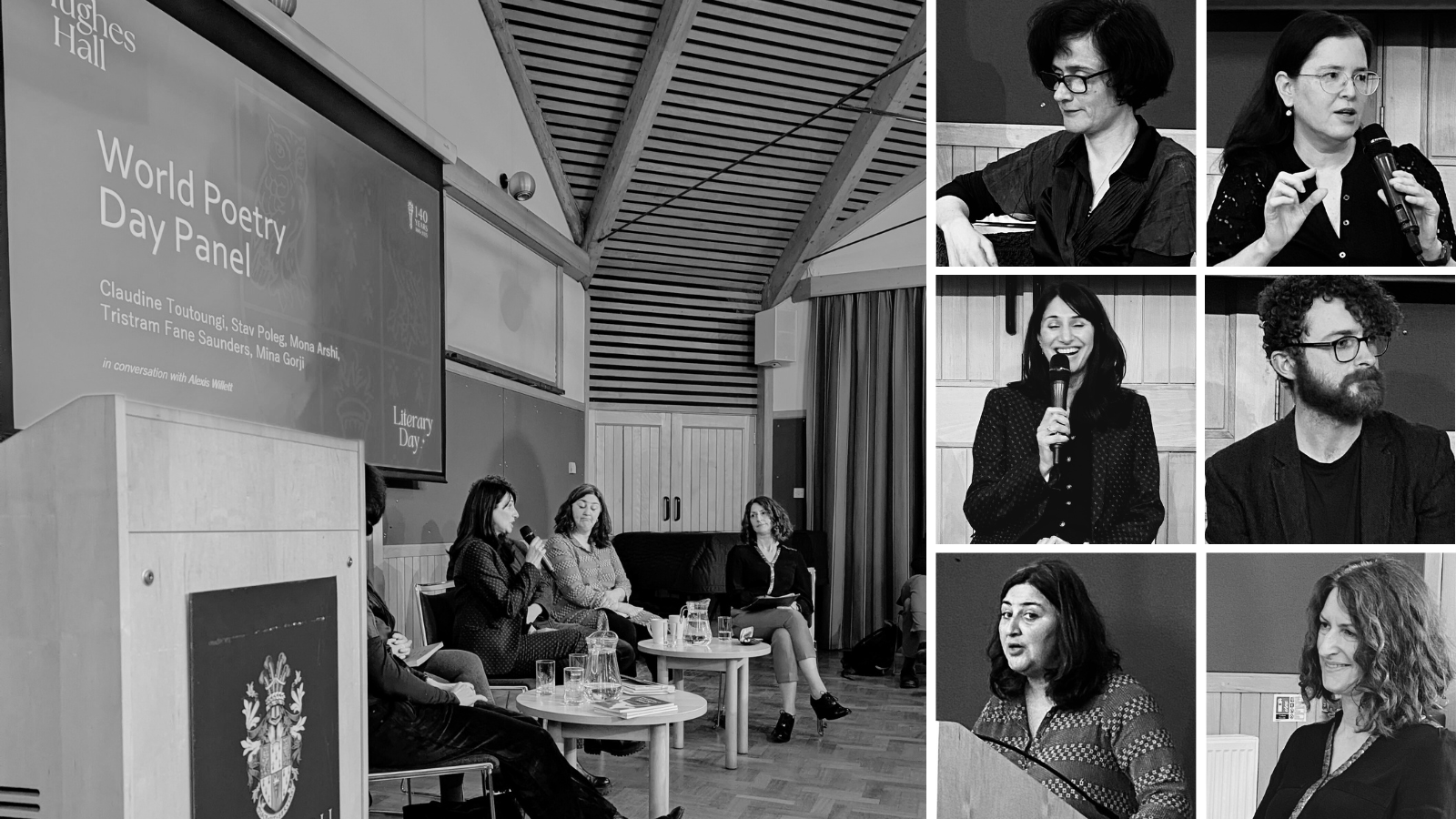
World Poetry Day Panel; Claudine Toutoungi, Stav Poleg, Mona Arshi, Tristram Fane Saunders, Mina Gorji, Alexis Willett (from left to right, top to bottom). Poets photographed by Catherine Jaskowiak.
The final session of the day was our much-anticipated World Poetry Day panel, featuring a line up of five very different poets. Each poet gave a reading including the real treat of performances of new and unpublished work by some of the panel, followed by a Q&A with the panel moderator, Hughes Hall Senior Member Alexis Willett, and then an audience Q&A. First to read and opening the panel with energy and humour, was Claudine Toutoungi who shared a poem from each of her three published collections, finishing with ‘We couldn’t get the parts to write this poem’. She was followed by Stav Poleg, who read two poems including her twisting philosophical sestina ‘Two Pictures of a Rose in the Dark’, and Mona Arshi, who read from her first collection Small Hands in honour of its tenth anniversary. Tristram Fane Saunders gave a fantastic performance of a new poem, written since being in Cambridge as Fellow Commoner in Creative Arts at Trinity College. The readings closed with Mina Gorji’s peaceful and understated reading of several poems from her two collections Art of Escape and Scale. The panel is best summed up in the comments of one attendee:
“The poets’ session was a highlight – great performances across a range of genres, providing a wonderful contrast of styles and emotional impact” – attendee comments |
With thanks to
- Our speakers: Eleanor Catton, Carlos Fonseca, Elif Shafak, Claudine Toutoungi, Stav Poleg, Mona Arshi, Tristram Fane Saunders and Mina Gorji.
- Our moderators: Megan Hunter, Adrian Poole, Burhan Sonmez, Alexis Willett.
- Other senior members: Annemarie Young, Nidhi Singal, Sonia Ilie.
- As well as enormous thanks to Hughes Hall Operations, Conference & Events teams and to the Heffers book stand.
1.4.25