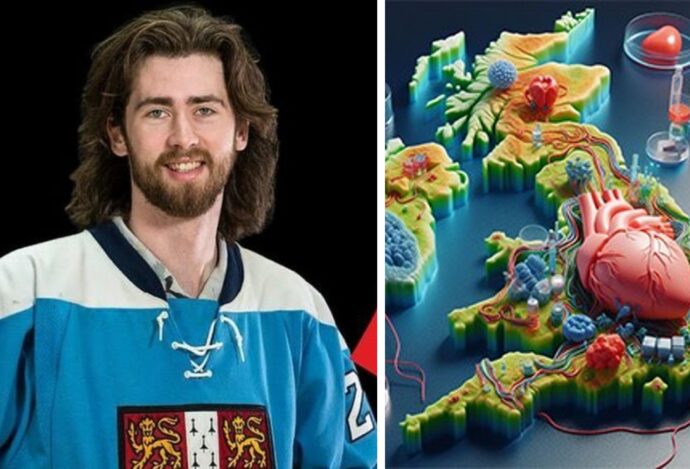
Engineer and ice hockey ‘star’, Jack Murphy, publishes review on ‘Biofabrication and biomanufacturing in Ireland and the UK.’
As we navigate the transition from the Fourth to the Fifth Industrial Revolution, the emerging fields of biomanufacturing and biofabrication are transforming life sciences and healthcare.
These sectors are benefiting from a synergy of synthetic and engineering biology, sustainable manufacturing, and integrated design principles. Advanced techniques such as 3D bioprinting, tissue engineering, directed assembly, and self-assembly are instrumental in creating biomimetic scaffolds, tissues, organoids, medical devices, and biohybrid systems. (click here for the full paper)
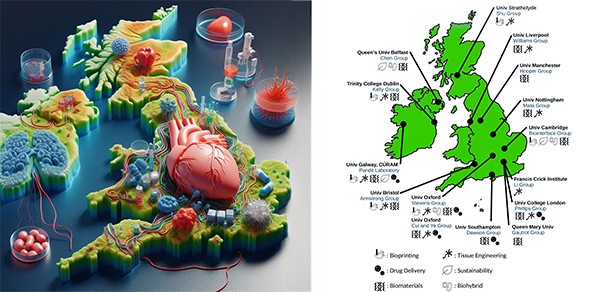
LEFT: Graphic abstract generated with Microsoft Copilot AI. RIGHT: A non-exhaustive regional breakdown of biomanufacturing and biofabrication groups from around the UK and Ireland as of March 2024.
We caught up with Jack to learn more.
What got you interested in your subject and what was your path to a PhD?
I was lucky to be introduced to academic research at a young age through a program my high school had with a nearby medical school. The lab I worked in was studying how engineered heart tissue could be used to model the effects of stem cell therapies on cardiac function. It was fascinating work, and it sparked my interest in research.
From there, the path to a PhD felt like a natural progression. I pursued an undergraduate degree in Biomedical Engineering at Trinity College Dublin and did part-time research in a lab during my studies. That experience solidified my desire to continue doing research, so I applied to PhD programs. I found a great fit at Cambridge, where I could continue to focus on lab-based models for studying cardiovascular disease.
Can you explain, to a lay audience, the importance of your research?
My research focuses on improving lab-based models for cardiovascular disease, which is the leading cause of death worldwide. One of the biggest challenges in developing new treatments is being able to predict their effectiveness before going into expensive and time-consuming clinical trials.
The current models we use—like 2D and 3D cell culture platforms or animal models—have significant limitations. Animal models, for example, often fail to translate to humans because of species-specific differences. Cell culture models, on the other hand, struggle to keep heart muscle cells mature and functional in the lab.
My research aims to overcome this by developing systems that can keep heart muscle cells in culture for long-term studies while maintaining their structure and function, just as they would in the human heart. If successful, this could lead to more accurate disease modelling and better drug-screening methods, ultimately accelerating the development of new treatments for cardiovascular disease.
What do you hope to do in future?
In short, I don’t know. Right now, I am focused on making the most of my PhD research and enjoying my time at Cambridge. I’m keeping an open mind about where my work might lead me—whether that’s continuing in academic research, exploring industry opportunities, or something else entirely. For now, I’m just excited to keep learning and growing in the field.

Jack won the Sports Club Personality ‘Personality of the Year’ award in 2024, as part of the Cambridge University Ice Hockey Club.
Are you involved in anything else outside of your research at Cambridge?
Being part of the Cambridge University Ice Hockey Club (CUIHC) has honestly been one of the highlights of my time at Cambridge, and I think most people in the club would say the same! Getting on the ice gives me a break from being a PhD student and lets me just have fun playing a game I’ve loved since I was a kid.
People often see balancing sports and studies as a challenge, but I’ve found that playing sport helps me stay focused and productive in my research. I’d encourage everyone at Cambridge to get involved in a sport, whether it’s at the College or University level—it’s a great way to meet people, stay active, and most importantly, have fun.
For more details about Jack’s recent publication, visit the Department of Engineering news page.
To read the article in the journal, ‘Bio-Design and Manufacturing’, click here.
4.12.24