Turning ecosystem potential into action: how regions move from plans to delivery with IPIP
“Across many regions, the challenge is not a lack of ideas, but a lack of execution. Innovation strategies are in place, institutions are active, and funding is often available – yet ecosystems remain fragmented and opportunities underexploited. This pattern is consistent across both emerging and advanced economies.” said IPIP Director, Dr Wojtek Wojaczek.
This was the starting point for the Innovation Policy Ignition Programme (IPIP) at Hughes Hall, University of Cambridge.

The IPIP team with the Programme cohort from Serbia and Silesia, at Hughes Hall during the residential.
Here, Dr Wojaczek reports back on recent success in Serbia and Silesia, in Poland.
Unlike traditional programmes focused on analysis or policy design, IPIP is built around execution. It brings together regional leaders from government, academia, and industry to develop and rigorously test practical action plans. The emphasis is simple: what can be implemented, by whom, and within existing institutional constraints. As one participant noted, “IPIP brought execution, structure, and a real focus on delivery.”
Dr Alexis Willett, Chair of the IPIP Advisory Board, reflected on this achievement: “Over the last nine months, we’ve seen the Innovation Policy Ignition Programme mature from a conceptual framework to a rich, living initiative that has sparked concrete action plans from multisector collaborations to drive regional economic growth. As IPIP opens to other regions around the world, we’re excited to see what extraordinary ideas and commitments will emerge and the real-world impacts these will have.”
The pilot cohort brought together teams from Serbia and Silesia (Poland) – two regions with different starting points, yet similar structural challenges. Across both, participants identified fragmentation, limited coordination, and weak pathways from innovation to market. Despite their different contexts, the underlying issues were strikingly similar. As one participant reflected, “We all face similar challenges, but from different viewpoints.”
What emerged were not high-level recommendations, but focused, testable interventions.
In Silesia, one team addressed what they described as “navigation paralysis” within a complex ecosystem. Despite a high density of companies, universities, and intermediaries, coordination remained limited. Their response was a regional collaboration platform – a “service desk” model connecting startups, corporates, and research institutions, reducing friction and enabling more effective partnerships.
In Serbia, a team developed a corporate–startup “Commercialisation Sprint,” a structured 90-day programme in which corporates define specific challenges and work directly with startups and university teams towards tangible outcomes. The model creates a clear path from innovation to commercial application, an area where many ecosystems struggle.
A defining element of the programme was the first IPIP Cambridge residential, held at Hughes Hall from 2–4 March 2026. Over three days, the teams presented and stress-tested their initiatives in a structured setting. Assumptions were challenged, ideas simplified, and ownership clarified. The focus was consistently on execution. As one participant put it, “This was the first time we stepped outside our own institutional bubble and saw the ecosystem as a whole.”
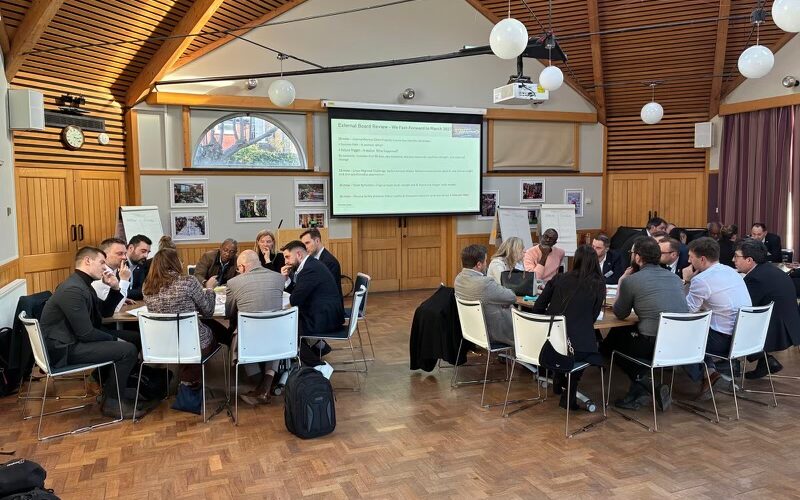
The residential also offered space for exchange – participants engaged with mentors, academics, and practitioners from the Cambridge ecosystem, gaining exposure to its collaborative and open culture.
Conversations continued beyond the sessions – over dinners and informal gatherings – helping to build trust and strengthen relationships. For many, this was an important part of the experience, combining practical challenge with genuine inspiration.
Early signals of implementation are already visible. Institutions have begun committing to pilot initiatives, corporate partners are engaging as mentors, and universities are preparing to scale new activities. More importantly, teams have shifted from discussion to delivery – working across institutional boundaries and building relationships that did not previously exist.
The experience of Serbia and Silesia points to a broader insight: most ecosystems do not lack ideas or resources – they lack mechanisms for coordinated execution. IPIP provides a structured environment in which regional teams align stakeholders, test interventions, and move towards implementation. The model is designed to be transferable across different institutional and economic contexts.
As the programme enters its next phase, attention turns to implementation on the ground. The longer-term value will be determined not by the quality of the plans developed, but by their ability to deliver tangible impact – through new collaborations, stronger institutions, and more effective pathways from innovation to market, while maintaining a socially inclusive approach.
In Silesia, this includes early-stage interventions focused on education, such as a pilot initiative working with primary and secondary schools to foster innovation awareness, creativity, and entrepreneurial thinking. By engaging teachers, schools, and local ecosystem actors, the initiative aims to build a more inclusive and future-oriented talent pipeline, ensuring that innovation capacity develops not only within institutions, but across society.
The Programme is now exploring opportunities to support new regions in its first full cohort. For more information, please see below.
Further information
Our Innovation Policy Ignition Programme supports regional governments in designing adaptive, high-impact entrepreneurship and innovation action plans. The Programme aligns academia, industry, and investment to accelerate regional transformation. Its core aim is to drive sustainable economic growth and enable inclusive innovation.
19.3.26