Hughes Fellow, Jane Mann, leads the team at Cambridge University Press & Assessment that is working with partners across the world to change the lives of children – and societies.
Jane and her team are on a mission: to transform lives through education. They draw on knowledge, research and networks across the University and work with ministries of education and international development organisations to improve the quality of education systems.
“We can change lives by improving education so everyone has the skills they need to achieve their goals and find their place in society,” said Jane Mann, Managing Director of the Partnership for Education and Education Director in the International Education Group at Cambridge University Press & Assessment. “To do this, we pair the vast experience available across Cambridge with local expertise to effect large-scale, systemic change to education practices, for the benefit of all.”
Jane is a Governing Body Fellow at Hughes Hall, bringing her know-how and networks to the research translation and impact programmes at Hughes Hall.
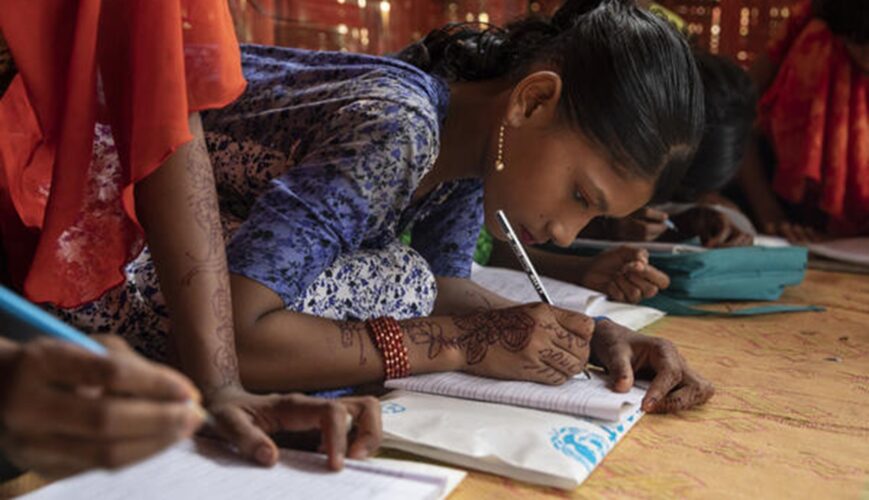
“We can change lives by improving education so everyone has the skills they need to achieve their goals and find their place in the society”
Work with governments around the world
The change being made by Jane’s team at Cambridge is clearly demonstrated through some of their most recent programme updates showing how, together with partners, they are transforming education systems – and children’s lives. For example:
- Working with Lebanon-based NGO Alsama Project on a new school-leaver qualification to help refugees and displaced youth access university, training and jobs worldwide.
- Developing a modern curriculum and assessment system for Uzbekistan with the national government and UNICEF that will improve learning for 8.8 million children and developing new curricula to train teachers that match the changes.
- Running a Digital Education Leadership Programme with UNICEF and the Global Partnership for Education to support government leaders to make education more inclusive, equitable and effective for all
To provide an overview of all their work – from maths and science teaching in Oman to national assessments in Singapore – they recently published their first impact report.
One of the stories highlighted in the report is Cambridge’s work with UNICEF to support children in the Rohingya refugee camps of Bangladesh.
Educating children in the Rohingya refugee community
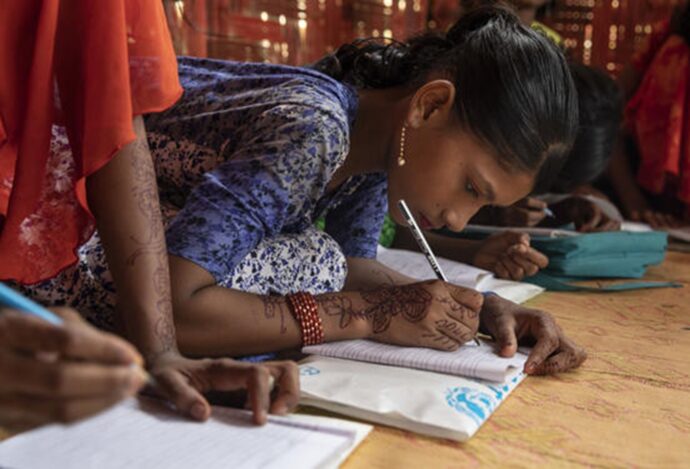
From 2019 to 2025, Cambridge worked with UNICEF and local teams to improve teaching and learning for children in the Rohingya refugee camps of Bangladesh.
The displacement of more than one million Rohingya people from Myanmar since 2016 has created a crisis that threatens to lock the community into long-term cycles of poverty while cutting off access to education completely.
Settlements in Bangladesh are home to about half a million children whose education has been critically disrupted, and whose future looks uncertain.
Cambridge’s role
In 2019, UNICEF engaged Cambridge to help improve education for Rohingya learners from ages 4 to 18.
Part of this work was to evaluate and identify challenges in education provision in the camps. Education for children in the Rohingya refugee camps is provided in 3,400 learning centres – 2,800 of which are supported by UNICEF – alongside other aid partners. In complex conditions and with limited services, children are taught English, Burmese, mathematics, science and life skills.
The review highlighted several key systemic areas for development:
- The existing curriculum was not a formal curriculum or aligned to any national standards.
- A lack of agreed and measurable learning outcomes.
- Limited quality assurance of teacher professional development.
- Classroom resources and materials of variable quality and usefulness.
- An inconsistent approach to assessment and little evidence of formative assessment being used in the classroom.
- A need for teacher development: roughly 85% of teachers had no prior teaching experience.
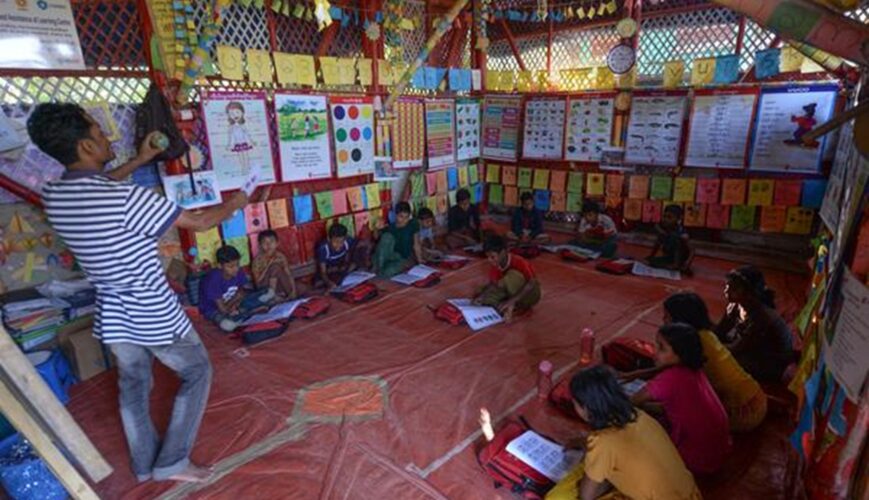
Camps in Bangladesh alone are home to around half a million children whose education has been critically disrupted, and whose future looks uncertain.
The new Myanmar National Curriculum
Following review work, Cambridge’s focus was to help with the implementation of the Myanmar National Curriculum in the camps. This was an important objective for the Rohingya community, to enable their children to study through a formal education system.
Cambridge produced an assessment framework, matched to the learning outcomes as set out in the Myanmar National Curriculum.
Jane told us more: “Alongside the development of the curriculum and assessment framework, we reviewed teaching and learning materials. Then, in 2022, we travelled to Bangladesh to provide training on formative assessment and the use of the framework we had developed.
“But our approach must be tailored to conditions on the ground. In camps, the use of Wi-Fi connectivity isn’t allowed, there’s no mobile reception and no electricity in learning centres. So, training is delivered on flipcharts and posters.”
Cambridge collaborates with local organisations on education transformation projects. In the Rohingya camps, they worked closely with BRAC, a Bangladesh-based international development organisation, to deliver the master training. And Cambridge works very closely with UNICEF.
Anika Tanjim Konoc, education officer at UNICEF, said: “This is the first time we’re bringing the assessment training into the camp and the way they have accepted the training, in spite of the language barrier, and the willingness to learn, has blown my mind. I’m really inspired”.
Helping girls to continue to study
While education provision in the camps is slowly improving, there remain problems to overcome.
These include high levels of teacher inexperience, classroom resources and materials of variable quality and usefulness, and student drop-outs, particularly girls. Social and religious norms mean that girls in the camps often face greater barriers to education than boys.
Students frequently transition out of the learning centres after the age of 11 or 12, as families weigh the challenges of the camp environment against the lack of formal milestones.
Jane adds: “The work we’re doing is designed to motivate the students and their caregivers in terms of producing measurable outcomes that they can document and demonstrate. We think this is particularly beneficial for girls as it allows them to provide and have a clear rationale for continuing study.”
Cambridge hopes to continue to support UNICEF’s mission of widening and improving education for children in the Rohingya refugee community, as part of the goal to use their experience and expertise to provide education excellence for everyone.
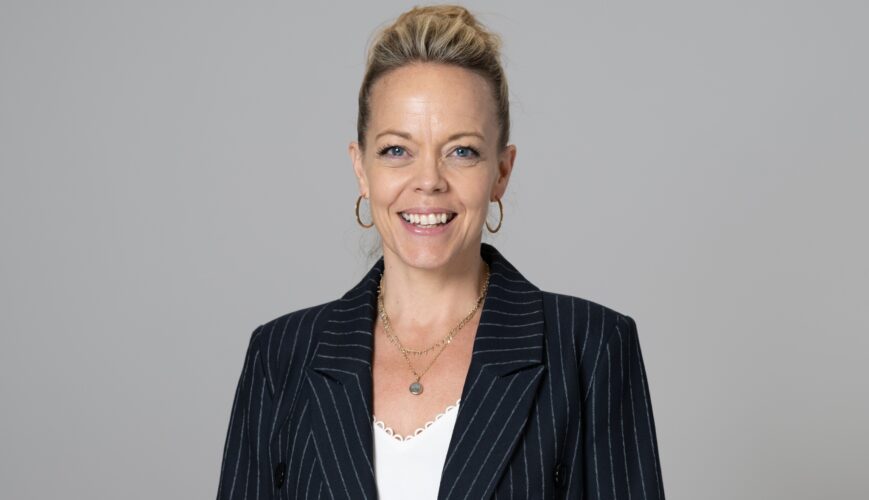
Jane Mann is Managing Director of the Partnership for Education and Education Director in the International Education Group at Cambridge University Press & Assessment. She is also a Governing Body Fellow at Hughes Hall,
Further information
- Jane Mann has worked in the educational sector for nearly three decades, advising on, implementing and managing programmes of system-level change and improvement, across diverse contexts, including Education in Emergencies. She has worked with ministries of education, government agencies, non-governmental organisations, donor agencies and educational organisations to support large-scale system transformation through to targeted specific interventions.
- Jane has also worked outside the education sector, advising and consulting on regulatory frameworks, trade publishing strategy, communications and process redesign. She has been a speaker at events such as the Education World Forum, London Book Fair, Transforming Education Summit (UNGA77), Global Online Learning Alliance and the Global Education Summit, is a member of the Centre for the Study of Global Human Movement (University of Cambridge) and a Salzburg Global Seminar Fellow, and is also a member of the BESA Executive Council.
- Cambridge University Press & Assessment partners with governments and non-governmental organisations around the world to improve the quality of education systems. They understand the critical role education plays in human capital development, to create stronger, prosperous and more equitable societies. Informed by the latest research, they develop customised solutions to suit a country’s individual context, needs and vision.
23.5.26