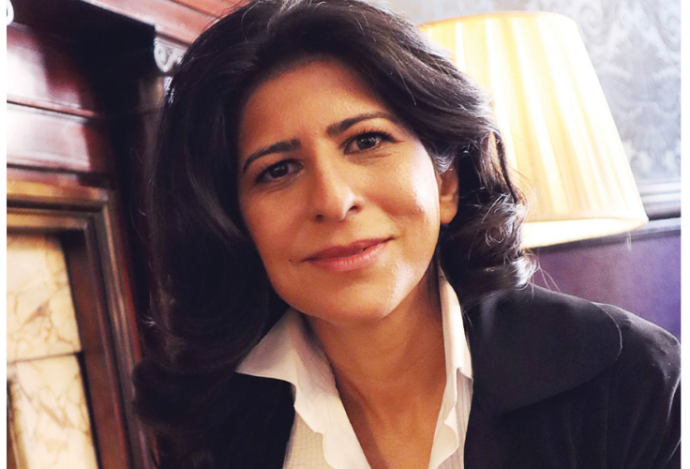
Governing Body Fellow Mahnaz Malik practices as an Arbitrator and Barrister in Twenty Essex Chambers in London.
She has over 23 years of legal experience in cross-border trade and investment, is a judge on The World Bank Sanctions Board, and has served on the ICSID Panel of Arbitrators and the ICC Commissions on Arbitration and Anti-Corruption.
Her first love, though, was writing, and she shares the story of how she recently rediscovered her creativity in the middle of a highly successful legal career.
I loved Cambridge. It was my first permanent home, because I’d been to eight schools and lived in many places, and finally as an eighteen-year-old I wasn’t the new girl any more. Everyone was new. So I became deeply attached to the place and always felt I had to come back one day. Now I work in international law, which is closely linked with academia. The time felt right to do some research and be a human bridge between scholarship and the practical application of international investment law. This is what very happily led me to a Fellowship at Hughes.
I started off at Cambridge as a writer. Reading law was a practical route to what I wanted to achieve in my life: not to end up penniless. In many ways I followed the conveyor belt – get a good law degree, go into the barrister route, make your way up and focus entirely on the law. Over the years as I tried to become a better lawyer, I ended up losing the writer part of me. Law was so overwhelming that I couldn’t do both side by side. I gave up a lot of my passions and hobbies, like playing polo, which I had done in Pakistan and at Cambridge. It’s only recently that creativity has been embraced in disciplines like finance, law and business. It’s taken me almost 27 years to realise that there is a way to marry all these aspects of myself, because I had totally cut out anything that didn’t fit what was expected of me.
I was a very idealistic student and, like many, wanted to change the world. I grew up in a country with lots of problems and a lot of injustice. And I felt that somehow my time at Cambridge would contribute to fixing that. Some of that gets a bit lost in the academic rigour, which is really important, but I think young people need to be prepared for what will happen when you leave this wonderful bubble. I thought if I ever came back as a Fellow, what was really important for me was to help build that bridge to what’s out there. I’ve spent quite a bit of time mentoring law students and it’s incredibly fulfilling for me to see them achieve. Being a Cambridge lawyer can be a straitjacket and very competitive; sometimes they just need to know that there are different pathways.
I feel that I’m not a typical lawyer because I have so many other interests and aspects as a person. I’ve worked very hard to create space in an environment where I just didn’t fit, and really it wasn’t even the colour of my skin or my background; it was just to do with my personality type. I felt under a lot of pressure and that if I did anything that was slightly out of the ordinary, then I was somehow not to be trusted. In the law, you have to be very brave to be different. It’s taken a fairly long time for me to find my voice and accept all those parts of me. It was only in the last couple of years, once I had achieved a certain amount of attainment in my field, that I felt able to express myself and my rather colourful journey.
I started writing again on LinkedIn. It sounds very ironic that the way I found expression was in a professional network talking to other lawyers, but with time my posts started becoming more and more creative. I don’t write about law, because I have been serving as an arbitrator and as an external judge on the World Bank Sanctions Board, which means I have to be very careful about what I say.
In a sense, that provided me a lovely kind of freedom. I started by writing about history, like the roses that have flowered in the Middle Temple (one of the Inns of Court) for 500 years. I wrote about my travels, conferences that I attended, and recently, a story about seeing guns and silk in the bazaar. That shows me how far I’ve come, because it’s the first time I’ve talked about my childhood. People’s responses have been so positive, and it’s been amazing to finally feel accepted for who I am. Now I’ve come out as a writer, and I feel I can embrace that part of me. It’s been a personal quest to get back to that confidence I had when I was younger.
I was an undergraduate at Churchill, so Hughes is my adopted college and I’m very much a convert. It’s an incredibly special, open and forward-looking place. One of the lovely things about keeping up your connection to Cambridge is the opportunity to reflect on your life journey, revisit your younger self and reconnect with that boldness and joy. You stay a member of a college all your life, you never really leave, and that is a real privilege.
As told to Maartje Scheltens
- This article is one of many in the latest edition of The Owl, Hughes Hall’s College magazine. To read the publication, visit The Owl.
28.3.25