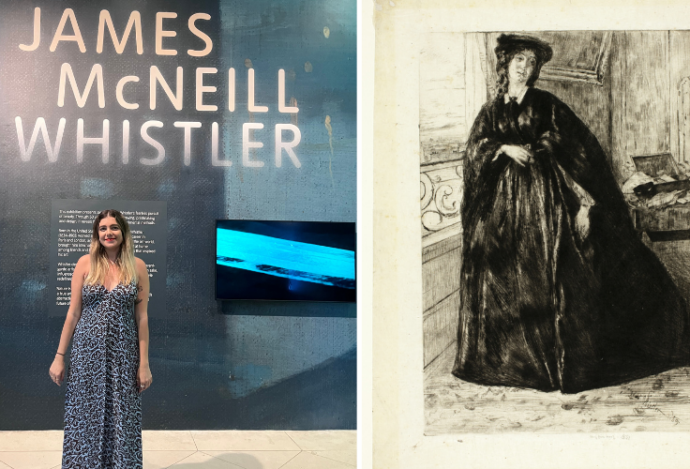
Hughes Fellow Dr Emmanuela Wroth Helps explore the Tate Britain’s James McNeill Whistler exhibit
“I hope the exhibit raises awareness about the importance of nineteenth-century theatre women as artists, celebrities, pioneers, and influencers who sometimes held great power and cultural acumen in Europe, from Paris to St Petersburg.”
Dr Wroth recorded audio guides for the exhibit on two portraits of celebrated 19th-century theatre women: an etching of the Parisian Creole can-can dancer Finette, and a painting of Lady Archibald Campbell, a Scottish London theatre producer, writer and designer.
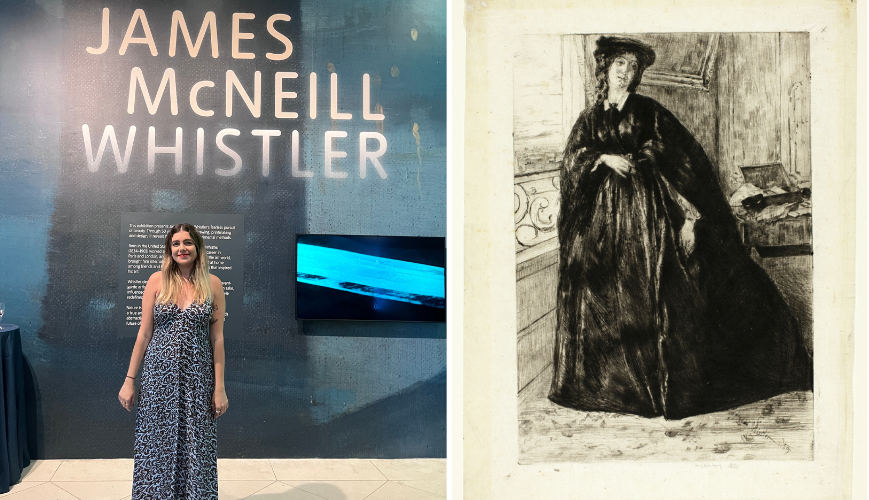
Emmanuela attends the opening of the exhibition; James McNeill Whistler’s ‘Finette’ (CC0 Public Domain Designation)
Dr Wroth writes here about her experience helping to shape the exhibition
I am a Leverhulme Early Career Fellow in the Faculty of Music, and a Research Fellow at Hughes Hall. My current research project, “Diasporic Divas”, recovers the overlooked careers of Afro-descendent and diasporic women performers in Western Europe in the 18th and 19th century. As a socio-cultural historian, I am interested in the construction and intersection of identity markers––such as gender, sexuality, race, ethnicity, class, disability and age––in historical celebrity performance culture, and how learning about this can inform and change current identity politics.

The James McNeill Whistler exhibit is the first major European showcase of Whistler’s (1834–1903) artwork in 30 years. Although American, he made his name in Paris, then the capital of culture in Europe. As an aspiring young artist, Whistler acquired renown in the French capital from the late 1850s by depicting contemporary Parisian celebrities. His first such portrait was an etching of the celebrated can-can dancer Joséphine Durwend (fl. 1840–1870), who went by “Finette”.
Although today Whistler is the much better known of the two, at the time of her 1859 portrait, Finette was a celebrity through whom Whistler gained recognition. Finette’s stardom was international, and she performed the can-can from Paris to St Petersburg, via London, from around the 1850s to 1870s. She is credited both with professionalising can-can dancing and exporting it across Europe as a nascent, national cultural product of France. A bastion and pioneer of French culture, Finette was Creole and likely born in Réunion Island, which was and remains a French colony. Her story is therefore important to colonial history and of particular interest to my “Diasporic Divas” project. In the early 1880s, Whistler also depicted Lady Archibald Campbell, born Janey Sevilla Callander (1846–1923), who was a renowned Scottish theatre producer, writer and designer, central to dress reform and the turn-of-the-century New Woman image.
As an expert of nineteenth-century celebrity performance culture in Europe, and its diasporic theatre women, I was invited to discuss Finette and Lady Archibald’s importance in the exhibition’s audio guide, with curator Dr Carol Jacobi. I also spoke at the Tate’s accompanying conference: Whistler in Action, on 18 June 2026, with a paper called ‘Finette, Whistler and the “Right to Opacity”’. Here, I detailed my new research into Finette for the exhibit. My most exciting find was an archival, handwritten, manuscript letter from Finette to the Parisian photographer Félix Nadar, in which she lamented how he captured her too stiffly. This shows how Finette called the shots, quite literally, with how artists such as Nadar or Whistler should capture her.
I hope the exhibit raises awareness about the importance of nineteenth-century theatre women as artists, celebrities, pioneers, and influencers who sometimes held great power and cultural acumen in Europe, from Paris to St Petersburg. They were akin to today’s film and pop stars, greatly shaping contemporary culture, the effects of which are still visible. Due to women’s historical exclusion from public discourse, and that performing art was ephemeral before the advent of late-nineteenth-century recording technologies, their stories have often been forgotten or erased. This erasure is exacerbated by other identity markers beyond gender, such as race, ethnicity and class.
Previously, I participated in exhibition study days for The National Gallery’s Discover Degas & Miss La La, and The Burrell Collection’s Discovering Degas in 2024. For both, I contributed knowledge about Miss La La (1858–1945), the celebrated 19th-century Afro-Prussian gymnast and circus performer whom Degas depicted in Paris. The recovery of forgotten celebrity theatre women’s history––often through men that captured them––is a growing trend in British museums. One day, I hope to curate exhibitions about the women themselves. For now, you can learn more about Finette and Lady Archibald at the James McNeill Whistler exhibition, closing on 27 September 2026.
16.7.26