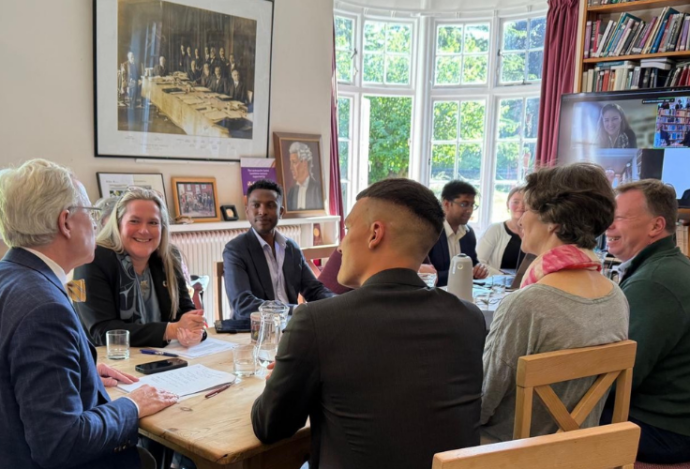
Hughes climate experts supporting sustainable development globally.
DemEd Global is a pioneering educational programme at Cambridge aiming to equip current and future law and policy leaders with the knowledge they need to advance sustainability and justice within and beyond their communities.
The Programme reached a significant milestone last month with over 200 people from around the world joining the Live from Bonn 2025 event. This gathering brought together experts, negotiators, professors, and youth leaders committed to the mission: building a more just, sustainable future through law.
Hosted by the University of Cambridge Democratising Education for Global Sustainability and Justice (DemEd Global) programme and the McGill-based Centre for International Sustainable Development Law (CISDL), this open-access event facilitated direct involvement with UN climate negotiations. Live from Bonn was about more than policies or procedures, it was about people—professors, students and professionals, including government negotiators, international organisation leaders and others, who are facing the world’s largest problems with courage and resolve.
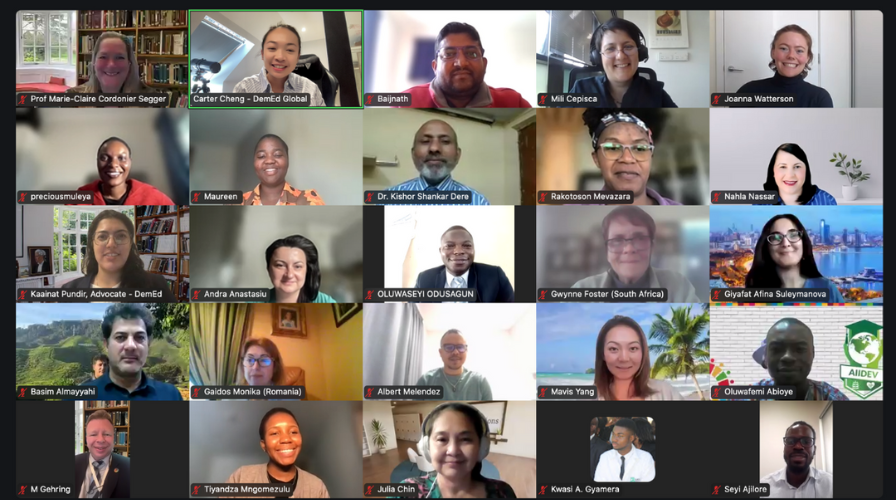
Through the stories, insights, and legal strategies shared at Live from Bonn, we took one more step forward together.
Leadership
Under the leadership of Professor Marie-Claire Cordonier Segger (DemEd Global Director; Chair in Sustainable Development Law and Policy at Lucy Cavendish) and the guidance of Dr Markus Gehring (Law Fellow and Director of Studies in Law at Hughes Hall), the programme transforms vision, solidarity and academic rigor into global access to education, training and real-world impact.
The Programme team are very grateful to Dr Gabrielle Sacconaghi Bacon for her generous contributions which allow DemEd Global to feature the work of leading researchers including Hughes Hall senior members: Dr Kennedy Mbeva (Research Associate at the Centre for the Study of Existential Risk), Prof Harro van Asselt (Professor of Climate Law in Land Economy) and Dr Jellie Molino (Research Associate at the Centre for Climate Change Engagement), whose insights and scholarly work are featured in the courses and events. Warmest thanks are also due to Nick Scott (Law Programme Director of the Centre for Climate Engagement), whose interventions were highlighted in the carbon markets round-table event, and to several students, especially recent law graduate Hader Aziz, who developed skills and networks through the programme.”
More than 4,000 learners from over 120 countries applied to DemEd Global’s spring offerings. The flagship courses—Wealth Economy, Trade Rules, and The UN Convention on the Rights of the Child (CRC)—brought together a mix of policymakers, community organisers, NGO leaders, legal scholars, and young professionals from all corners of the globe.
Change-makers
Learners include passionate change-makers driving real impact within and beyond their communities:
- In Nepal, a youth leader is utilising his takeaways from the Trade Rules course to advance an International Court of Justice campaign, while preparing to host the 2025 South Asian Climate Justice Camp.
- In Nigeria, the founder of a child rights NGO sees the CRC course as a way to bring local policies into alignment with global frameworks—empowering her organisation to train others, challenge abuses, and advance legal reforms.
- In Mexico, a Sustainable Development Engineer working at the country’s largest private university is using his learnings from the Wealth Economy course to scale up his community climate projects.
These stories are the core of DemEd Global. Each story is a reminder that while climate change is a global challenge, solutions must be shaped by local knowledge—and by those who live with its consequences every day.

DemEd Global offers legal literacy, critical thinking, and collaborative spaces where learners build solutions that work for their communities.
Looking ahead, two exciting new courses will be piloted in Autumn 2025. The first, on Investment Law, and building on the success of the Wealth Economy course, delves into the legal foundations of green investment and carbon finance. The second course, focusing on CEDAW—the Convention on the Elimination of All Forms of Discrimination Against Women, explores how gender equality intersects with climate law, land rights, and sustainable finance—equipping learners with new lenses to analyse justice and inclusion.
Further information
- For more on the University of Cambridge Democratising Education for Global Sustainability and Justice (DemEd Global) programme
- To learn more about the programme or the courses please contact the team via email at demedglobal@law.cam.ac.uk.
8.7.25