Hughes Hall students shine again at this year’s Falling Walls Lab!
Last week, the Department of Engineering hosted the UK Falling Walls Lab, challenging postgraduates and postdocs of all disciplines from the Universities of Cambridge, Bolton, Strathclyde and Manchester to pitch their innovative ideas – in just three minutes.
Hughes student Mahlaqua Noor was awarded second place for her compelling pitch, Breaking the wall of the unshakable virus, to the panel of judges, one of whom was Yizhou Yu, a Hughes student who won the global final of the competition last year.
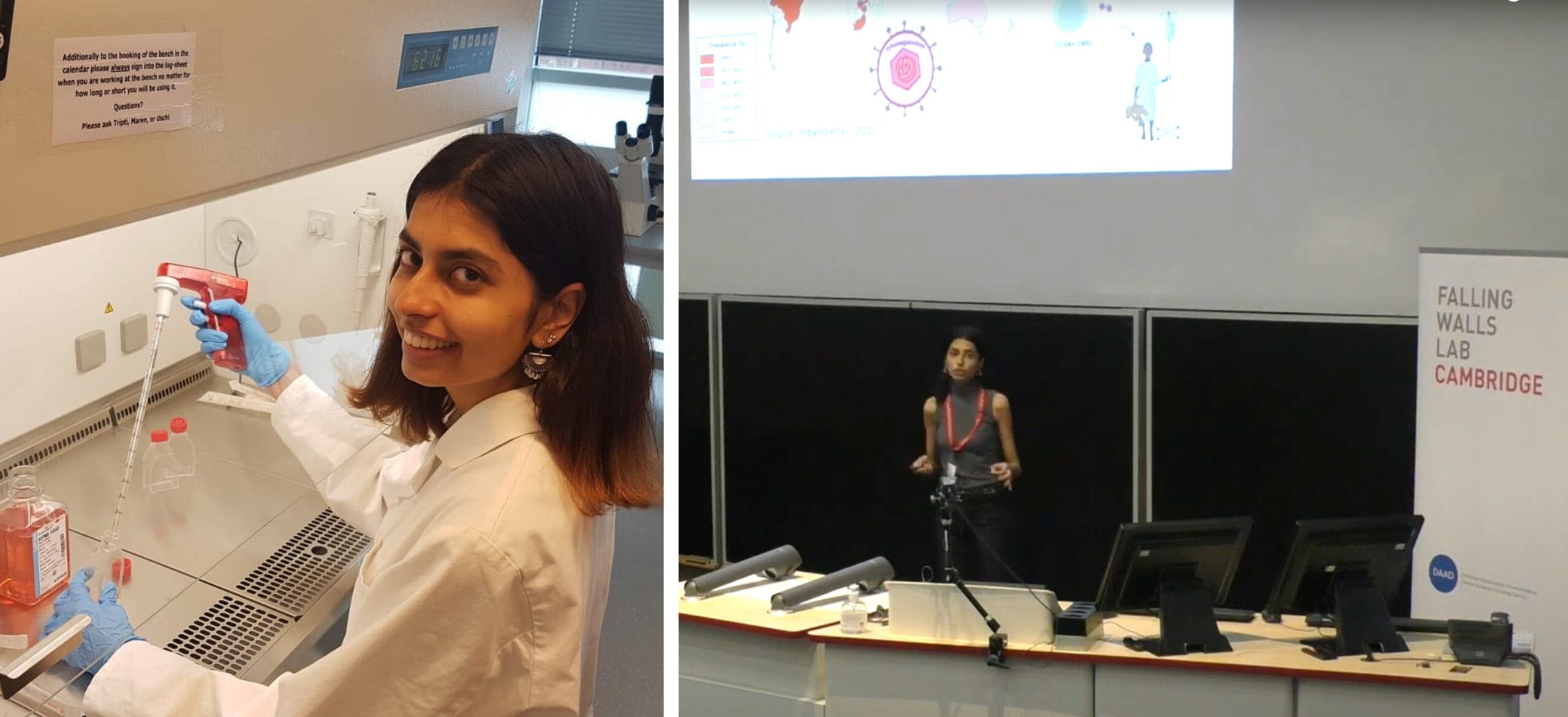
Mahlaqua Noor, Hughes PhD student, in the lab and presenting at the Falling Walls Lab.
“I am a strong advocate of public engagement, representation, and equal access in science. Falling Walls was an incredible opportunity to talk about my research and its impact to a broader community.” Said Mahlaqua Noor, Hughes PhD student in Medicine and runner-up in the challenge for her pitch Breaking the wall of the unshakable virus.
Starting in 2009, the Falling Walls Foundation has worked to connect science leaders with academia, business and the public sector in order to share knowledge, promote businesses and bolster international innovation and impact.
Falling Walls Lab is a global interdisciplinary pitch competition for students and early-career professionals to showcase a breakthrough that positively impacts science and society. It is an opportunity to gain exposure for an idea, strengthen communications skills, and foster networking and collaboration.
“I study human cytomegalovirus (HCMV) and its interactions with the host immune system. Human cytomegalovirus has a huge burden of disease with a global seroprevalence of around 80%. Once it infects a human host, it will retreat into a dormant phase causing “latency” ensuring its own survival at the cost of its host’s future health. HCMV causes life-long infection and cannot yet be cured. Unfortunately, there is no licensed vaccine to prevent HCMV infection. Therefore, to design and develop better antiviral therapies to treat, prevent or cure HCMV, a better understanding of its interaction with the immune system is needed and that is where my PhD research comes in.”
Mahlaqua is currently working on her PhD in Medicine and looks forward to her next steps.
“First thing’s first: catch up on sleep! Throughout my academic journey, I have worked to reconcile scientific innovation and social equity and hope that in the future I can continue to do so. I am not sure what is in the future for me, but science will always be a huge part of whatever I decide to do next.”

Dr Dante McGrath (left), 2024 UK winner, next to 2023 international winner, Hughesian and jury member, Yizhou Yu, Founder of Healthspan Biotics. Credit: Adam Page/University of Cambridge
Mahlaqua has been an active member of Hughes Hall throughout her time here and has made a big impact on the student and alumni community.
Speaking of the College, Mahlaqua says, “One word – amazing! I have met some of the most kind and empathic people here at Hughes Halls from the Porters’ to the accommodation team to the College nurse and the list goes on. I have worked as part of the College fundraising team (and got to hear some truly fun stories from the College alumni) and talked to prospective students who were thinking of applying to Hughes Hall because I know what a difference Hughes Hall has made in my life at Cambridge, and I wanted to pay it forward.”
A Gates Scholar 2019, Mahlaqua was an elected member of the Gates Cambridge Student Council for two years and served as a Community Officer and an Alumni Officer. Her work within the Gates Cambridge Student Council echoed her commitment to building an environment where Gates Scholars from across the globe were included in conversations centred around welfare, accessibility, and well-being. She has also participated in numerous science outreach activities including teaching at local schools for The Brilliant Club.
Mahlaqua studied Biochemistry and Cell Biology at Jacobs University where she designed microcapsules for T-cell activation which plays a crucial role in the human immune system. For her undergraduate thesis in neuroscience and neurodegenerative disease, she is using mouse models to research the role of the protease, cathepsin K, in the choroid plexus, a network of cells that produce the cerebrospinal fluid in the ventricles of the brain.
We can’t wait to hear what you do next – congratulations, Mahlaqua!
23.8.2024