Energy storage has been named as one of the top challenges in the transition to a zero-carbon power grid by the year 2035.
Hughesian chemical engineer Mark Carrington’s research on new battery technology looks set to play a pivotal role in the new green economy.

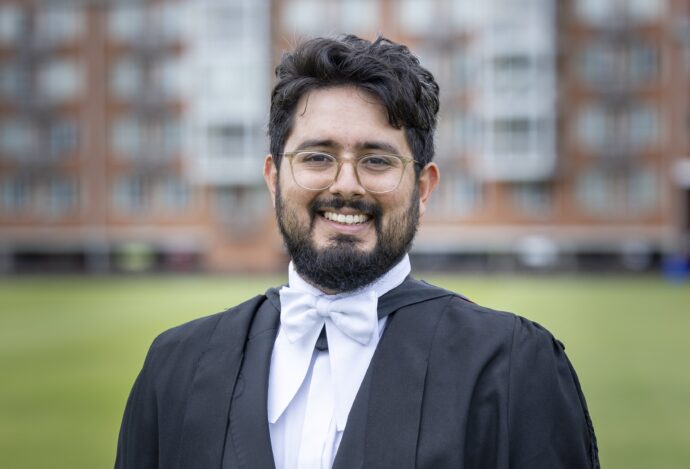
Mark at graduation, 2024
What drives you? One of our first questions to someone who graduated with his PhD in July 2024, but has already received more plaudits and awards than some people do in their whole careers. As a graduate student, Mark represented Cambridge at the 71st Lindau Nobel Laureate Meeting in Germany – the largest regular meeting of Nobel Laureates in the world. He served as a part-time consultant for the United Nations Industrial Development Organization (UNIDO). An article based on his MPhil research was featured on the cover of the journal Chem; two of his other articles have been published in Nature. He project-managed a Faraday Institution Industry Sprint worth £240k, and his translational venture Oxonium Energy won £10,000 from Cambridge Innovation Capital in the Chris Abell Postdoc Business Plan Competition 2023 and came second in the 2022 Trinity Bradfield Prize. And in 2024 he is taking up a prestigious Miller Postdoctoral Fellowship as the Kathryn A. Day award recipient at the University of California, Berkeley.
Mark is down to earth, given all his achievements. ‘The work that I do just captures my attention for hours and hours at a time, so I lose myself in it. I never really had an interest in going into academia for its own sake. My research is purely driven by scientific curiosity and the potential to solve really, really difficult problems, and I’m happy to be gaining some traction in that already.’
In the transition to green energy, battery storage is such a really difficult problem. Because wind and sunshine are not available 24/7, conventional power plants are kept running to fill the gaps. But if green energy could be stored at the grid level, it would be available on demand, without the need for gas or coal installations. This is where Mark’s new battery designs come in. These batteries are different to the light, small batteries we use every day, or that are built into our phones and laptops. Those are built to be as small, light and energy-dense as possible. Portability and density are not important for grid-scale storage batteries, which will be built in large central facilities, for example near a wind farm. Most of all, they need to be efficient and cheap to make and run, so extra costs are not passed on to consumers. Existing solutions are all batteries based on metals, which cost a lot to obtain, both in financial terms and in environmental damage.
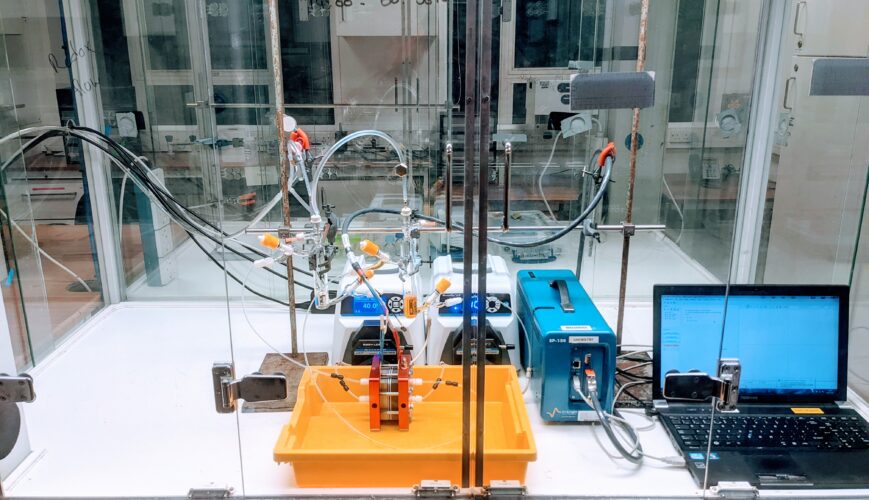
Laboratory battery system for prototyping new materials
Mark’s innovation, which is now moving out of the lab and into the prototype testing phase, is a battery that doesn’t require any metals. It’s made from commodity chemicals that can be synthesised around the world and – importantly – can be repurposed at the end of the storage facility’s twenty-year lifespan. Not only can this technology store backup power to the grid, but it could also help replace diesel generators to supply developing countries with cheap, clean, reliable energy. One of the most rewarding things for Mark is to see the real impact that his research could have. ‘I see an opportunity for this to change lives, not just to meet carbon emission targets, but also to empower communities.’
Mark’s route into battery storage research was not a direct line. ‘It’s not something that I had my sights set on at the beginning. It’s something that developed very naturally as my interests shifted.’ As one of the top ten school leavers in mathematics in Trinidad and Tobago, he was offered a government scholarship to study anywhere in the world. Once at Stanford University in California, chemical engineering drew him; having grown up in a country made wealthy by petrochemicals, oil and gas reserves, he knew he’d always find a job. ‘But my career advisor at Stanford happened to be a world-renowned chemical engineer who encouraged me to apply for PhD programmes. I tried to put the decision off as much as I could by taking a year out, to figure out if research was something that I enjoyed and was good at, then doing a Master’s.’
That Master’s brought Mark to Hughes Hall in 2018, where his interest chimed with the College’s support for entrepreneurship and real-world applications of research. He became President of the Hughes Hall Enterprise Society, where students interested in start-ups and industry have the chance to meet experts and innovative business owners. ‘When I decided to continue to a PhD, of course I stayed at Hughes. I enjoy the community and the networks that exist in and around the College.’
Mark’s batteries have huge potential, and it’s clear he will be one to watch as he continues his career in California, wherever it takes him. ‘In the future, I could go in lots of directions: academia, industry, setting up my own company. The skills that I’ve developed over the last couple of years can serve all of these different areas. I can come up with a plan, but I know well enough that once life starts to unfold, the original strategy goes out of the window and you have to improvise and update as you go on. I don’t even kid myself into thinking that I know what the next three years will bring. I just take it as it comes.
‘You think that at the end of a PhD you would have some level of confidence in what you know, and can call yourself an expert, but the more I’ve dug into this over the last couple of years, the more I realise how little I actually know in the grand scheme of things. To solve a problem as complex as transitioning to net zero and how to deal with the complex infrastructure of the energy grid, the core chemistry is only a very small part of all of that: you have to deal with the economics, logistics and policy regulations. It’s such a rich interdisciplinary area, I’ll never get bored with exploring it.’
- This article is one of many in the latest edition of The Owl, Hughes Hall’s College magazine. To read the publication, visit The Owl.
5.6.25