As part of the 2026 Cambridge Alumni Festival, Hughes Hall hosted a panel discussion examining the strategic and human costs of the war in Afghanistan.
The timing of the event marked five years since the fall of Kabul to the Taliban and 25 years since the 9/11 attacks that precipitated the US-led campaign to defeat al-Qaeda and the Taliban and build democracy in Afghanistan.
Christina Lamb, Chief Foreign Correspondent at The Sunday Times, and Zahra Joya, Afghan journalist and founder of Rukhshana Media, spoke in the panel. They were chaired by Hughes Hall’s President Sir Laurie Bristow, who served as the UK’s last ambassador to Afghanistan until the Taliban took power in 2021. Our speakers were delighted to see such a good turnout on the day, especially at a time when many seem to be forgetting Afghanistan, despite the horrendous situation the country’s girls and women are now trapped in.
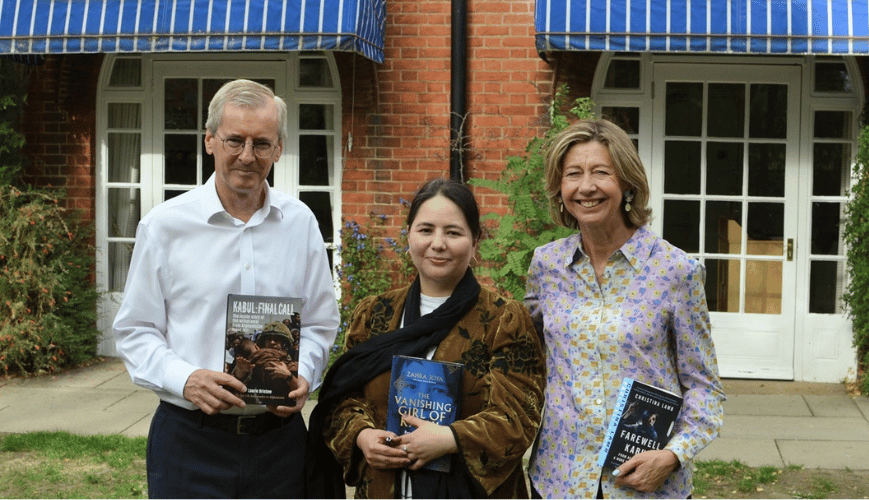
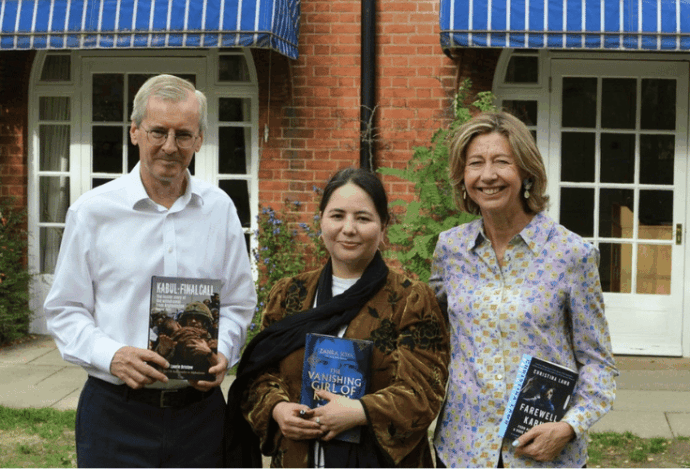
From left to right: Laurie Bristow, Zahra Joya and Christina Lamb.
Christina, one of the world’s leading war correspondents, spent many years reporting in Afghanistan, where she started her career in the late 1980s during the Soviet occupation and covered the direct aftermath of 9/11. Among the ten books she has authored are The Sewing Circles of Herat: A Memoir of Afghanistan and Farewell Kabul: From Afghanistan to a More Dangerous World.
Zahra founded Rukhshana Media (named after a young woman stoned to death by the Taliban in 2015) in 2020. Rukhshana is a news agency run by women to tell the stories of Afghanistan’s women and girls. Since fleeing Afghanistan in 2021, Zahra continues to run the agency from the UK. Zahra’s memoir, The Vanishing Girl of Kabul, was published in July 2026.
The campiagn in Afghanistan
Christina spoke about the American desire for revenge on al-Qaeda after the 9/11 attacks and that it was this, more than a desire to reconstruct the Afghan state, which drove the campaign in the beginning.
Over time, the US intervention shifted focus and sought to impose a Western-backed government in Afghanistan. Christina believes that focusing on this, instead of listening to what the Afghan people wanted – food, security, education and other basic rights – was one of the biggest mistakes made in Afghanistan.
Zahra added that many ordinary Afghan people have the mindset that every political change in their country is enacted by outsider hands, as the people are not consulted on what matters most to them.
A human rights and humanitarian crisis
Zahra outlined some of the horrific decrees made the Taliban government against women in Afghanistan, including that women may not speak to each other in a loud voice, must have a male chaperone whenever they are outside, no access to education past the age of 12, and have limited access to healthcare or employment.
Christina added that Afghanistan under the Taliban also faces a humanitarian crisis including a severe food shortage, as evidenced by the World Food Programme in Afghanistan having to turn away six out of seven starving mothers with malnourished children. Financial support from the US government has been slashed.
Zahra expressed her doubts over whether there is any force behind international law holding the Taliban accountable for their actions. She pointed out that Taliban members are often welcomed into European countries for “technical conversations” with governments who want to send Afghan refugees home.
Warfare and male dominance
Drawing a parallel between the Bayeux Tapestry, currently on display in the British Museum, and twenty-first-century conflicts, Christina highlighted the almost entirely male cast of military conflicts throughout the last 1,000 years of history. Barely any women are involved as delegates in peace negotiations conducted around the world.
The Bayeux Tapestry features three female figures in the margins, two of whom are being sexually attacked by men. Christina stated that, in every conflict she has covered, sexual violence has been used as a weapon against women (and sometimes against men too). This is the subject of Christina’s book Our Bodies, Their Battlefield.
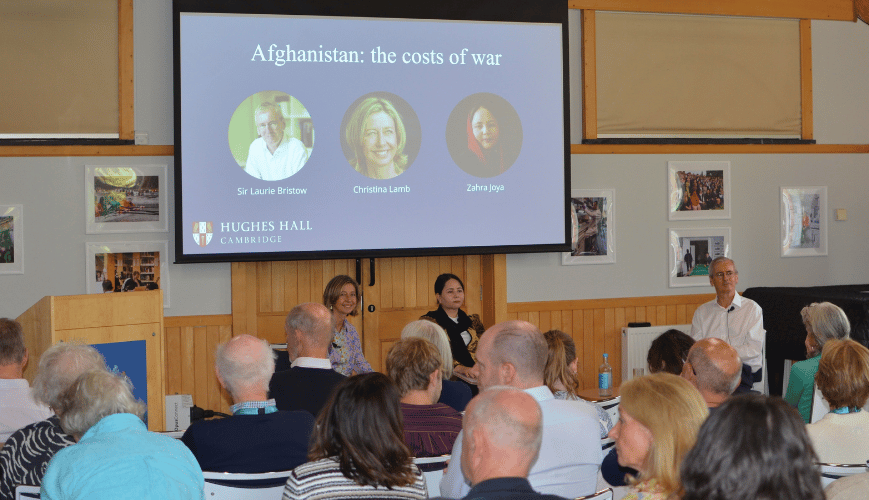
The panellists were pleased by the strong turnout from Hughes Hall and University alumni.
Thank you to Christina, Zahra and Laurie for a thought-provoking discussion.
Further information
To read more about these issues and to hear from those speaking at the event, their books can be found here:
- The Sewing Circles of Herat: My Afghan Years by Christina Lamb
- Farewell Kabul: From Afghanistan to a More Dangerous World by Christina Lamb
- Our Bodies, Their Battlefield: What War Does to Women by Christina Lamb
- The Vanishing Girl of Kabul: Betrayal, Hope and an Extraordinary Fight for Women’s Rights by Zahra Joya
- Kabul: Final Call by Laurie Bristow
Hughes Hall will continue to host events discussing the biggest questions of our time. See what’s coming up on our events pages.
6.10.26