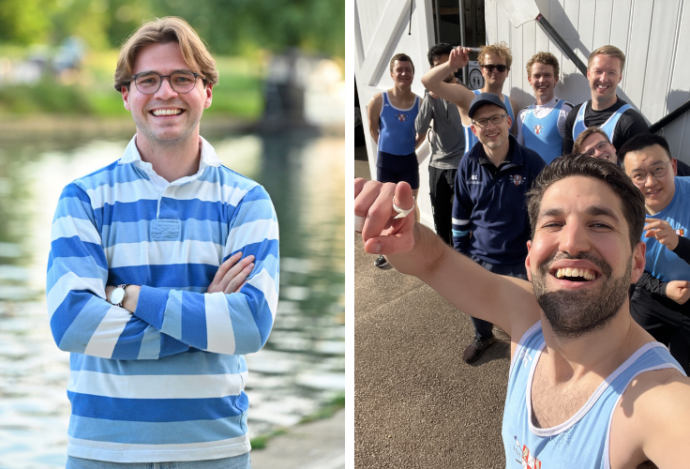
“Reason to be up before the sun…and a community that made my time in Cambridge even more worthwhile”
At this year’s annual Boat Club Dinner, Cox Marno Swart gave a moving speech thanking the Hughes Hall Boat Club for shaping his student years.
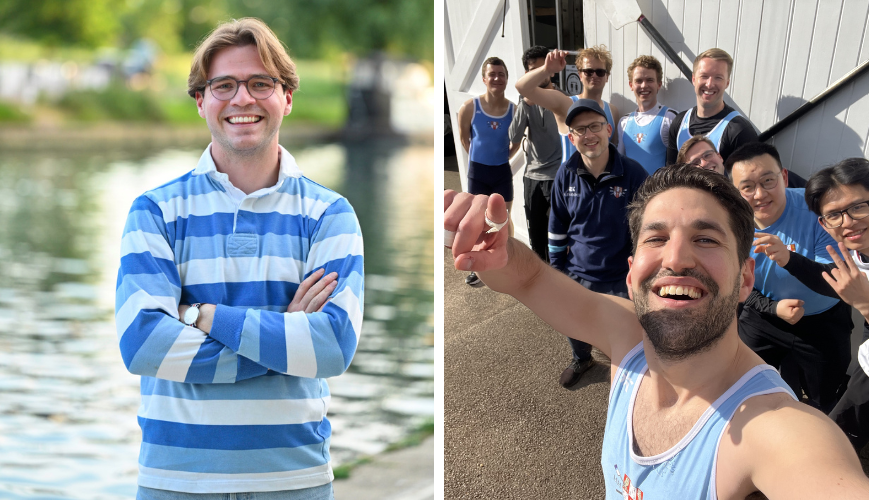
Marno (left) and on of the crew he rowed with at Hughes.
Captain of Coxswain’s Address
“I joined the boat club in Michaelmas of 2023. I had just finished one of those insanely packed nine-month master’s in London and decided I wanted to take full advantage of the longer period I would have in Cambridge. I wanted to find some sense of community. Something bigger than myself to be a part of. Because a PhD, as anyone who has attempted one will readily tell you, is a rather lonely endeavour: it is mainly you, your research, and the dawning suspicion that you may have bitten off more than you can chew. What I was looking for was something outside of all that. Something to care about that had nothing to do with my thesis.
And that is exactly what I found here. This club has kept me grounded through the long stretches when my work would not. It has given me a reason to be up before the sun, a crew to be accountable to, and a community that made my time in Cambridge even more worthwhile. I did not come here to cox. But rowing – and the people in this room – turned out to be no small part of why I will leave Cambridge so very glad that I came.
When I think back on the 2025/2026 rowing year, I will remember our [W1] majestic win by the length of a bow ball against Jesus II at the Pembroke Regatta. I will remember that no one can swing a boat around Grassy Corner like Ashleigh. I will remember the heavens opened upon us as we were sparring Christ’s. I will remember singing Unwritten before every race. I will remember that Maddie fell in the river. I will remember Kathy as our honorary Hughesian, who has rowed in our boat for every race this term. And no matter the outcome of this Bumps campaign, I can assure you that I would not have wanted it any other way.
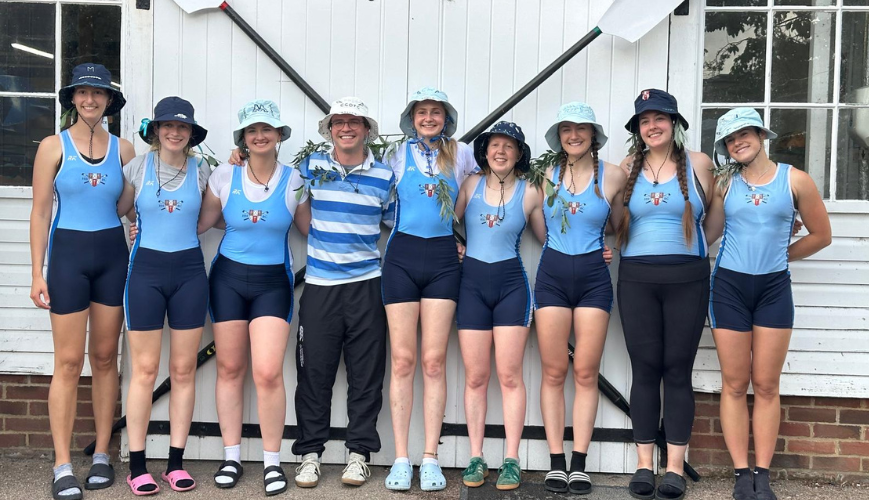
HHBC W1 boat with greens after the Bumps.
Now, I would be remiss if I did not say a word about my coxswains. In a boat full of people rowing backwards, we are the ones facing forward, the ones who are expected to know what is coming – the corner or the swan with a death-wish. The rowers put their backs to all of it and simply trust us to see if for them. That trust is the entire job, and it is an enormous responsibility: eight people, a great deal of expensive equipment, and the small matter of everyone’s safety, resting on the person at the back of the boat doing the shouting.
Not long ago I was looking at photographs of Hughes Hall crews from a couple of years back, and I realised I recognised not one of them. What I did recognise were the boats. The same shells, the same blades: the same battered Bladerunner, Carol and Squire in which hundreds of students learn to row. And it struck me that the people in those photographs once cared for those boats in the same way that we do now. They rigged them, washed them, cursed them and loved them, just as we do. They got up in the same dark, sat in the same cold, and felt the very same thing we feel on the rare and glorious occasion that the boat actually runs.
This club has been doing this for a very long time – racing the Mays since long before any of us arrived – and it will continue on long after all of us are gone. None of us own it. We look after it for a little while, and then we hand it on. And I find that genuinely moving: that across all those decades, and among all those faces we will never meet, we are quietly bound together by the same shells, the same river, and the same ridiculous, wonderful decision to get up before dawn and pull on an oar to compete in objectively one of the silliest races in rowing. That, to me, is what belonging looks like. It is why the results of this week [Mays] matters so much less than the simple fact of having been part of it all. Blades would be marvellous. But they were never really the point. The point was always this: the people in this room, the ones who came before us, and the ones who will come long after.”
Marno is currently a PhD candidate in his third year in medical ethics and law, under the supervision of Jeffrey Skopek (also at Hughes Hall). His research specifically focuses on women’s access to pain relief during vaginal birth, and his broader research interests include reproductive rights and ethics, human rights, and matters of constitutional law.
20.7.26