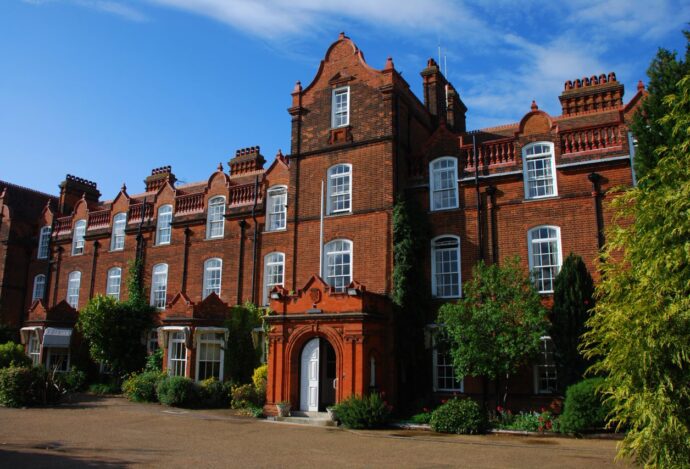
Taking just 14 students in its first year at Crofton Cottages in Newnham Croft, Cambridge, the Cambridge Training College for Women Teachers outgrew its early home.
A bigger space and more permanent location was needed so ten years later, on 19th October 1895, the building now known as the Margaret Wileman Building (after the College’s seventh Principal) officially opened on its current site at Wollaston Road.

An early photograph of the Margaret Wileman Building.
According to Elizabeth Hughes’ own account of the opening day, so many people filled the marquee in the gardens that “the governing body and speakers had to get down, as best they could, the steep grassy slope, and enter the tent by a hole in the back!” Even more disastrous, when the speakers retreated to the library for cream cake and hot scones, they found the room “swept and garnished by the hungry hordes which had passed through it.” (This account published in Margaret Bottrall’s book, Hughes Hall: 1885-1985, p. 20-23.)
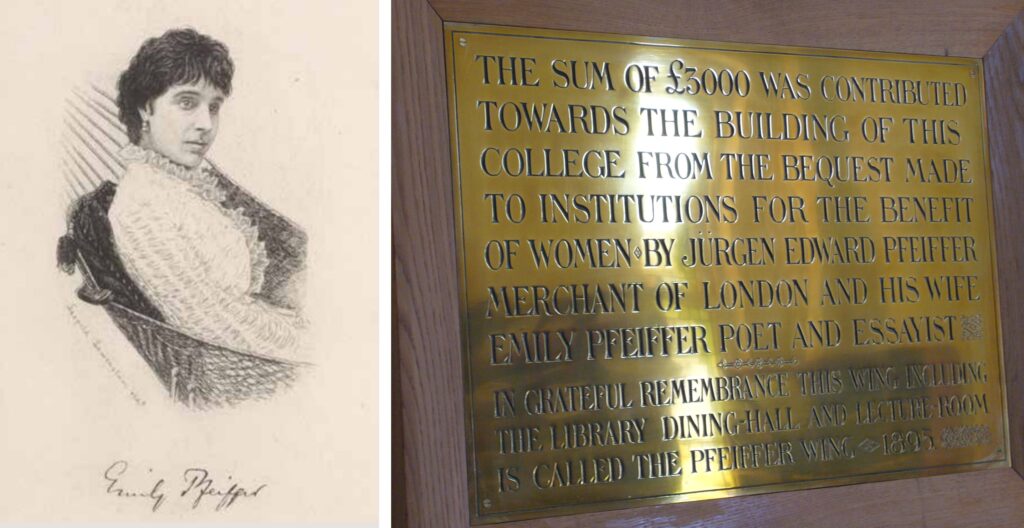
Emily Pfeiffer and her husband, Jürgen Edward Pfeiffer, shared acommitment to supporting ‘charitable and educational purposes in favour of women’. Their equal partnership in philanthropy is recorded in the brass plaque in the Wileman Building, the building they helped fund.
The new building on Wollaston Road was funded in large part by a bequest from Edward and Emily Pfeiffer, philanthropists who left money on their deaths to support the cause of women’s education. Today, visitors to the College can still see evidence of this bequest in the name of the Pfeiffer Room, and the bronze plaque commemorating the donation.
Looking back
At the time when Hughes Hall was founded in 1885, education for girls was becoming more common, but education for teachers was still difficult to come by. A need for the provision of professional education for women teachers was acknowledged and the establishment of a teacher training college in Cambridge was organised.
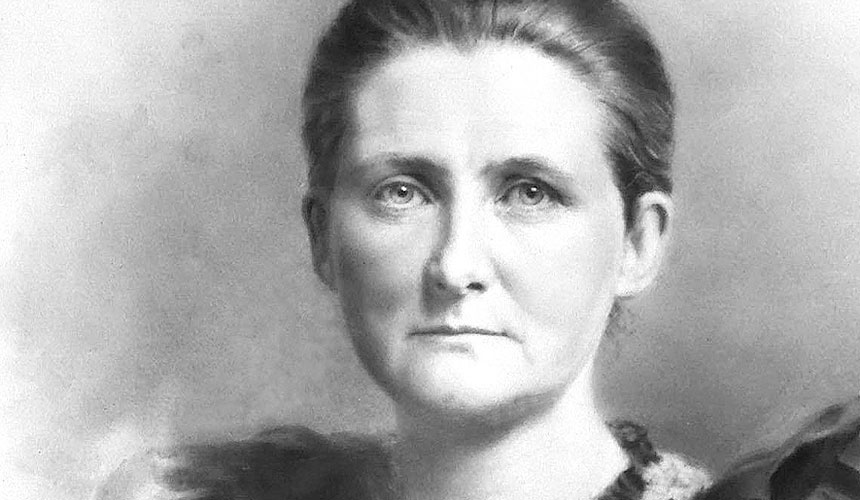
Elizabeth Phillips Hughes MBE (22 June 1851 – 19 December 1925).
The idea of teacher training for secondary school teachers was still in its infancy, but qualified women were needed to take up roles at these new secondary girls’ schools. Elizabeth Hughes, a bright graduate from Newnham College, was chosen to be Principal of Cambridge Training College for Women Teachers (CTC), as it was originally named, and the College was later renamed Hughes Hall in her honour.
A grand building
The heart of the College life, the Margaret Wileman Building was designed by William Fawcett and inaugurated in 1895.
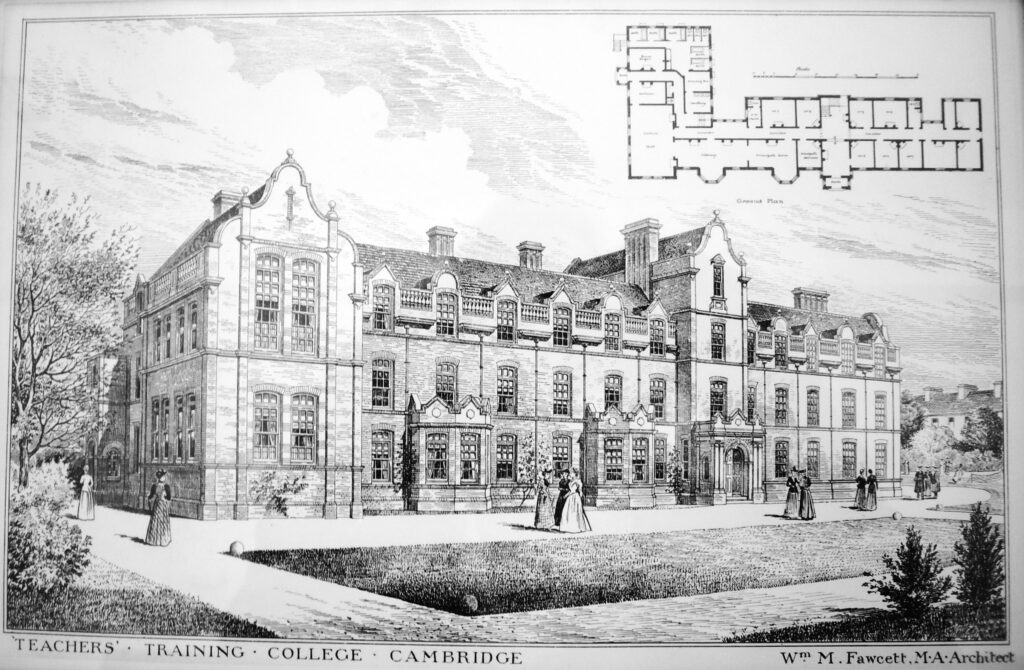
Early architectural designs for the College’s main building.
Fawcett, himself a graduate of Jesus College, was one of Cambridge’s most distinguished architects, and buildings in his graceful style dot the city – the present University Registry building on Mill Lane was designed by Fawcett (1886), and the old Cambridge University Press board room building (behind the Pitt Building on Trumpington Street) was also originally built to his design (1893).
The iconic red brick exterior and blue carpeted interior of the Margaret Wileman Building form the backdrop of many memories made here at Hughes Hall. Alumna Valery Cowley, who matriculated in 1965 remembers the day she arrived to begin her PGCE. “I was given one of the two top ‘tower’ rooms in the red brick main building, up a flight of stairs which meant my trunk has to be un/packed on the floor below. The main corridors were carpeted in royal blue.”
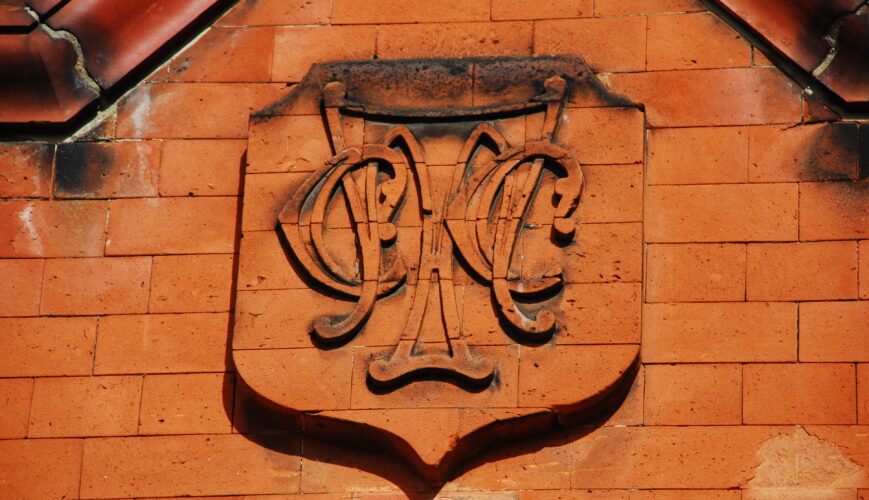
You might spot this shield above the entrance to the Margaret Wileman Building.
The emblem above the entrance to the Margaret Wileman Building reads CTC, which stands for Cambridge Training College (For Women Teachers), the original name for Hughes Hall. The doorway is also flanked by two dates: 1885, the date of our foundation; and 1895, the date the College’s first purpose-built building opened on Wollaston Road.
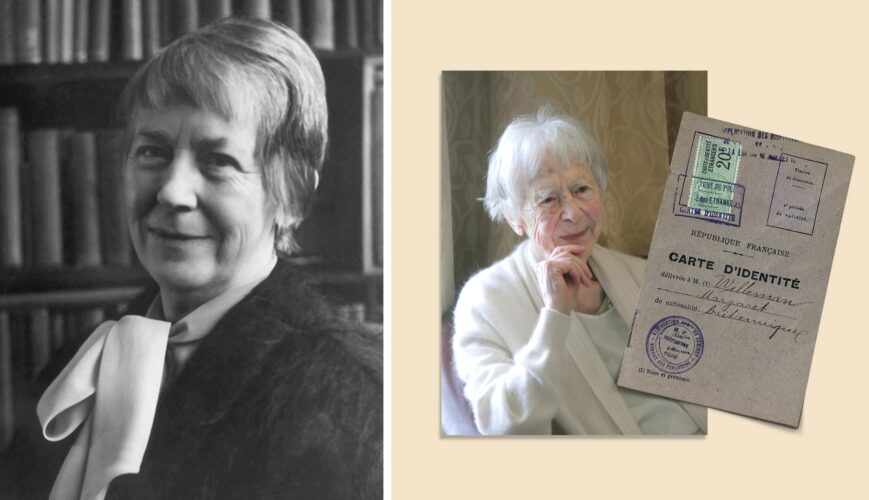
Miss Margaret Wileman, who died in 2014 at the age of 106, was the seventh Principal then first President of Hughes Hall from 1953-73 and was an Honorary Fellow for thirty years. Living close by, off Hills Road, she maintained her interest in the College until her final days.
A growing College
Over time, the College has extended the Margaret Wileman Building and acquired and built a number of buildings on or near the main site. The 1990s saw the construction of Chancellor’s Court, which was inaugurated in 1992 by the then Chancellor of the University, HRH the Duke of Edinburgh, and the Centenary Building, which opened in 1997.
This flowering of buildings at the end of the 20th century culminated with the Fenner’s Building which opened in 2005. Fenner’s has a distinctive vantage-point over the University’s historic cricket ground and towards the spire of the church of Our Lady and the English Martyrs – the tallest church spire in Cambridge. The building has a large Dining Hall which hosts everyday meals, formal dining events, and grand College gatherings. There are also two roof terraces, and student study-bedrooms – all of which make the most of the unique view to the west. In 2016, the College opened Gresham Court, a new student accommodation building facing the Margaret Wileman Building across the cricket field.
From the very beginning, Hughes Hall has been an institution focused on educational excellence to support practical and positive change in the world beyond academia. The student community is amongst the most internationally mixed, cosmopolitan and diverse of any college in the University, and supports graduates and mature undergraduates in all fields and from all walks of life.
19.10.25